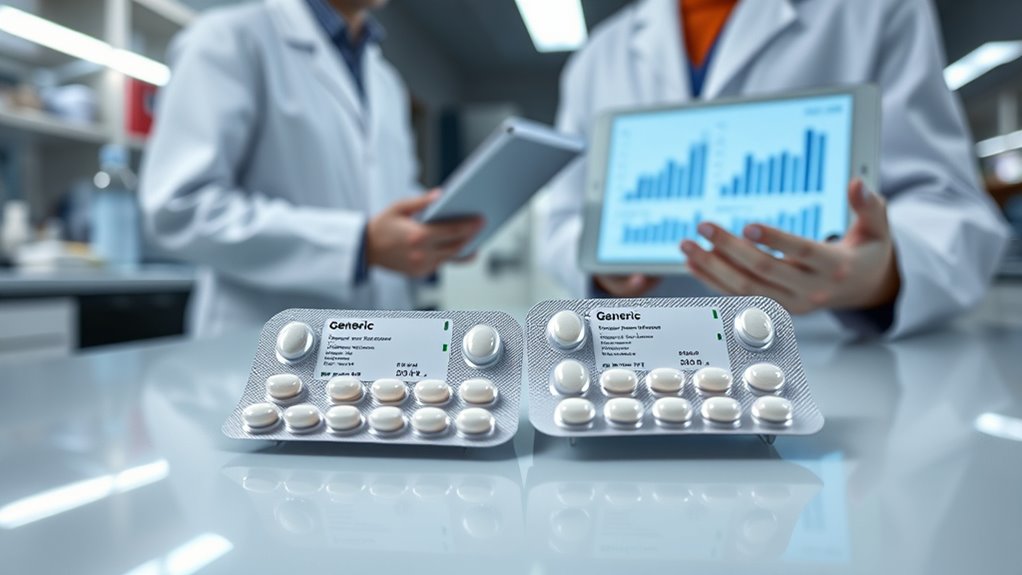

Generic drugs undergo rigorous scientific testing to make certain they are as safe and effective as brand-name medications. Through bioequivalence studies, researchers compare how the active ingredients are absorbed and processed in your body, confirming that the generic works just like the original. Regulatory agencies set strict guidelines to guarantee quality, safety, and efficacy. If you want to understand how these processes protect your health and ensure trust in generics, there’s more to explore.
Key Takeaways
- Bioequivalence studies compare how quickly and efficiently generic and brand-name drugs are absorbed and processed in the body.
- Pharmacokinetic parameters such as absorption rate and blood concentration levels are used to establish bioequivalence.
- Regulatory agencies require rigorous clinical trials and data to demonstrate that generics match the safety and efficacy of original drugs.
- Quality control during manufacturing and ongoing monitoring ensure generics maintain consistent potency and stability over time.
- Proven bioequivalence ensures generics are safe, effective, and trusted as cost-effective substitutes for original medications.

Have you ever wondered how generic drugs can be both affordable and just as effective as their brand-name counterparts? The key lies in the rigorous process of demonstrating bioequivalence, which involves thorough clinical trials and strict adherence to regulatory standards. When a pharmaceutical company develops a generic medication, they must prove that it delivers the same amount of active ingredient into your bloodstream in the same timeframe as the original drug. This is critical because it ensures the medication will work as intended, providing the same therapeutic benefits without unnecessary costs.
To achieve this, companies conduct carefully designed clinical trials that compare the generic to the brand-name drug. These studies measure how quickly and efficiently the active ingredient is absorbed, distributed, metabolized, and eliminated from your body—known as pharmacokinetics. The goal is to show that there are no significant differences between the two drugs in these parameters. If the data confirms bioequivalence, it means the generic will produce the same clinical effects and safety profile as the original medication.
Clinical trials compare absorption, distribution, metabolism, and elimination to confirm bioequivalence.
Regulatory standards play a essential role in this process. Agencies like the FDA in the United States or the EMA in Europe set strict guidelines to ensure that generics meet high-quality benchmarks. They require detailed data from clinical trials demonstrating bioequivalence, along with manufacturing practices that guarantee consistency and purity. These standards serve to protect consumers, assuring you that the generic drug you receive is safe, effective, and manufactured to the same rigorous quality as the brand-name drug.
Additionally, ongoing monitoring and quality control are essential to maintain the integrity of generic drugs throughout their shelf life. The process of approval involves more than just demonstrating bioequivalence. Regulatory agencies also review the drug’s stability, packaging, and labeling to ensure that it maintains its quality throughout its shelf life. Once approved, generic drugs can be marketed and prescribed with confidence, knowing they meet the same standards. This process helps to lower healthcare costs because generics are typically less expensive—saving you money—while still delivering the same health benefits.
Understanding this process can help you appreciate why generic drugs are a reliable choice. The combination of detailed clinical trials and strict regulatory standards ensures that generics are not only affordable but also equally effective and safe. So, when your healthcare provider recommends a generic medication, you can trust that it has undergone the necessary testing and approval processes to serve as a genuine substitute for the brand-name drug.

HealthCareAisle Diclofenac Gel, 1%, Arthritis Pain Relief – 50 g tube – Original Prescription Strength (NSAID)
- Relieves arthritis pain: Clinically proven to reduce arthritis discomfort
- NSAID formulation: Provides temporary relief by targeting inflammation
- Comparable to national brand: Same active ingredient as Voltaren Gel
As an affiliate, we earn on qualifying purchases.
As an affiliate, we earn on qualifying purchases.
Frequently Asked Questions
How Do Regulatory Agencies Determine Bioequivalence Standards?
Regulatory agencies determine bioequivalence standards through pharmacokinetic analysis, comparing the generic drug to the brand-name version. They set specific guidelines, such as acceptable ranges for parameters like Cmax and AUC, based on regulatory guidelines. You’ll find that they require rigorous clinical studies to guarantee the generic performs similarly in your body, maintaining safety and efficacy. These standards help guarantee you get a reliable, effective medication at a lower cost.
Are There Any Long-Term Safety Differences Between Brand-Name and Generic Drugs?
You won’t find significant long-term safety differences between brand-name and generic drugs, as they are rigorously tested for bioequivalence. This means your patient outcomes remain consistent, ensuring safety over time. Regulatory agencies require extensive studies to confirm that generics deliver the same therapeutic effects and safety profile. As a result, you can confidently prescribe generics, knowing they maintain long-term safety and support positive patient outcomes just like their brand-name counterparts.
What Role Do Excipients Play in Bioequivalence?
Excipients, or inactive ingredients, play a subtle yet crucial role in bioequivalence. They influence formulation consistency, ensuring the drug dissolves and absorbs predictably. While they don’t directly affect the active ingredient, they help maintain stability and bioavailability. You might not notice these tiny components, but they’re essential in making sure generic drugs work just as effectively and safely as their brand-name counterparts.
Can Bioequivalent Generics Be Substituted Automatically?
Yes, bioequivalent generics can often be substituted automatically, but it depends on your country’s regulations and your healthcare provider’s advice. Automatic substitution is designed to guarantee patient safety while providing more affordable medication options. However, you should always consult your pharmacist or doctor before switching, as they consider individual health needs. This way, you maintain safety and effectiveness when using bioequivalent generics.
How Does Bioequivalence Impact Drug Pricing and Accessibility?
Bioequivalence drives down drug prices by enabling cost reduction and increasing market competition. When generics are proven bioequivalent to brand-name drugs, they offer the same therapeutic benefits at a lower cost, making medications more accessible. This competition encourages manufacturers to lower prices, benefiting your wallet and improving access to essential medicines, especially for those who might otherwise struggle with affordability.
Conclusion
Understanding the science behind generic drugs and bioequivalence helps you make informed decisions about your medications. Did you know that over 90% of prescriptions in the U.S. are filled with generics? This highlights their importance in healthcare affordability and access. Rest assured, generics undergo rigorous testing to match brand-name drugs in safety and effectiveness. So, next time you pick up a generic, you can trust it’s just as reliable as the brand-name version.