

To develop an HPLC method, start by understanding your analytes’ properties and selecting suitable solvents and buffers. Gradually optimize the mobile phase composition, adjusting the organic-to-aqueous ratio, pH, and flow rate to improve peak resolution and symmetry. Monitor the effects of each change carefully and record your adjustments. Achieving well-resolved, symmetrical peaks is key for reliable results. Keep refining these parameters, and you’ll discover more about creating effective, robust HPLC methods.
Key Takeaways
- Select appropriate solvents and buffers based on analyte polarity and solubility for optimal separation.
- Gradually adjust the organic-to-aqueous ratio in the mobile phase while monitoring peak resolution.
- Optimize pH and add ion-pairing agents to improve peak shape and resolution of target analytes.
- Conduct systematic test injections, varying one parameter at a time, to evaluate effects on peak symmetry and efficiency.
- Validate the method by ensuring consistent, sharp, and symmetrical peaks for reliable, reproducible analysis.
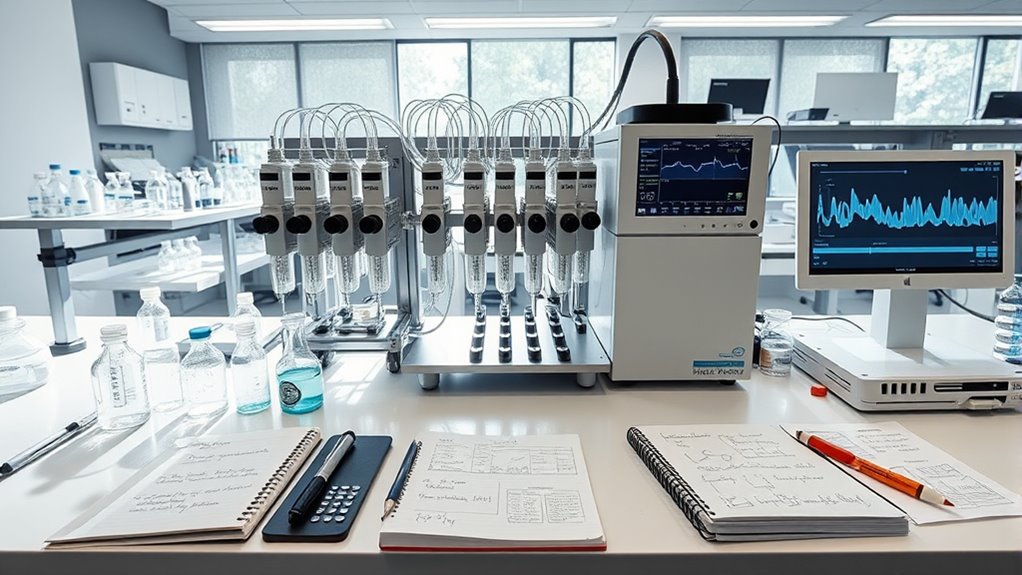
Developing a reliable HPLC method is essential for accurate and reproducible analysis of complex mixtures. One of the most critical steps in this process is mobile phase optimization. Your goal is to select the right combination of solvents and buffers to achieve ideal separation. Start by considering the chemical properties of the analytes, such as polarity and solubility. Adjust the ratio of organic to aqueous components gradually, monitoring how each change affects peak resolution and overall chromatogram quality. A well-optimized mobile phase ensures that compounds elute within a reasonable timeframe without overlapping or tailing, which can compromise quantification accuracy. Keep in mind that the mobile phase should also be compatible with your detection method, whether UV, fluorescence, or mass spectrometry, to prevent interference and maintain sensitivity. Additionally, employing proper sample preparation techniques can significantly enhance the overall method robustness.
Peak symmetry is another crucial aspect of method development. Symmetrical peaks indicate that analytes are well-resolved and that the interaction between the compounds and the stationary phase is consistent. To improve peak symmetry, you may need to fine-tune the mobile phase composition or adjust the flow rate. Sometimes, small changes in pH or the addition of ion-pairing agents can markedly enhance peak shape and resolution. It’s important to observe how peak symmetry responds to these modifications; asymmetrical or fronting peaks often signal issues like poor column efficiency, inappropriate mobile phase, or sample overload. Achieving symmetrical peaks not only improves quantitation accuracy but also simplifies data interpretation.
During this process, it’s helpful to run several test injections, varying one parameter at a time to isolate its effect. Keep detailed notes on each adjustment, including mobile phase composition, pH, flow rate, and temperature. This systematic approach allows you to identify the conditions that yield the best separation and peak shape. Remember, the goal isn’t just to get peaks to appear but to produce sharp, symmetrical peaks that are easy to integrate and quantify reliably. Consistent peak symmetry and a stable, optimized mobile phase are the foundation of a robust HPLC method. Once you’ve achieved these, you can proceed to validate your method, confident that it will deliver accurate, reproducible results across different runs and sample types.
HPLC solvent and buffer selection kit
As an affiliate, we earn on qualifying purchases.
As an affiliate, we earn on qualifying purchases.
Frequently Asked Questions
How Do I Troubleshoot Poor Peak Resolution?
To troubleshoot poor peak resolution, first check peak symmetry; asymmetric peaks often indicate issues. Adjust the mobile phase composition—changing solvent ratios or pH can improve separation. Make certain your flow rate and column temperature are ideal, as these affect resolution. Inspect your column for clogging or degradation, and consider reconditioning or replacing it. Fine-tuning these parameters helps achieve sharper, better-resolved peaks, enhancing your HPLC analysis accuracy.
What Are Common Reasons for Baseline Noise?
Baseline noise often results from improper column selection or unsuitable mobile phase composition. You might notice increased noise if the column isn’t compatible with your analytes or if the mobile phase isn’t well-filtered or properly prepared. Additionally, fluctuations in flow rate, temperature, or detector settings can contribute. To minimize noise, make certain you select an appropriate column and optimize your mobile phase to match your method, maintaining consistent conditions throughout your analysis.
How Can I Improve Method Robustness?
To improve method robustness, focus on optimizing solvent selection and mobile phase composition. Use high-quality, consistent solvents to reduce variability, and fine-tune the mobile phase pH, flow rate, and gradient to guarantee reliable separation. Regularly check instrument calibration and maintain consistent sample preparation. These steps help your method perform reliably across different runs and conditions, minimizing fluctuations and improving overall robustness.
What Are the Safety Precautions During Method Development?
During method development, you should wear proper safety gear like gloves, lab coats, and eye protection to prevent chemical exposure. Handle chemicals carefully, following safety data sheets and proper disposal procedures. Always work in a well-ventilated area or fume hood to avoid inhaling fumes. Keep spill kits nearby, and be cautious with solvent mixtures and reagents, ensuring you minimize risks and maintain a safe laboratory environment.
How Do I Validate an HPLC Method Effectively?
Imagine cracking the code of your chromatography parameters—that’s how you effectively validate your HPLC method. You should follow validation protocols meticulously, evaluating parameters like accuracy, precision, specificity, and robustness. Run multiple tests, compare results, and confirm consistency. Document everything thoroughly, and review data against acceptance criteria. This systematic approach guarantees your method’s reliability, guaranteeing it performs accurately for your analytical needs every time.
Conclusion
By following this step-by-step guide, you can confidently develop reliable HPLC methods. Remember, trust in your process and stay patient—accuracy and precision are worth the effort. Some believe that method development is purely technical, but it’s also a creative art that requires intuition and perseverance. When you see your results align perfectly, it’s a reminder that with dedication, you can turn complex challenges into successful solutions. Keep pushing forward—you’re capable of great discoveries.