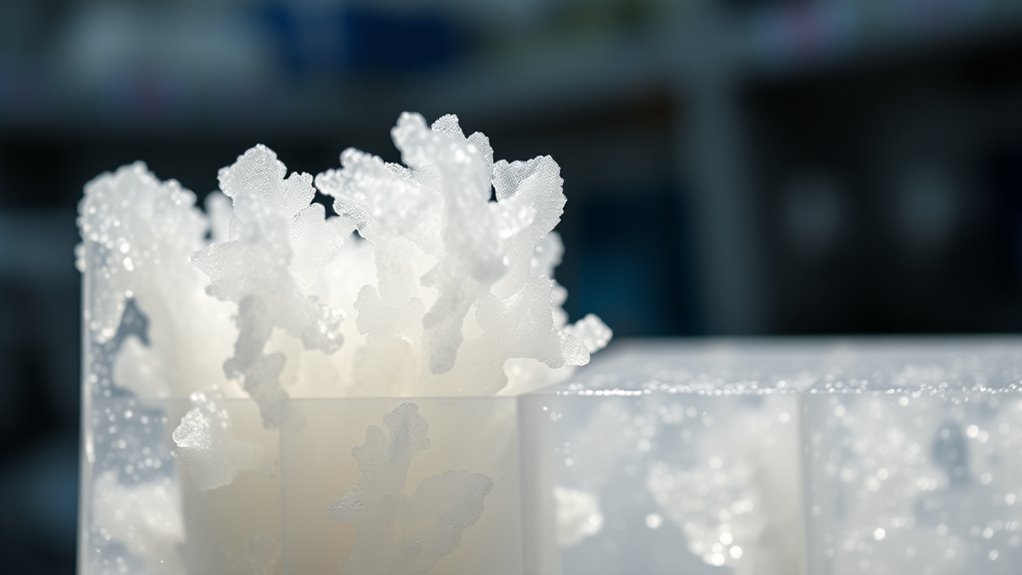

Aerogels are remarkable materials known for their lightweight, porous structure that makes them excellent insulators and filters. You can use them to reduce energy costs in buildings or create efficient filtering systems for air and liquids. Their unique properties allow for diverse applications across industries, all while being environmentally friendly and sustainable. If you’re curious about how they work and their future potential, there’s plenty more to explore behind their innovative uses.
Key Takeaways
- Aerogels are highly effective insulators due to their porous structure and low thermal conductivity.
- Their lightweight nature makes them ideal for energy-efficient insulation in buildings and transportation.
- Aerogels can be engineered as filters for air and liquids, capturing fine particles and contaminants.
- Eco-friendly manufacturing advances are enhancing aerogels’ sustainability for insulation and filtration uses.
- Ongoing innovations aim to improve scalability and cost-effectiveness for widespread adoption in sustainable applications.

Aerogels are remarkable materials known for their exceptional lightweight properties and versatility. As a user or developer exploring new applications, you’ll find that their unique structure opens up innovative possibilities across various industries. When it comes to advanced manufacturing, aerogels require specialized production techniques that balance efficiency and precision. Manufacturing these materials involves removing liquids from gel precursors through supercritical drying or other methods, which can be complex and energy-intensive. However, ongoing advancements aim to streamline these processes, making aerogels more accessible and cost-effective for widespread use. By refining manufacturing techniques, you can produce aerogels with consistent quality, tailored properties, and lower environmental footprints, which is essential for sustainable development.
From an environmental impact perspective, aerogels present both opportunities and challenges. On the positive side, their high insulation efficiency means you can markedly reduce energy consumption in buildings, vehicles, and industrial processes, leading to lower greenhouse gas emissions. Their lightweight nature also means less fuel is needed for transportation, further decreasing carbon footprints. Additionally, many aerogels are made from abundant, non-toxic raw materials like silica, which minimizes environmental risks compared to other synthetic insulators. Yet, you should be aware that the production process can be energy-intensive, especially if it involves high-temperature supercritical drying, which may generate emissions and waste. To address these concerns, researchers are exploring alternative manufacturing methods that use less energy and produce fewer pollutants. Developing eco-friendly aerogel formulations from renewable resources or recycling waste materials can also reduce environmental impact. As a user, understanding these factors helps you make informed choices about sourcing and deploying aerogels in environmentally conscious projects.
Moreover, the durability and recyclability of aerogels influence their environmental footprint over their lifecycle. While aerogels are generally stable, some formulations may degrade under certain conditions, leading to waste concerns. Encouraging reuse and recycling of aerogel materials can mitigate these issues, aligning with sustainable practices. As the technology advances, you can expect innovations that make aerogels more eco-friendly, such as biodegradable variants or production methods that consume less energy. Additionally, improving the scalability of manufacturing processes can help meet increasing demand while reducing environmental impacts. Overall, the interplay between advanced manufacturing techniques and environmental impact plays a fundamental role in shaping the future of aerogels. By staying informed about these developments, you’ll be better equipped to incorporate aerogels into projects that prioritize sustainability, efficiency, and innovation, harnessing their full potential while minimizing ecological footprints.
Frequently Asked Questions
Are Aerogels Environmentally Sustainable to Produce?
You might wonder if aerogels are environmentally sustainable to produce. While they use raw materials like silica or polymers, concerns about biodegradability and sourcing arise. Producing aerogels consumes energy and may involve environmentally taxing processes, but ongoing research aims to develop biodegradable options and more sustainable sourcing methods. So, although not fully eco-friendly yet, efforts are underway to improve their sustainability in production.
How Durable Are Aerogels Under Extreme Conditions?
You’ll find that aerogels have moderate thermal resilience and decent mechanical robustness under extreme conditions. While they resist high temperatures and maintain insulation properties, they can be brittle and prone to cracking if subjected to sharp impacts or rapid temperature changes. To improve durability, researchers are working on composite aerogels. Overall, they perform well in extreme environments, but handling them carefully guarantees longevity and maintains their insulating and filtering effectiveness.
Can Aerogels Be Recycled or Reused?
You can recycle or reuse aerogels, but recycling challenges make it difficult. Their fragile structure and specialized production processes limit straightforward recycling options. However, you can often repurpose aerogels for other applications, enhancing their reuse potential. To maximize their lifespan, handle aerogels carefully and consider alternative reuse methods, which can help reduce waste and make the most of these lightweight materials despite recycling hurdles.
What Are the Potential Health Risks of Handling Aerogels?
Handle aerogels with care because they can pose health risks. You might experience skin irritation from direct contact, and inhaling tiny particles during handling can cause respiratory issues. It’s a case of “better safe than sorry,” so always wear gloves, masks, and eye protection. Proper ventilation helps reduce particle inhalation risks. By taking these precautions, you can avoid potential health hazards and safely work with aerogels.
Are Aerogels Cost-Effective for Large-Scale Applications?
You’ll find aerogels are cost-effective for large-scale applications when you consider the cost analysis and manufacturing costs. Although initial expenses can be high, their durability and excellent insulation properties can reduce energy costs over time. As manufacturing techniques improve and scale increases, production costs decline, making aerogels more affordable. Ultimately, they’re a smart investment for large projects where long-term savings outweigh upfront costs.
Conclusion
Think of aerogels as the silent guardians of innovation, like wisps of cloud shielding the world’s warmth and purity. They remind you that sometimes, the lightest touch can make the biggest difference—protecting, insulating, filtering. Just as a gentle breeze can carry change, aerogels quietly transform industries, proving that strength and resilience come not from bulk, but from subtlety. Embrace their delicate power, and see how small advancements can create a safer, more efficient future.