
When doing FTIR library matching, make sure your sample preparation is excellent; poor prep can lead to misleading spectra. Always calibrate your instrument properly to avoid distorted data. Carefully interpret the spectra by identifying key absorption bands rather than relying solely on automated matches. Cross-check potential library hits with your understanding of the sample and consider artifacts or noise. If you follow these tips, you’ll improve your chances of accurate identification—keep going to discover more essential insights.
Key Takeaways
- Ensure high-quality, well-prepared spectra through proper sample grinding, clean surfaces, and appropriate dilutions.
- Calibrate the FTIR instrument regularly to obtain accurate, distortion-free spectral data.
- Critically evaluate library matches by examining key spectral features rather than relying solely on automated scores.
- Be aware of common artifacts and baseline shifts caused by poor sample prep that can mislead library identification.
- Use contextual sample information and multiple spectral features to confirm correct identification and avoid false positives.
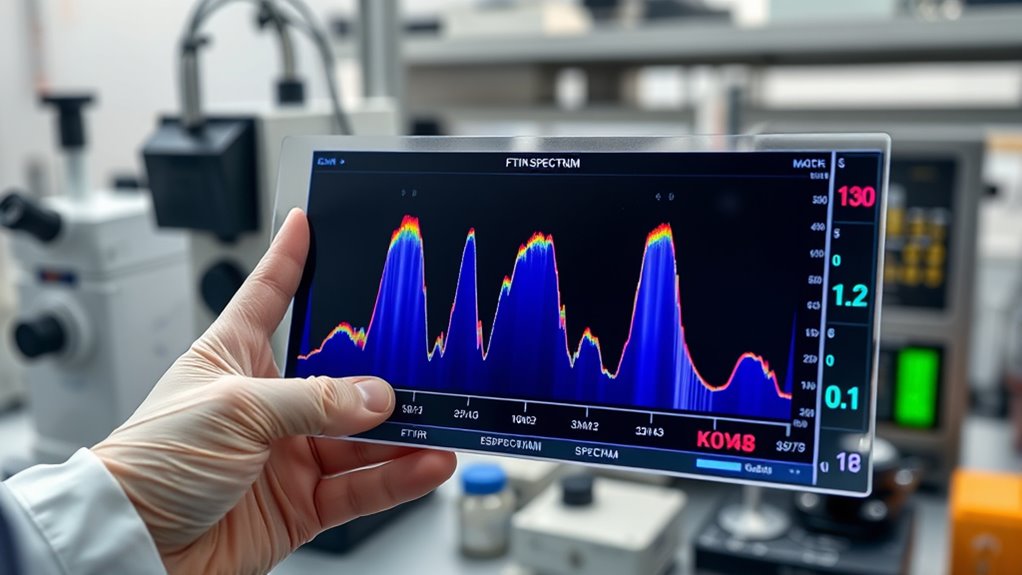
Have you ever wondered how scientists quickly identify unknown materials? The answer often lies in Fourier-transform infrared (FTIR) spectroscopy combined with library matching. When you’re faced with an unknown sample, the process begins with careful sample preparation. Proper sample prep is vital because it directly impacts the quality of the spectral data you’ll obtain. Whether you’re analyzing a solid, liquid, or thin film, you need to guarantee the sample is prepared consistently. For solids, grinding the material into a fine powder and using appropriate sampling techniques—like a KBr pellet or ATR (Attenuated Total Reflectance) accessory—helps produce a clear, interpretable spectrum. Liquids may require proper dilution or a suitable cell, while films should be flat and clean. If the sample isn’t prepared correctly, it can lead to distorted spectra, making spectral interpretation more challenging and increasing the risk of misidentification. Additionally, instrument calibration is essential to ensure accurate spectral data collection and reliable results. Once you have a high-quality spectrum, spectral interpretation becomes your next vital step. This involves examining the absorption peaks and their intensities to understand the molecular vibrations within the sample. Recognizing characteristic bands—such as those for functional groups like carbonyls, hydroxyls, or aromatic rings—guides you in narrowing down the possible identities. But spectral interpretation isn’t just about identifying peaks; it’s also about understanding the context. You need to compare your spectrum with reference data from an extensive FTIR library. When you perform library matching, the software compares your spectrum against thousands of known spectra, giving you potential matches ranked by similarity scores. Accuracy in interpretation relies heavily on your ability to recognize key features and distinguish genuine matches from coincidental similarities. However, pitfalls can occur during both sample preparation and spectral interpretation. Poor sample prep can introduce noise, baseline shifts, or artifacts that skew your spectral data. If your spectrum is compromised, even the best library match might lead you astray. Similarly, relying solely on automated library matching without understanding the spectral features can result in false positives. It’s essential to review the spectral data critically, verifying that the peaks align with the suspected compound’s known vibrational modes. Always consider the context of your sample—its origin, expected composition, and possible contaminants—alongside the library match. Combining meticulous sample preparation, careful spectral interpretation, and critical evaluation of library results ensures more reliable identification. When you follow these principles, FTIR library matching becomes a powerful tool for rapid, accurate material analysis, minimizing errors and maximizing confidence in your conclusions.
Frequently Asked Questions
How Often Should FTIR Libraries Be Updated?
You should update your FTIR libraries regularly, ideally every 6 to 12 months, to guarantee accurate library maintenance. Frequent updates help incorporate new data, improve data validation, and prevent outdated information from affecting your results. Stay proactive by reviewing and validating your library content, especially after significant instrument or method changes. Consistent updates enhance matching accuracy and reliability, keeping your FTIR analysis precise and dependable over time.
Can Library Matching Identify Unknown Compounds?
Think of FTIR library matching as a skilled detective solving a mystery. It can often identify unknown compounds, but spectral ambiguities and database limitations may lead to misidentifications. You might find a match that seems correct but isn’t definitive. While helpful, library matching works best when you understand its boundaries. It’s a tool to narrow down possibilities, not always to provide absolute certainty on its own.
What Are Common Software Tools for FTIR Library Matching?
You can use software tools like OMNIC, KnowItAll, or Spectrum Quant to perform FTIR library matching. These tools access spectral libraries and help identify compounds quickly. Make sure to validate your data by comparing spectra and checking for consistency. Effective software aids in accurate identification, but always double-check your results with data validation practices to avoid false positives or misinterpretations.
How Do Sample Preparation Techniques Affect Library Matching Accuracy?
Imagine your sample as a clear mirror reflecting its true identity. If you guarantee sample consistency, your FTIR spectra become reliable, making library matching more accurate. Contamination effects act like smudges, distorting the reflection and leading to misidentification. Proper sample preparation—cleaning, uniformity, and avoiding contaminants—keeps the mirror pristine, so your spectral database can match confidently, resulting in precise identification and trustworthy results.
Is There a Universal FTIR Library Applicable Across Industries?
There isn’t a universal FTIR library applicable across industries because industry-specific databases better match your samples. You should look for libraries that contain standardized spectral formats, ensuring compatibility and more precise identification. Using industry-specific databases helps you avoid mismatches and improves confidence in your results, especially when analyzing complex or unique materials. Always verify that the library aligns with your sample type for ideal matching accuracy.
Conclusion
Remember, while FTIR library matching is a powerful tool, it’s only as good as the library you use. Don’t rely solely on software; always verify matches with your sample’s context and other analysis methods. Some might think software can do all the work, but your expertise guarantees accurate identification. By combining reliable libraries with your judgment, you’ll avoid pitfalls and confidently interpret your spectra, leading to more trustworthy results.