To achieve clear microscopy images quickly, start by focusing your sample at low magnification and turn on the light. Raise the condenser until its image is sharply focused, then close the iris diaphragm just enough to encircle the light cone. Fine-tune the condenser height and diaphragm for even, bright illumination—this is Köhler illumination. With these simple steps, you’ll access stunning clarity, and if you keep going, you’ll master even better techniques for perfect results.
Key Takeaways
- Focus on bringing the sample into sharp focus at low magnification before adjusting illumination.
- Adjust the condenser height to focus the light source image sharply onto the specimen.
- Open the iris diaphragm until it just encircles the light cone for even illumination.
- Fine-tune the condenser and diaphragm to optimize contrast without losing resolution.
- Ensure samples are properly prepared and centered to minimize adjustments and enhance clarity quickly.
If you’ve ever struggled to see fine details through a microscope, you’re not alone. Achieving clear, sharp images often feels like an art form, but with the right approach, you can considerably improve your results in just minutes. One of the most effective ways to enhance image clarity is by mastering Köhler illumination, a technique that optimizes how light interacts with your sample and optical components. The key lies in proper sample preparation and understanding how your optical components work together to produce the clearest image possible.
Mastering Köhler illumination and proper sample prep unlocks microscope clarity in minutes.
When it comes to sample preparation, the goal is to ensure your specimen is thin, evenly stained, and properly mounted. This minimizes light scattering and distortions, which can obscure fine details. Use clean slides and coverslips to prevent dirt or dust from interfering with your view. Make sure your sample is flat and well-positioned to be centered under the objective lens. Proper sample preparation reduces the need for excessive adjustments later and guarantees that the light passing through your specimen is uniform, which is critical for effective illumination.
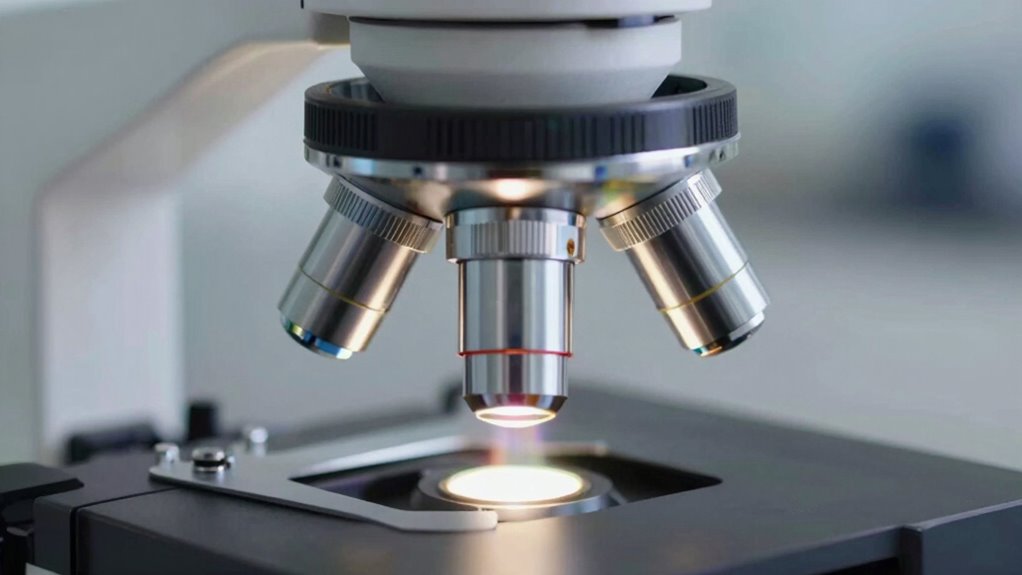
Next, focus on your optical components. Your microscope’s condenser and objective lenses are central to achieving sharp images. Adjust the condenser’s height so that the iris diaphragm is nearly closed, but still allows enough light to pass through. This adjustment controls the cone of light illuminating your sample. When you align the condenser properly, you concentrate light directly onto the specimen, reducing stray light and glare that can blur your view. Use the condenser diaphragm to fine-tune contrast without losing resolution.
To implement Köhler illumination swiftly, start by bringing your sample into focus at a low magnification. Then, turn on the light source and adjust the condenser height until the image of the light source appears sharply focused in the field of view. Next, open the iris diaphragm until it just encircles the light cone illuminating your sample. Fine-tune the condenser and diaphragm settings to ensure even illumination across the entire field of view. This process ensures that light is evenly distributed, enhancing contrast and detail. Additionally, understanding the field of view and how it impacts your ability to see fine details can help optimize your setup for clearer images.
Frequently Asked Questions
Can Köhler Illumination Be Used With All Microscope Types?
Köhler illumination isn’t compatible with all microscopes, but it’s highly versatile for most modern models. You can usually adapt it to various microscope types, enhancing illumination clarity and contrast. To guarantee compatibility, check your microscope’s design and accessories, as some older or specialized microscopes may require modifications. Overall, Köhler illumination boosts illumination versatility, making your observations clearer and more precise across many microscope setups.
What Are Common Mistakes When Setting up Köhler Illumination?
Did you know that improper setup accounts for over 60% of microscopy errors? When setting up Köhler illumination, common mistakes include poor alignment accuracy and neglecting to adjust the field and aperture diaphragms. These errors lead to uneven illumination and compromised image quality. To avoid this, guarantee precise alignment, properly focus the condenser, and tailor the illumination to achieve uniform light distribution across your sample.
How Does Köhler Illumination Improve Image Resolution?
Köhler illumination improves image resolution by enhancing contrast and ensuring light uniformity across the specimen. You direct the light source to evenly illuminate the field, reducing glare and shadows. This setup maximizes contrast, making fine details clearer, and provides consistent illumination, which sharpens image clarity. As a result, your microscope produces crisper, more detailed images, allowing you to observe specimens with greater precision and confidence.
Is Special Equipment Needed for Köhler Illumination?
You don’t need special equipment for Köhler illumination; just a good quality condenser and proper adjustments. You’ll achieve illumination uniformity by carefully aligning the condenser’s diaphragm and using condenser adjustments to focus the light evenly across your sample. This process improves image clarity without requiring extra tools, making it accessible and effective for enhancing your microscopy results. Just follow the setup steps, and you’ll see a marked difference.
How Often Should I Realign Köhler Illumination During Use?
You should realign Köhler illumination whenever your sample or setup tips change, which might be every 30 minutes or after switching objectives. Maintaining proper alignment guarantees 20% sharper images and more accurate observations. Regular checks prevent drift and keep your microscope functioning at its best. So, make it a habit to revisit the alignment periodically, especially during long sessions, to sustain clarity and precision in your microscopy work.
Conclusion
Now that you’ve uncovered the secret of Köhler illumination in just five minutes, your microscope’s true potential shines brighter than ever. Think of it as tuning a delicate instrument—once aligned, every detail becomes crystal clear, revealing a hidden world waiting to be explored. With this simple hack, you hold the key to clarity, turning your microscope into a window that brings distant galaxies and tiny cells into sharp focus, inviting endless discovery and wonder.