In acid–base titrations, you rely on carefully chosen indicators like phenolphthalein or methyl orange to signal the reaction’s endpoint with a distinct color change. This helps you measure the precise volume of titrant needed to neutralize the unknown solution, revealing its concentration accurately. Choosing the right indicator guarantees you don’t mistake the endpoint, leading to reliable results. If you continue exploring, you’ll discover how selecting the best indicator makes all the difference.
Key Takeaways
- Acid-base titrations use indicators that change color at specific pH ranges to signal the endpoint visually.
- Proper indicator selection ensures the color change occurs precisely at the equivalence point for accurate concentration measurement.
- Common indicators like phenolphthalein and methyl orange are chosen based on the titration type and expected pH at equivalence.
- The colorful color transition provides an easy, visual method to determine when the neutralization reaction is complete.
- Accurate titrations depend on careful observation of the indicator’s color change, ensuring precise calculation of unknown concentrations.
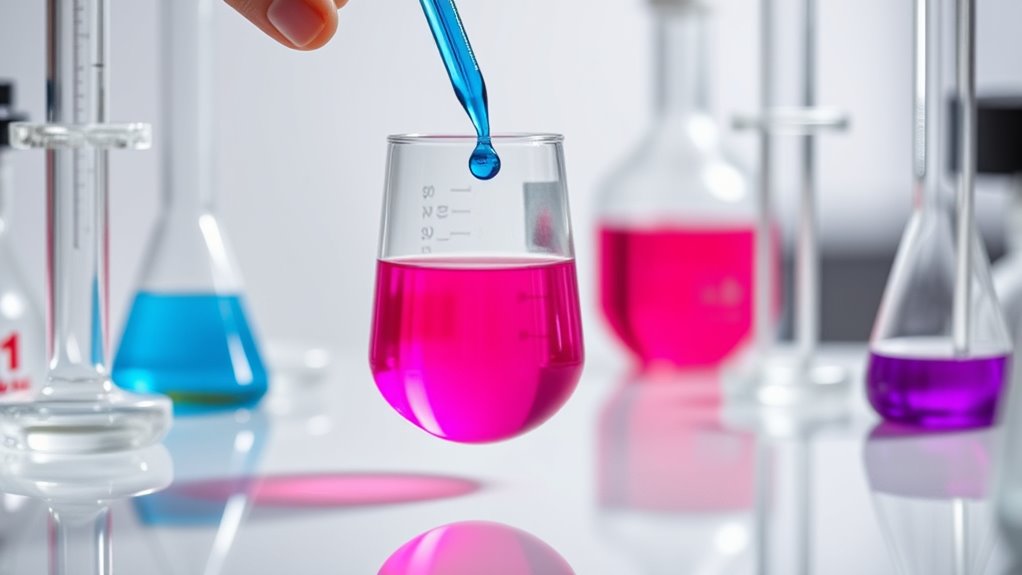
Have you ever wondered how chemists determine the exact concentration of an unknown acid or base? The answer lies in a process called titration, a technique that allows you to find precise measurements through a carefully controlled reaction. Central to this process is the choice of an indicator, which is essential for indicator selection and endpoint determination. Your goal is to identify the moment when the acid and base have completely reacted, signaling the endpoint with a visible color change.
Titration reveals unknown acid or base concentrations through careful reaction and color-changing indicators.
When planning a titration, selecting the right indicator is imperative. Different indicators change color at specific pH levels, so you need to match the indicator’s transition range to the expected equivalence point of your reaction. For example, if you’re titrating a strong acid with a strong base, the equivalence point is typically at pH 7. In this case, phenolphthalein works well because it turns from colorless to pink around that pH.
On the other hand, if you’re working with a weak acid and a strong base, the endpoint might occur at a higher pH, requiring you to choose an indicator like methyl orange, which changes color at a lower pH. Picking the correct indicator guarantees that the color change accurately reflects the completion of the reaction, making your endpoint determination precise. Additionally, understanding the contrast ratio of your indicator can help you select the most suitable one for your titration conditions.
As you perform the titration, you slowly add the titrant—usually a standard solution of known concentration—into the unknown solution. You’ll watch carefully for the characteristic color change that signals the endpoint. This moment is pivotal because it indicates that you’ve reached the point where the acid and base have neutralized each other exactly. To improve the accuracy of the titration, proper technique and careful observation are essential.
The accuracy of your titration hinges on this observation, so choosing an appropriate indicator for the specific acid-base pair is essential. If you pick an indicator with an inappropriate transition range, the color change might occur too early or too late, leading to erroneous concentration calculations.
Frequently Asked Questions
How Do Different Indicators Affect Titration Accuracy?
When you choose an indicator, it affects titration accuracy by matching its pH shift range to your titration’s equivalence point.
Proper indicator selection ensures the color change occurs exactly at the right moment, preventing errors.
If you pick the wrong indicator, the transition pH won’t align with the endpoint, leading to inaccurate concentration measurements.
Can Titrations Be Performed Without a Burette?
Titrations are like a precise dance, but you don’t always need a burette. You can use a pipette for accurate volume transfer, especially if it’s properly calibrated.
Digital titrators also eliminate the need for traditional burettes, offering automated precision. While a burette is standard, these tools allow you to perform titrations effectively without one, making your process more flexible and reliable.
What Are Common Errors in Acid-Base Titrations?
When performing acid-base titrations, common errors include inaccurate pipette calibration, leading to incorrect volume measurements, and sample contamination, which affects results.
You might also overshoot the endpoint or use poorly stored solutions. Always check your pipette calibration before starting, and verify samples are clean to prevent contamination.
Careful technique helps you get precise, reliable results, avoiding these typical pitfalls.
How Is Endpoint Detection Optimized for Precision?
Think of endpoint detection like fine-tuning a musical instrument. To hit the perfect note, you calibrate your pH meter regularly, guaranteeing accurate readings.
Using automatic titration helps precisely detect the endpoint by controlling the addition of titrant and monitoring changes in real-time. This combination minimizes errors, enhances precision, and assures your titration results are reliable and consistent.
Making your measurements as harmonious as a well-played symphony.
Are There Alternative Methods to Titration for Concentration Measurement?
You can explore alternative methods like spectrophotometric analysis, which measures how much light a solution absorbs to determine concentration accurately.
Conductivity measurements are another option; they assess how well a solution conducts electricity, reflecting ion presence.
Both methods offer precise, rapid results without relying on titration’s color change, making them useful for quick, accurate concentration assessments in various laboratory settings.
Conclusion
By mastering acid–base titrations, you open a visually engaging way to determine concentrations accurately. While some might see it as merely colorful chemistry, it’s actually a precise method rooted in solid scientific principles. With careful technique, you’ll find this approach both educational and reliable. So, don’t dismiss its elegance—embrace the vibrant process, knowing it’s a powerful tool for understanding chemical reactions and achieving accurate measurements in your experiments.