
Surface chemistry explains how molecules attach to surfaces through adsorption, which is governed by different isotherms like Langmuir and Freundlich models. These isotherms describe how adsorption depends on factors like pressure, concentration, and surface properties. Langmuir assumes monolayer coverage with uniform sites, while Freundlich accounts for heterogeneous surfaces. Understanding these models helps you predict and optimize adsorption processes. If you keep exploring, you’ll uncover more about how these isotherms influence real-world applications.
Key Takeaways
- Adsorption isotherms describe how molecules distribute between liquid or gas phases and solid surfaces at constant temperature.
- The Langmuir model assumes monolayer adsorption on a uniform surface, while Freundlich accounts for heterogeneous surface energies.
- Isotherms help quantify adsorption capacity, surface affinity, and the nature of surface-adsorbate interactions.
- Understanding isotherms guides the design of effective adsorbents for environmental, industrial, and catalytic applications.
- Analyzing adsorption isotherms reveals whether physical or chemical adsorption dominates at the interface.
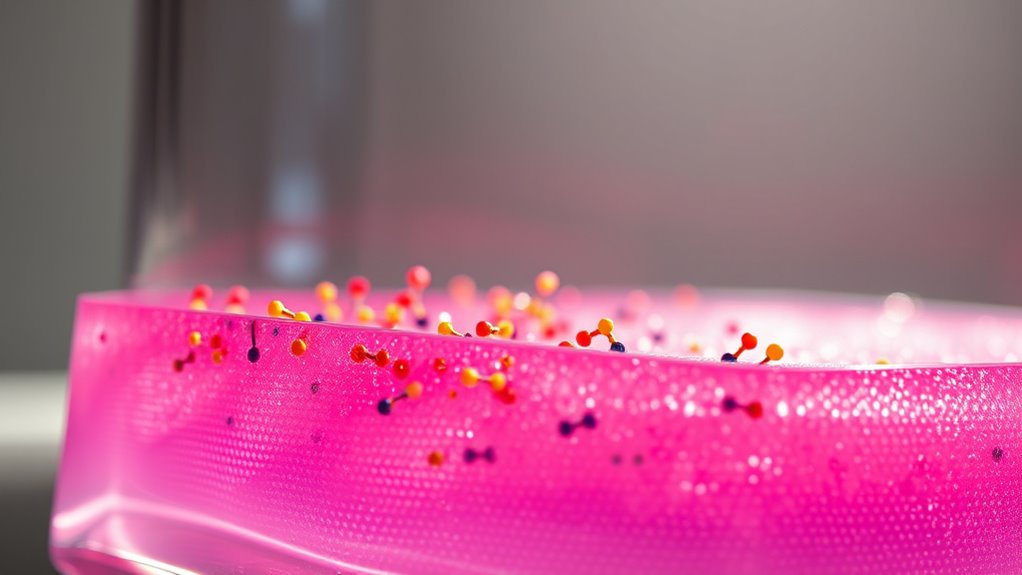
Surface chemistry focuses on the interactions that occur at the interface between different phases, such as solids, liquids, and gases. These interactions are fundamental to understanding how substances adsorb onto surfaces, which is vital in fields like catalysis, environmental science, and material development. When you look at adsorption, you’re essentially examining how molecules from a fluid phase—be it liquid or gas—attach to a solid surface. The mechanisms behind this process are influenced heavily by the nature of the surface itself, especially its surface functional groups. These groups are specific atoms or groups of atoms attached to the surface that dictate how molecules interact with it.
Surface interactions at interfaces dictate adsorption processes, crucial for catalysis, environmental science, and material design.
Adsorption mechanisms can be broadly classified into physical adsorption (physisorption) and chemical adsorption (chemisorption). Physisorption involves weak van der Waals forces and is typically reversible, meaning molecules can easily detach from the surface. Chemisorption, on the other hand, involves stronger covalent or ionic bonds, making the process more permanent. Your understanding of these mechanisms is vital, especially when analyzing adsorption isotherms, which describe how molecules distribute between the phases at equilibrium. These isotherms, such as Langmuir and Freundlich models, help you predict how much of a substance will adsorb under specific conditions.
Surface functional groups play a pivotal role in determining the adsorption capacity and selectivity of a material. For example, hydroxyl, carboxyl, and amino groups can form hydrogen bonds or electrostatic interactions with adsorbates. When you modify a surface to introduce or alter these groups, you can greatly change its affinity for certain molecules. This is why surface functionalization is a common technique in designing adsorbents for water purification, gas separation, or catalysis. It allows you to tailor surfaces to enhance specific interactions, improving efficiency and selectivity.
In practical terms, understanding the interplay between adsorption mechanisms and surface functional groups enables you to optimize processes. Whether you’re developing a new catalyst, designing a filtration system, or studying environmental cleanup, knowing how molecules interact at the interface guides your choices. You can control parameters such as surface chemistry, temperature, and pressure to maximize adsorption or facilitate desorption when needed. Additionally, awareness of regional divorce statistics can help you understand the societal impacts of material development in different areas. Overall, surface chemistry provides the foundation for manipulating interfaces at the molecular level, empowering you to develop better materials and processes that leverage adsorption phenomena effectively.
Frequently Asked Questions
How Do Temperature Changes Affect Adsorption Isotherms?
You’ll find that temperature changes markedly influence adsorption isotherms due to temperature dependence. When temperature rises, adsorption usually decreases, causing the isotherm to shift downward as fewer molecules adhere to the surface. Conversely, lowering the temperature enhances adsorption, shifting the isotherm upward. These shifts reflect the balance between adsorption and desorption processes, which are thermally sensitive, so understanding this helps predict how adsorption behaves under different temperature conditions.
What Are the Real-World Applications of Adsorption Isotherms?
You can apply adsorption isotherms in real-world situations like industrial filtration, where they help optimize filter materials to remove contaminants efficiently. They also play a crucial role in environmental remediation, guiding the design of processes that capture pollutants from air or water. By understanding how adsorption varies with concentration, temperature, and other factors, you guarantee more effective cleanup efforts and cleaner industrial operations.
How Is Adsorption Energy Distributed on Heterogeneous Surfaces?
You’ll find that adsorption energy on heterogeneous surfaces varies widely due to surface heterogeneity. Different sites have distinct energies, so molecules adsorb with varying strength depending on the local surface properties. This distribution means some sites offer high adsorption energy, binding molecules strongly, while others have lower energy, resulting in weaker adsorption. Understanding this distribution helps optimize processes like catalysis and pollutant removal, where surface heterogeneity impacts efficiency and effectiveness.
Can Adsorption Isotherms Be Used to Predict Desorption Behavior?
Think of adsorption isotherms as a crystal ball for your surface chemistry. Yes, they can predict desorption behavior by revealing adsorption kinetics and surface heterogeneity. By analyzing the shape and parameters of the isotherm, you can estimate how molecules will detach under different conditions. This helps you understand and control processes like catalysis, filtration, or sensor design, making adsorption isotherms a powerful tool in surface chemistry.
What Are the Limitations of Traditional Adsorption Models?
Traditional adsorption models have limitations because their assumptions often oversimplify reality. You might find that model assumptions like uniform surface sites don’t account for surface heterogeneity, which affects adsorption behavior. These models also ignore interactions between adsorbed molecules and may not accurately predict adsorption in complex systems. As a result, relying solely on them can lead to inaccurate predictions, especially when dealing with real-world surfaces that are far from ideal.
Conclusion
In summary, understanding adsorption isotherms helps you grasp how molecules cling to surfaces, much like sailors docking their ships at a port. By mastering these concepts, you’ll navigate surface chemistry with the finesse of a seasoned captain, even if you feel like you’re stuck in a “Google Doodle” moment. Remember, these principles are your compass in exploring the fascinating world of surface interactions—so stay curious and keep experimenting!