
In drying ovens, moisture removal relies on convection and airflow, which can lead to uneven drying and longer process times, especially for heat-sensitive samples. Vacuum ovens use a pressure difference that replaces airflow, allowing moisture to evaporate at lower temperatures and with more uniformity. This difference makes vacuum ovens better for delicate or sterile materials. To understand how this mass transfer variation impacts drying efficiency and sample integrity, keep exploring these options further.
Key Takeaways
- Drying ovens rely on convection and airflow for moisture removal, which can be slower and less uniform.
- Vacuum ovens use pressure differential, allowing moisture to evaporate at lower temperatures and more efficiently.
- Open environment in drying ovens increases contamination risk, unlike sealed vacuum chambers that provide a cleaner process.
- Precise temperature control in vacuum ovens ensures consistent drying, reducing thermal stress on sensitive materials.
- The mass transfer mechanism in vacuum ovens enables faster, more effective dehydration of delicate or heat-sensitive samples.

When choosing between drying ovens and vacuum ovens, understanding their fundamental differences can help you select the right equipment for your needs. One key aspect to consider is how each oven manages temperature control and contamination risk. Drying ovens typically operate at atmospheric pressure, relying on convection to remove moisture from samples. They allow for straightforward temperature adjustments, making it easy to set and maintain specific drying conditions. However, because these ovens are open to the environment, contamination risk becomes a concern, especially when working with sensitive or sterile materials. The open-air environment can introduce dust, microbes, or other particles, potentially compromising your samples.
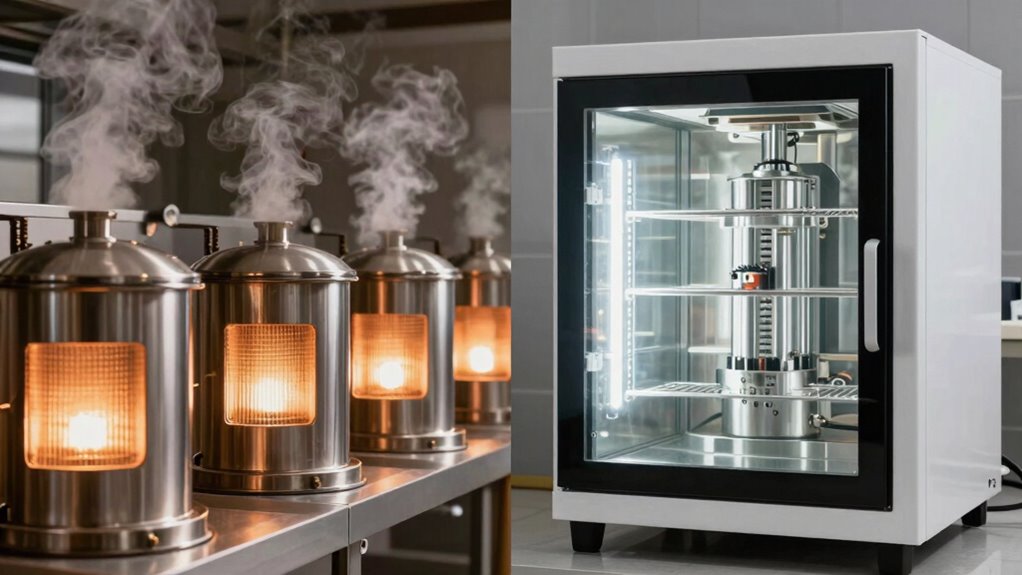
Drying ovens operate at atmospheric pressure, relying on convection and risking contamination from the environment.
In contrast, vacuum ovens create a low-pressure environment that drastically reduces the boiling point of water and other solvents, allowing for drying at lower temperatures. This precise control over temperature is a significant advantage if you’re dealing with heat-sensitive materials or require consistent, uniform drying. Since vacuum ovens operate in a closed system, contamination risk diminishes substantially. The sealed chamber prevents airborne particles from entering, maintaining the purity of your samples and reducing the likelihood of cross-contamination. This environment is particularly beneficial for applications like pharmaceuticals, electronics, or delicate biological specimens, where contamination could invalidate results or damage the material.
The difference in mass transfer mechanisms between these two types of ovens also influences their suitability for various tasks. Drying ovens rely on convective heat transfer and airflow to remove moisture, which can sometimes lead to uneven drying or longer process times. On the other hand, vacuum ovens facilitate mass transfer through pressure differential, enabling moisture to evaporate more efficiently from the material even at lower temperatures. This efficiency not only speeds up the drying process but also minimizes thermal stress on sensitive samples, protecting their integrity. Additionally, advanced temperature controls in vacuum ovens contribute to more consistent and reliable drying outcomes.
Another aspect to consider is how each oven manages temperature control. Drying ovens often have simple thermostats that maintain a set temperature, but fluctuations may occur, especially in larger units. Vacuum ovens typically feature more advanced temperature controls, providing precise and stable conditions that are vital for delicate processes. This level of control ensures consistent results and reduces the risk of overheating or under-drying.
Ultimately, your choice hinges on your specific requirements. If you need quick drying of robust materials and are less concerned about contamination, a drying oven might suffice. However, if your work involves heat-sensitive, sterile, or contamination-sensitive samples, a vacuum oven offers superior temperature regulation and a cleaner environment. Understanding these differences in mass transfer and environmental control will guide you toward the equipment that best fits your application, guaranteeing optimal results every time.
Frequently Asked Questions
How Does Humidity Affect Drying Oven Efficiency?
Humidity impact profoundly affects drying oven efficiency. When humidity levels are high, moisture in the air slows down the evaporation process, reducing your drying efficiency. You might notice longer drying times and inconsistent results. To maintain ideal performance, guarantee proper ventilation and consider dehumidifying the environment. By controlling humidity, you help the oven operate more effectively, speeding up drying and ensuring consistent, high-quality results every time.
Can Vacuum Ovens Dry Heat-Sensitive Materials Better?
Yes, vacuum ovens are better at drying heat-sensitive materials because they remove moisture more efficiently without exposing your items to high temperatures. By reducing pressure, they lower the boiling point of water, allowing for gentle moisture removal. This controlled environment prevents heat damage, ensuring your heat-sensitive materials stay intact while achieving ideal drying. So, if you need careful moisture removal, a vacuum oven is your best choice.
What Maintenance Is Required for Each Oven Type?
You need to follow specific maintenance routines for each oven type. For drying ovens, regularly clean the interior and heating elements, and stick to calibration schedules to guarantee accurate temperature control. For vacuum ovens, clean seals and chambers frequently to prevent leaks, and perform calibration checks to maintain vacuum integrity. Both require scheduled inspections and preventative maintenance to keep them operating efficiently and accurately.
Are There Safety Risks Unique to Vacuum Ovens?
Yes, vacuum ovens pose unique safety risks. You need to be cautious with the vacuum pump, ensuring it’s properly maintained to prevent failures. Pressure safety is critical; if the chamber isn’t sealed correctly, sudden pressure changes can cause injury. Always monitor pressure levels and inspect seals regularly. Proper training and safety protocols help you minimize risks associated with vacuum pressure and pump operation.
How Do Energy Costs Compare Between Drying and Vacuum Ovens?
Think of energy costs as a tightrope you walk carefully—vacuum ovens often use more energy due to their sealed, low-pressure environment, making them less cost-efficient. Drying ovens generally consume less energy because they operate at higher pressures and temperatures. While vacuum ovens save time and improve quality, expect higher energy consumption, impacting your overall cost efficiency. Balancing these factors helps you choose the right oven for your needs.
Conclusion
Choosing between drying ovens and vacuum ovens depends on your needs, but remember, it’s not just about heat—it’s about how you transfer it. Like peeling back layers to reveal what’s hidden, understanding the mass transfer difference exposes the true power of each oven. So, consider what’s beneath the surface, because sometimes, the smallest difference in process can unleash the greatest results. Don’t just dry, transform your approach—because in the end, it’s all about what you reveal.