Thermodynamics helps you understand energy flow in chemical systems. Gibbs free energy (G) predicts if a reaction will occur spontaneously at constant temperature and pressure. When ΔG is negative, the process is favorable; if positive, it needs external energy. Equilibrium is reached when ΔG is zero, meaning forward and reverse reactions balance. Mastering these concepts reveals how energy and disorder interact, and exploring further uncovers the deeper principles guiding chemical reactions.
Key Takeaways
- Gibbs free energy (ΔG) predicts whether a reaction is spontaneous at constant temperature and pressure.
- Negative ΔG indicates a spontaneous process; positive ΔG signifies a non-spontaneous one.
- At equilibrium, ΔG equals zero, meaning forward and reverse reactions occur at equal rates.
- The relationship ΔG = ΔH – TΔS links enthalpy, entropy, and temperature to reaction spontaneity.
- Systems tend toward minimized free energy, with equilibrium representing the lowest possible ΔG.
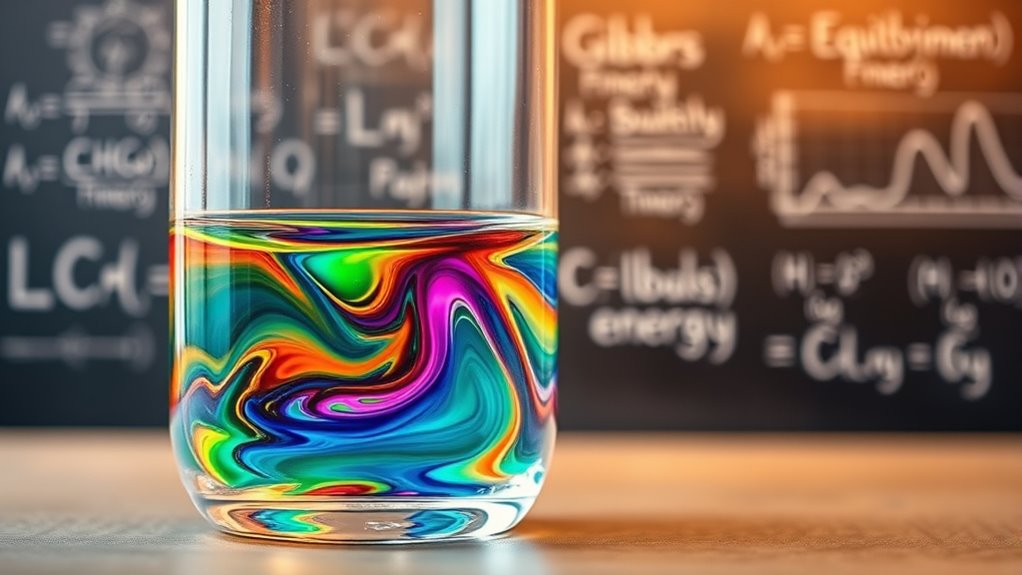
Have you ever wondered how heat moves or why engines work the way they do? The answers lie in the principles of thermodynamics, which explain energy transfer and transformation. One essential concept is entropy, a measure of disorder or randomness in a system. When you look at a chemical reaction, understanding entropy calculation helps determine whether the reaction will happen spontaneously or require energy input. Reaction spontaneity hinges on the change in free energy, which combines enthalpy and entropy considerations. If the entropy increases during a process, it often favors spontaneity, but you need to analyze the entire system’s free energy change to be sure.
Understanding entropy helps determine if a chemical reaction occurs spontaneously.
In thermodynamics, the Gibbs free energy (G) is the key to predicting reaction behavior at constant temperature and pressure. When you calculate the change in Gibbs free energy (ΔG), you’re effectively evaluating whether a reaction will occur spontaneously. The formula ΔG = ΔH – TΔS links enthalpy change (ΔH), entropy change (ΔS), and temperature (T). If ΔG is negative, the reaction is spontaneous; if positive, it isn’t. When it’s zero, the system is at equilibrium, meaning no net change occurs over time. This equilibrium state is dynamic, with reactions continuously happening but maintaining a steady composition.
Understanding how Gibbs free energy relates to reaction spontaneity also helps you grasp the concept of equilibrium. At equilibrium, the forward and reverse reactions happen at the same rate, and the free energy of the system is minimized. This balance point occurs when the free energy change for the reaction reaches zero. By calculating entropy and free energy, you can predict whether a process will proceed on its own or require external energy. This insight is vital in fields like chemistry, biology, and engineering, where controlling reactions and energy flow matters.
The beauty of thermodynamics lies in its ability to provide a quantitative framework for these phenomena. By mastering entropy calculation, you gain the tools to analyze whether a reaction is spontaneous, and by applying Gibbs free energy concepts, you understand the conditions that lead to equilibrium. Whether you’re designing a chemical process or studying biological systems, these principles help you predict and control energy transformations. Recognizing how entropy and free energy interplay allows you to see beyond the chaos and order within systems, giving you a clearer picture of the underlying forces shaping reactions and energy flow in the universe. Additionally, understanding environmental considerations ensures sustainable practices in energy management and chemical processes.
Frequently Asked Questions
How Does Gibbs Free Energy Relate to Spontaneity in Biological Systems?
You can tell that Gibbs free energy indicates spontaneity in biological systems because a negative change means reactions like protein folding or enzyme catalysis happen naturally. When the free energy decreases, these processes occur without extra energy input, making them spontaneous. So, if the Gibbs free energy change is negative, you know that protein folding and enzyme activity are thermodynamically favorable, driving essential biological functions efficiently.
Can Gibbs Free Energy Be Applied to Non-Chemical Processes?
Think of Gibbs free energy as a versatile tool that extends beyond chemistry. You can apply it to mechanical systems and economic models, where it helps assess whether processes will move forward spontaneously. Just like in chemical reactions, a decrease in free energy indicates a system’s tendency to improve stability. So, yes, Gibbs free energy can guide decisions and predictions in various non-chemical processes, making it a powerful concept across disciplines.
How Do Temperature Changes Affect Gibbs Free Energy Calculations?
Temperature changes markedly impact Gibbs free energy calculations because of temperature sensitivity. As temperature fluctuates, it influences energy fluctuations within a system, altering the balance between enthalpy and entropy. You’ll notice that higher temperatures often favor processes that increase entropy, affecting spontaneity. To accurately predict how reactions behave under different conditions, you need to account for these temperature-dependent energy fluctuations, which can shift the Gibbs free energy and change the reaction’s direction.
What Role Does Entropy Play in Reaching Equilibrium?
Entropy plays a key role in reaching equilibrium by contributing to disorder increase. As a system moves toward equilibrium, entropy increases, making the process spontaneous. You’ll notice that when entropy contribution is high, the system favors the state with maximum disorder, helping it reach equilibrium faster. fundamentally, entropy drives the process by promoting disorder, guiding the system toward the most stable, balanced state where free energy is minimized.
How Is Gibbs Free Energy Used in Industrial Chemical Engineering?
Imagine transforming raw materials into valuable products—you use Gibbs free energy to guide reaction optimization. You analyze how changes in temperature, pressure, and concentration affect free energy, helping you determine the most efficient conditions. This guarantees process efficiency by minimizing energy waste and maximizing yield. In industrial chemical engineering, Gibbs free energy becomes your tool for designing and controlling reactions, making processes more sustainable and cost-effective.
Conclusion
Understanding Gibbs free energy helps you grasp whether a reaction will occur spontaneously, guiding you in predicting chemical behavior. Did you know that nearly 80% of all chemical reactions in nature reach equilibrium naturally? By mastering these concepts, you can better appreciate how life’s processes, from photosynthesis to metabolism, keep running smoothly. Keep exploring thermodynamics—it’s like deciphering nature’s secret code for energy transformations!