Phase diagrams are visual tools that show how temperature, pressure, and composition influence material phases. They help you identify stable phases and predict what happens during heating or cooling, such as melting or solidification. By understanding the key points on the diagram, you can make informed decisions about alloy design or heat treatments. With a grasp of their interpretation, you’ll be better equipped to control material properties—keep exploring to learn more insights.
Key Takeaways
- Understand the axes: temperature, pressure, and composition to interpret phase boundaries and stability regions.
- Identify key features like phase regions, lines (e.g., melting, peritectic), and points (e.g., invariant points).
- Use the diagram to determine which phases are stable at specific temperatures and compositions.
- Relate cooling curves to phase diagram features to predict phase transitions during cooling processes.
- Apply phase diagrams to design alloys, optimize heat treatments, and predict material behavior under different conditions.
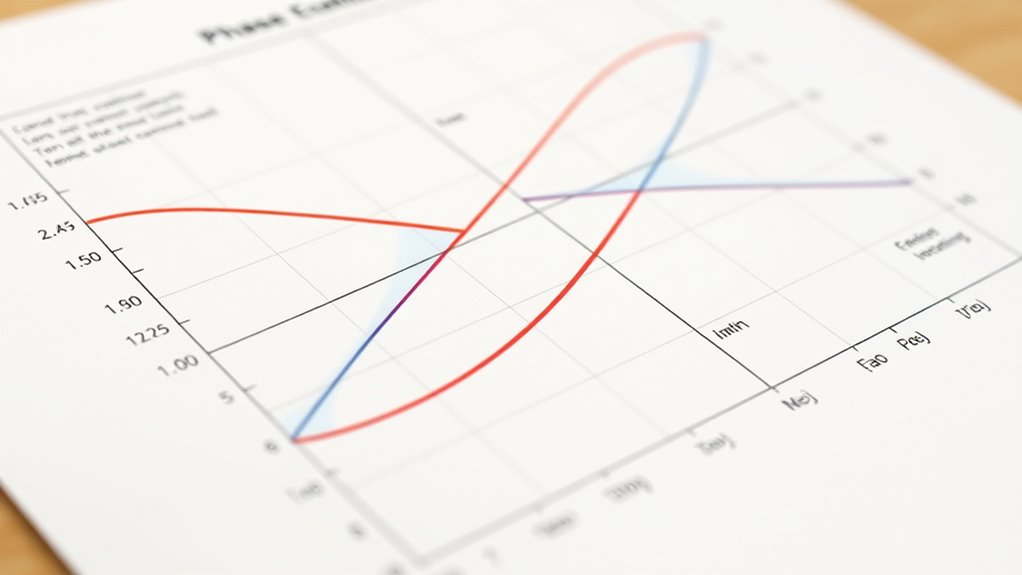
Phase diagrams are essential tools in understanding the states of a substance under different conditions of temperature and pressure. They provide a visual map of how materials behave when subjected to various thermal and pressure changes, which is crucial in fields like metallurgy, materials science, and engineering. When you examine a phase diagram, you’re essentially observing the relationship between temperature, pressure, and the composition of a system, allowing you to predict phases, phase transitions, and the stability of different states.
One key aspect of phase diagrams involves alloy compositions. If you’re working with alloys, understanding how different elemental mixtures influence the phases present at specific temperatures and pressures is vital. The diagram reveals the ranges of compositions where certain phases are stable, how they coexist, or how they transform as conditions change. For example, in a binary alloy system, the phase diagram shows you the temperature at which a solid solution begins to form or melts, and where it separates into multiple phases. This knowledge guides you in alloy design, heat treatment processes, and ensuring the desired mechanical properties.
Alloy compositions determine phase stability, transformations, and microstructures crucial for material performance.
Cooling curves are another important element linked to phase diagrams. When you cool a material from a high temperature, the cooling curve records how the temperature decreases over time. By analyzing these curves alongside phase diagrams, you can determine when phase transitions occur during cooling. For instance, a sudden drop or plateaus in the cooling curve often indicate a phase change, such as solidification or crystallization. These transitions correspond to specific points on the phase diagram, like the melting point or the peritectic temperature. Recognizing these features helps you control cooling rates to optimize material properties, avoid unwanted phases, or produce specific microstructures.
Understanding how alloy compositions influence phase diagrams allows you to manipulate the final microstructure of an alloy, ensuring it meets your strength, ductility, or corrosion resistance requirements. By examining the diagram, you can tell whether a particular composition will solidify into a single phase or multiple phases, and at what temperatures. When combined with cooling curves, this insight helps you plan thermal treatments to achieve precise results. Additionally, the importance of natural materials and their properties is often reflected in phase diagrams, especially when working with materials like ceramics or composites.
In practical terms, mastering phase diagrams means you can predict the behavior of materials during manufacturing or service. Whether you’re designing new alloys, optimizing heat treatments, or analyzing failure modes, knowing how to read and interpret these diagrams makes you more effective. They serve as a roadmap, guiding you through the complex interplay of temperature, pressure, and composition, enabling you to produce better, more reliable materials tailored to your specific needs.
Frequently Asked Questions
How Can Phase Diagrams Be Applied in Real-World Industries?
You can apply phase diagrams in real-world industries by guiding material design and improving industrial processes. They help you understand how different materials behave under varying temperatures and pressures, enabling you to optimize alloy compositions or predict material stability. This guarantees you develop stronger, more durable products, reduces manufacturing costs, and enhances quality control. Using phase diagrams, you make informed decisions that streamline production and innovation in industries like aerospace, automotive, and metallurgy.
What Are Common Errors When Interpreting Phase Diagrams?
Imagine maneuvering a map with blurry lines—that’s like misinterpreting phase boundaries. You might mistake a phase boundary for a stable boundary, leading to errors. Common mistakes include ignoring the equilibrium assumption, which is crucial for accurate readings, and misreading temperature or composition axes. These errors cause you to misunderstand the true phase relationships, so always double-check the boundaries and remember they represent equilibrium states, not just any snapshot in time.
How Do Temperature and Pressure Changes Affect Phase Boundaries?
Temperature effects cause phase boundaries to shift, often moving toward higher temperatures for melting or vaporization. Pressure influence can either raise or lower these boundaries depending on whether the process involves compression or expansion. When pressure increases, you’ll typically see phase boundaries move to favor denser phases, while decreasing pressure favors less dense phases. Understanding these effects helps you predict how materials change states under different temperature and pressure conditions.
Can Phase Diagrams Predict New Material Properties?
Yes, phase diagrams can aid in phase prediction, which is essential for material innovation. By understanding how different phases form under specific temperature and pressure conditions, you can anticipate new material properties. This helps you design and develop advanced materials with tailored characteristics, enabling breakthroughs in technology. Using phase diagrams effectively, you can predict how materials behave, guiding your experiments and fostering innovative solutions in material science.
What Tools Assist in Creating Accurate Phase Diagrams?
You rely on thermodynamic software and experimental techniques to create accurate phase diagrams. Thermodynamic software helps you model complex systems, predict phase equilibria, and optimize compositions efficiently. Experimental techniques, like differential scanning calorimetry and X-ray diffraction, provide real-world data to validate your models. Combining these tools, you can develop precise, reliable phase diagrams that guide material development and enhance your understanding of various material behaviors.
Conclusion
By understanding how to read and use phase diagrams, you gain a powerful tool for predicting material behavior. Did you know that over 70% of materials science applications rely on phase diagrams to optimize manufacturing processes? Mastering this skill helps you make informed decisions, saving time and resources. Keep practicing, and you’ll unveil the secrets they hold—transforming complex data into practical insights for your projects and innovations.