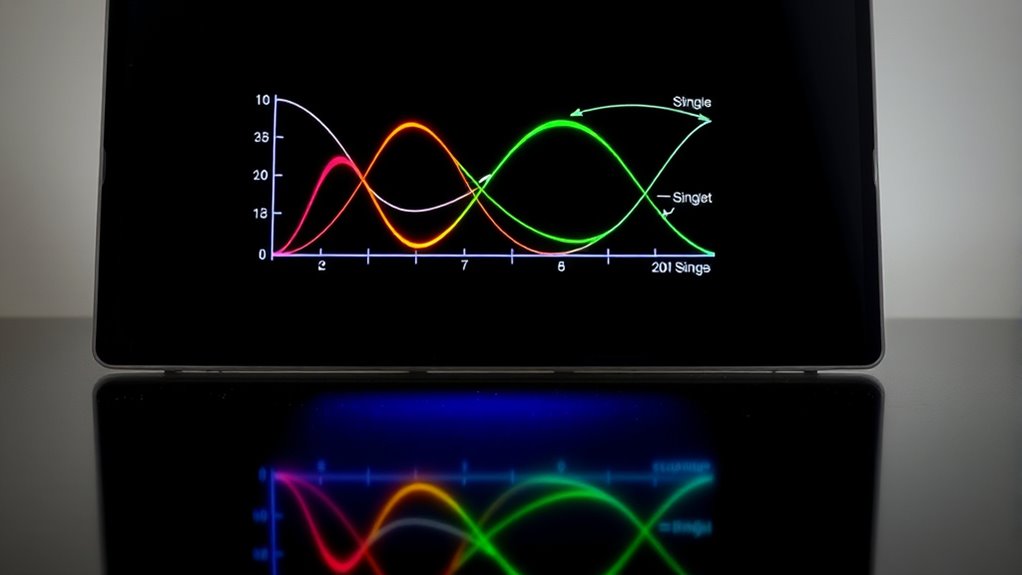

A Jablonski diagram maps out how molecules absorb light and move between energy states. It shows progressions from the ground state to excited singlet states, then back to ground via fluorescence, or to triplet states through intersystem crossing. The diagram also highlights processes like phosphorescence and energy transfer, revealing how excited molecules release light or react. If you keep exploring, you’ll gain a clearer understanding of how these energy pathways influence photochemical behaviors.
Key Takeaways
- Jablonski diagrams visually represent energy states and transitions involved in molecular photochemistry.
- They illustrate absorption, fluorescence, intersystem crossing, and phosphorescence pathways.
- The diagrams show how molecules rapidly transition from ground to excited states upon photon absorption.
- Fluorescence occurs when molecules emit light as they return from excited singlet states to the ground state.
- Energy gaps between states influence emission wavelengths and possible photochemical reactions.
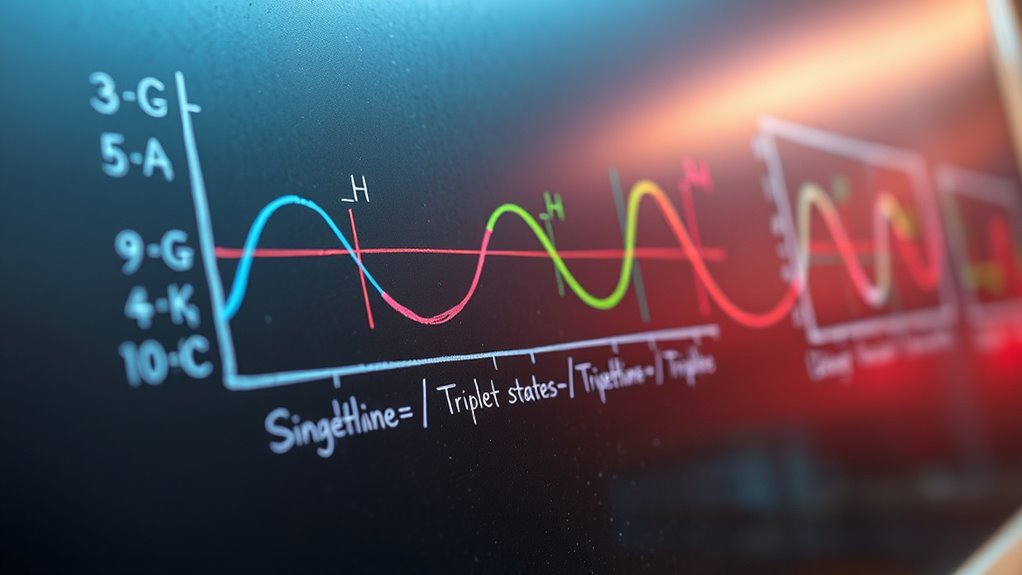
Have you ever wondered how light can trigger chemical reactions? It’s all about the way molecules absorb and respond to photons, which is where the concept of energy states comes into play. When a molecule absorbs a photon, it jumps from a lower energy state, known as the ground state, to a higher energy state, often called an excited state. These energy states are discrete, quantized levels, and each corresponds to specific molecular configurations. Understanding these states is essential because they determine how molecules behave after absorbing light, whether they emit it, undergo a chemical change, or return to their original state.
The Jablonski diagram provides a clear visual of this process. It maps out the various energy states a molecule can occupy and the possible transitions between them. When a molecule absorbs light, it moves from its ground state (S₀) to an excited singlet state (S₁ or higher). This initial excitation is usually very rapid, taking only a few femtoseconds. From there, the molecule can follow multiple pathways. One common route is fluorescence, where the molecule returns to the ground state by emitting a photon. This fluorescence mechanism involves a transition from an excited singlet state back to the ground state, releasing energy as light. The process is usually quick, happening within nanoseconds, and the emitted light often has a longer wavelength than the absorbed light, which is why fluorescence appears shifted or “stretched” compared to the original excitation.
However, not all excited molecules return directly to the ground state through fluorescence. Some undergo a process called intersystem crossing, where the molecule transitions from an excited singlet state to a triplet state—a different kind of excited state with unpaired electrons. From this triplet state, the molecule may emit phosphorescence or undergo chemical reactions. The energy states involved in these transitions are vital because they influence the likelihood and type of emission or reaction. The energy gaps between states determine whether energy is released as light or transferred to other molecules, initiating further chemical changes. Additionally, the color of emitted light is affected by the specific energy transition pathways, which are crucial in designing efficient photochemical systems.
Frequently Asked Questions
How Do Jablonski Diagrams Vary Among Different Molecules?
You’ll notice that Jablonski diagrams vary among molecules because of their molecular differences. These differences affect energy level variations, leading to unique absorption and emission pathways. For example, conjugated molecules often show more complex diagrams due to multiple excited states, while simpler molecules have straightforward energy transitions. By understanding these variations, you can predict how different molecules respond to light, which is essential in designing photochemical applications.
What Role Does Spin-Orbit Coupling Play in Photochemical Processes?
Did you know that spin-orbit coupling affects over 50% of photochemical reactions? It plays a vital role in electronic transitions by enabling otherwise forbidden transitions between states of different spin multiplicities. This coupling mixes singlet and triplet states, increasing the likelihood of intersystem crossing. As a consequence, spin-orbit coupling influences reaction pathways, quantum yields, and the lifetimes of excited states, making it indispensable for understanding photochemical behavior.
Can Jablonski Diagrams Predict Reaction Pathways?
Jablonski diagrams can help predict reaction pathways by illustrating energy transfer and molecular conformations during electronic transitions. They show how molecules absorb and emit light, which influences subsequent reactions. By analyzing the diagram, you can determine potential pathways, including intersystem crossing or fluorescence, based on energy states and conformations. While not definitive, they provide valuable insights into possible reaction routes and the role of excited states in photochemical processes.
How Are Non-Radiative Transitions Represented in Diagrams?
Ever wondered how energy dissipates without light emission? You see, non-radiative shifts are shown in diagrams as wavy arrows or dashed lines, indicating processes like vibrational relaxation and internal conversion. These pathways allow molecules to lose energy as heat or vibrational energy instead of emitting photons. By representing these pathways clearly, the diagram helps you understand how molecules return to lower energy states without radiative emission efficiently.
What Are the Limitations of Jablonski Diagrams in Photochemistry?
You should know that Jablonski diagrams have limitations in photochemistry because they rely on diagrams simplification and energy level approximation. These diagrams don’t account for complex interactions like vibrational coupling or environmental effects, which can influence photophysical processes. As a result, they might oversimplify the actual energy transitions, making it harder to predict precise behaviors in real systems, especially when non-radiative pathways and molecular complexities are involved.
Conclusion
Understanding Jablonski diagrams is like holding a map through the complex landscape of photochemistry. They guide you step-by-step, revealing how molecules absorb and emit light, much like a lighthouse illuminating the dark. By mastering these fundamentals, you can better navigate the exciting world of light-matter interactions, open new insights and innovations. Keep these diagrams in your toolkit—they’re your compass in the vibrant, glowing domain of photochemistry.