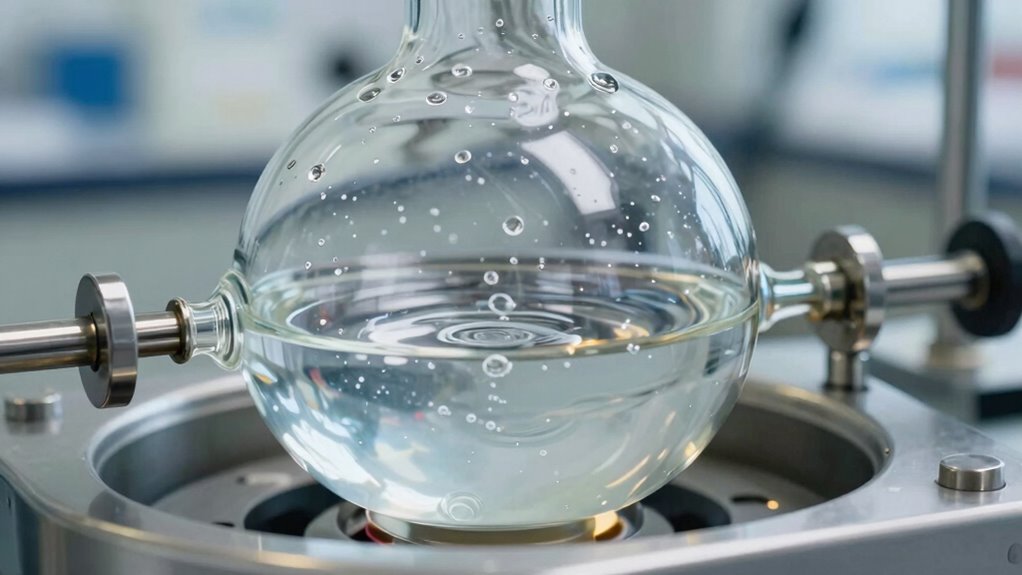

Bumping happens when rapid, violent boiling surges in your rotary evaporator, often caused by uneven heating or sudden temperature increases. To prevent it, you should use gentle heating, control your temperature carefully, and add anti-bumping granules or bump traps to provide nucleation sites. Adjusting vacuum levels properly and maintaining steady rotation also help create a thin, stable film for efficient evaporation. Keep these tips in mind, and you’ll better understand how to minimize bumping and improve your process.
Key Takeaways
- Bumping occurs due to rapid vaporization and violent boiling surges caused by uneven nucleation sites or sudden temperature increases.
- Using anti-bumping granules or bump traps creates nucleation sites, preventing sudden vapor surges and reducing bumping risk.
- Gentle heating and gradual temperature ramp-up maintain controlled boiling, minimizing violent surges and bumping occurrences.
- Proper vacuum level and rotation speed balance ensure efficient evaporation without excessive pressure or turbulence that causes bumping.
- Regular system maintenance, including leak checks and condenser cleaning, promotes stable conditions and reduces bumping potential.
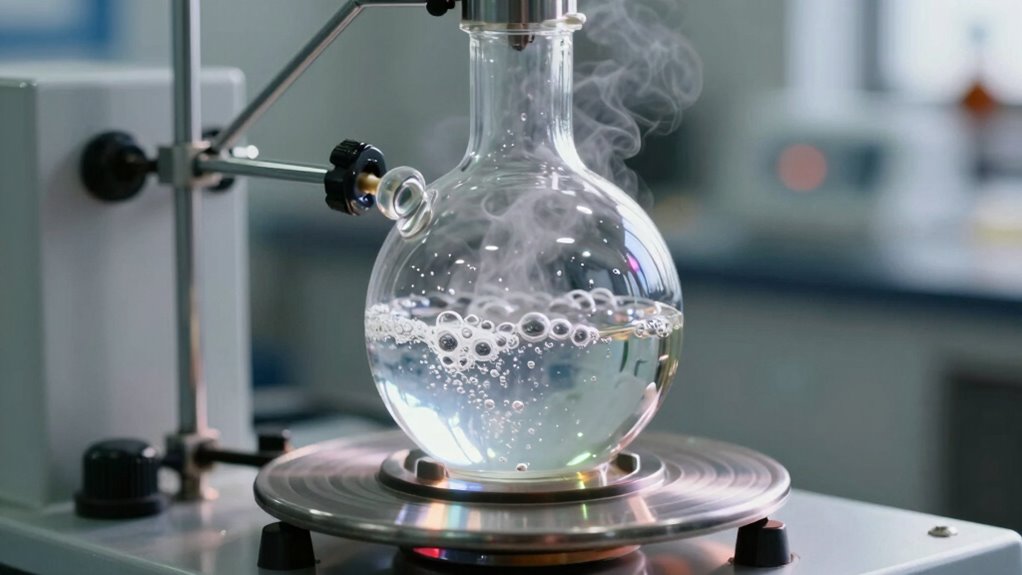
Rotary evaporation is a widely used laboratory technique for efficiently removing solvents from samples, especially when working with heat-sensitive materials. Its primary goal is to maximize solvent recovery while maintaining high evaporation efficiency. When you operate a rotary evaporator, you’re taking advantage of the system’s design to gently and effectively eliminate solvents, minimizing loss and ensuring your sample stays intact. Achieving ideal solvent recovery depends on controlling several factors, including temperature, rotation speed, and vacuum pressure, which all influence evaporation efficiency.
The core physics behind rotary evaporation involves reducing the boiling point of the solvent through vacuum application. As you turn on the system, a rotating flask is heated gently while spinning continuously. This rotation creates a thin film of liquid on the flask’s surface, dramatically increasing the surface area exposed to heat. Because of this, solvents evaporate more rapidly than they would in a static container, making the process more efficient. The vacuum lowers the ambient pressure, which in turn reduces the solvent’s boiling point, allowing you to evaporate it at lower temperatures. This combination of rotation and vacuum ensures you recover as much solvent as possible without exposing your sample to damaging heat.
However, one common issue you might encounter during rotary evaporation is bumping. Bumping occurs when rapid boiling causes the solvent to suddenly and violently surge, potentially splashing into the condenser or damaging the sample. Bumping not only hampers evaporation efficiency but can also lead to loss of solvent and contamination of your system. To prevent bumping, you should start with a gentle heating and gradually increase the temperature. Using a bump trap or anti-bumping granules in the flask can also help by providing nucleation sites, allowing bubbles to form smoothly and preventing sudden surges.
Controlling the rotation speed is equally important; too fast, and it might cause splashing or splattering, reducing evaporation efficiency and risking bumping. Too slow, and the solvent may not form the thin film necessary for rapid evaporation. By fine-tuning these parameters—temperature, vacuum level, and rotation speed—you maximize solvent recovery and evaporation efficiency. Regularly inspecting the system for leaks or blockages, and ensuring the condenser remains clean, also helps maintain consistent performance. Additionally, understanding the physics behind vacuum and temperature control can help optimize your process further.
Frequently Asked Questions
Can Temperature Variations Prevent Bumping During Rotary Evaporation?
Yes, temperature control can prevent bumping during rotary evaporation. By maintaining a consistent temperature, you guarantee solvent stability, which reduces sudden boiling or bumping. Carefully adjusting the temperature to match the solvent’s boiling point helps avoid rapid vaporization. You should monitor and control the temperature settings closely, especially when working with volatile or sensitive solvents, to keep the process smooth and bump-free.
How Does Solvent Viscosity Influence Bumping Risk?
Did you know that solvents with higher viscosity can increase bumping risk by up to 30%? Viscosity effects play a significant role in bumping prevention because thicker solvents tend to boil more unevenly, causing sudden eruptions. To minimize bumping, you should consider selecting solvents with lower viscosity or adjusting the rotation speed to promote smoother evaporation. Properly managing viscosity can make your rotary evaporation safer and more efficient.
Are There Safety Precautions for Handling Bumping Incidents?
You should prioritize labor safety by wearing appropriate protective gear and ensuring your equipment is well-maintained to prevent bumping incidents. In case bumping occurs, stop the rotary evaporator immediately and carefully vent the system to release pressure. Regular equipment maintenance helps identify potential issues early, reducing risks. Always follow safety protocols, stay alert, and have emergency procedures in place to handle bumping effectively and safely.
What Role Does Atmospheric Pressure Play in Bumping?
Atmospheric pressure influences bumping by affecting pressure fluctuations inside your rotary evaporator. When vapor pressure surpasses atmospheric pressure, rapid boiling occurs, leading to bumping. As pressure fluctuates, especially if it drops unexpectedly, it can cause violent eruptions. To minimize bumping, you need to control vapor pressure and maintain consistent atmospheric pressure, often by applying a vacuum. This helps keep boiling smooth and prevents sudden, dangerous eruptions.
Can Specific Solvent Mixtures Reduce Bumping Occurrence?
While no solution is perfect, choosing specific solvent mixtures can help reduce bumping, especially if they enhance solvent compatibility and promote mixture stability. You might consider blending solvents that resist sudden boiling or phase separation, which minimizes the risk of bumping. By carefully selecting and testing these mixtures, you can improve your evaporation process, making it smoother and more controlled, ultimately protecting your sample and equipment.
Conclusion
Understanding the physics behind bumping helps you prevent it during rotary evaporation. While some believe gentle heating alone stops bumping, research shows that controlling vapor pressure and using anti-bumping agents are more effective. By applying these techniques, you guarantee a smoother, safer evaporation process. So, next time you set up your rotary evaporator, remember that mastering the science behind bumping gives you better control and better results—proving that science truly makes a difference.