
To understand how substances dissolve, you need to look at ionic interactions and ligand complexation. Strong ionic bonds hinder dissolving, while weaker or shielded interactions promote it. Ligands can bind to metal ions, forming complexes that often increase solubility by reducing charge or changing polarity. By controlling these interactions, you can influence dissolving behaviors. Keep exploring these principles, and you’ll uncover the key rules behind dissolving substances effectively.
Key Takeaways
- Ligand coordination can increase solubility by shielding ionic charges and altering molecular polarity.
- Strong ionic interactions hinder dissolving; weaker interactions or ligand shielding promote solubility.
- Complex formation modifies ionic interactions, often enhancing solubility and stability of ions in solution.
- Chelating agents like EDTA bind metal ions, preventing precipitation and increasing solubility.
- Understanding ionic forces and ligand effects enables control over dissolving, precipitation, and complex stability.
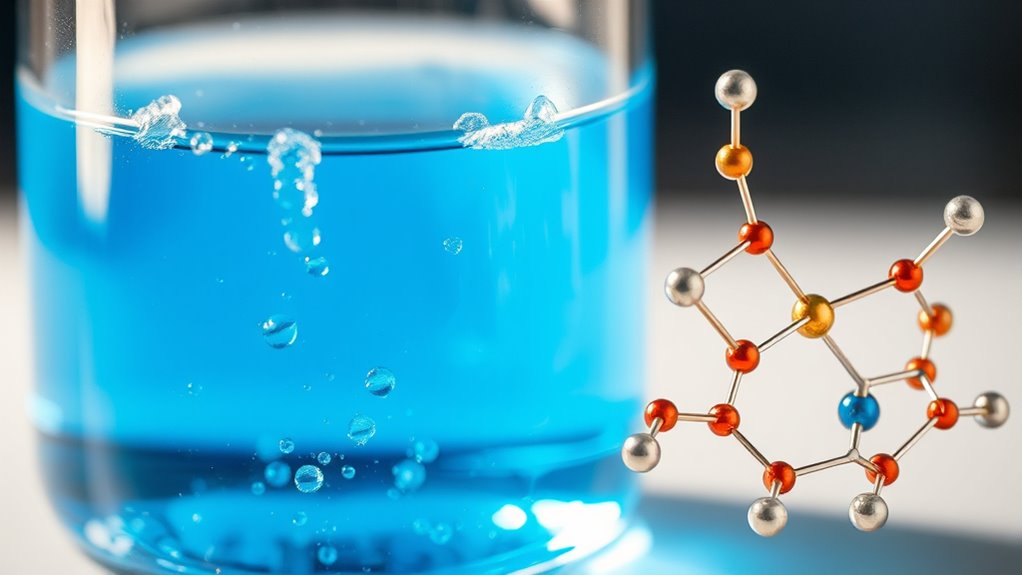
Solubility and complexation are fundamental concepts in chemistry that greatly influence how substances interact in solutions. When you dissolve a compound, you’re essentially breaking it apart and dispersing its particles throughout the solvent. This process depends heavily on the nature of ionic interactions—forces between charged particles—and how well these particles can be stabilized or destabilized by the surrounding molecules. In many cases, solubility hinges on the balance of these ionic interactions; if they’re strong and the solvent can’t effectively shield the charges, the compound won’t dissolve easily. Conversely, if the ionic interactions are weak or the solvent can coordinate with the ions, dissolution becomes more favorable.
Ligand coordination plays a pivotal role in complexation, which involves forming stable associations between metal ions and molecules called ligands. These ligands are typically Lewis bases that donate electron pairs to the metal, creating a coordinate covalent bond. When you introduce ligands into a solution containing metal ions, they can bind to the metal center, forming complexes that often have different solubility properties than the free ions. For example, a metal ion that’s barely soluble on its own can become highly soluble once complexed with suitable ligands. This is because ligand coordination can effectively shield the metal ion’s charge or alter the overall polarity of the complex, making it more compatible with the solvent.
Understanding how ionic interactions influence solubility helps you predict whether a substance will dissolve or precipitate, especially when dealing with salts and ionic compounds. The strength of these interactions determines whether the ions remain bound together or separate into free ions that disperse evenly in solution. When complexes form through ligand coordination, they often modify the solution’s chemistry, impacting solubility, reactivity, and stability. For instance, chelating agents like EDTA bind strongly to metal ions, increasing their solubility and preventing unwanted precipitation. Additionally, the design of solubility-enhancing complexes is a key factor in many pharmaceutical and industrial applications.
In practical terms, controlling ionic interactions and ligand coordination allows you to manipulate solubility for various applications. Whether you’re designing drugs that need to dissolve efficiently, preparing solutions for industrial processes, or understanding environmental chemistry, these principles help you predict and influence how substances behave in solution. By recognizing the role of ionic interactions in stability and how ligand coordination can alter solubility, you gain deeper insight into the rules governing dissolving and complex formation—fundamental tools in the chemist’s toolkit.
Frequently Asked Questions
How Does Temperature Influence Solubility and Complex Formation?
Temperature effects directly influence solubility and complex stability. As temperature rises, you’ll notice that many substances become more soluble because increased heat provides energy to break intermolecular forces. However, for some complexes, higher temperatures can destabilize them, reducing their stability. So, you need to contemplate how temperature impacts both solubility and complex stability to predict or control dissolving processes effectively.
Can Complexation Increase the Solubility of Poorly Soluble Compounds?
Sure, complexation enhancement can turn a stubbornly insoluble compound into a soluble superstar. By forming complexes, you can regulate solubility, making the unmixable, mixable. This trick is like giving your compound a VIP pass to dissolve more easily. So, yes, complexation can boost solubility, transforming a poor performer into a soluble champion, all thanks to the clever rules of solubility regulation behind the scenes.
What Role Do Ionic Strength and Ph Play in Solubility?
Ionic strength effects can either increase or decrease solubility depending on the compound, as higher ionic strength often stabilizes ions in solution. pH influence is essential; it affects the ionization state of compounds, making them more or less soluble. You should consider both factors when predicting or controlling solubility, because adjusting ionic strength or pH can optimize dissolution rates or stability of your solution.
Are There Practical Applications for Controlling Complexation in Industry?
You can regulate complexation in industry for practical uses like pharmaceutical formulations, where it helps improve drug solubility and stability, and in environmental remediation, where it aids in removing contaminants. By adjusting factors like pH or adding specific ligands, you influence how complexes form and dissolve. This control enhances the effectiveness of treatments, ensures safety, and optimizes product performance in both pharmaceuticals and environmental cleanup efforts.
How Do Solvent Properties Affect Solubility and Complex Stability?
Imagine trying to dissolve sugar in cold water versus hot water; hotter water helps dissolve more quickly. Solvent properties like polarity and dielectric constant directly influence solubility and complex stability. A highly polar solvent with a high dielectric constant stabilizes charged species, boosting solubility and complex formation. Conversely, less polar solvents weaken interactions, making complexes less stable. Your choice of solvent shapes the success of dissolving and complexation processes in industry.
Conclusion
By understanding the subtle dance between solubility and complexation, you gain a secret key to *discovering* many chemical mysteries. While the rules may seem delicate, mastering them can open doors to new discoveries and innovations. Embrace these insights gently, and you’ll find yourself *steering* the world of chemistry with confidence and curiosity. After all, sometimes the most intriguing answers lie just beyond the surface, waiting for you to *reveal* them with a curious mind.