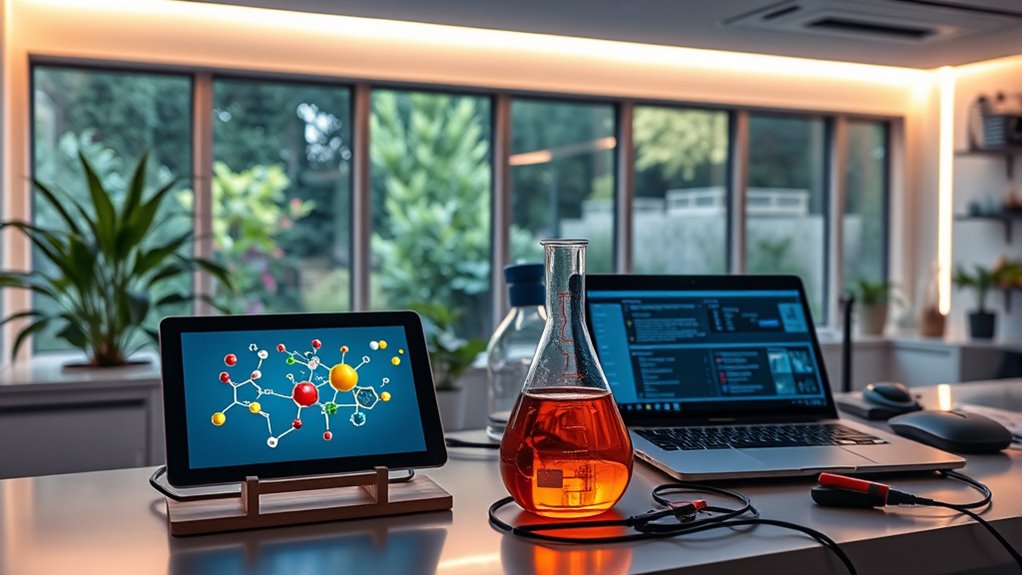

Yes, you can definitely do chemistry online through remote labs. These virtual platforms simulate real-world equipment and reactions, allowing you to perform experiments safely from any location. Interactive safety protocols and realistic tools help you develop skills and understanding just like in a physical lab. As technology advances, remote labs are becoming more effective and accessible, opening new possibilities in science education. If you’re curious about how this works, keep exploring to see what’s possible.
Key Takeaways
- Remote labs enable students to perform hands-on chemistry experiments virtually, enhancing accessibility and safety.
- Virtual simulations replicate real equipment, allowing measurement, mixing, and observation without physical risks.
- Interactive safety protocols promote responsible handling and safety awareness in an online environment.
- Repeated digital experiments improve practical skills and understanding, bridging theory and practice effectively.
- Technology-driven remote labs demonstrate that meaningful, safe, and engaging chemistry education is possible online.
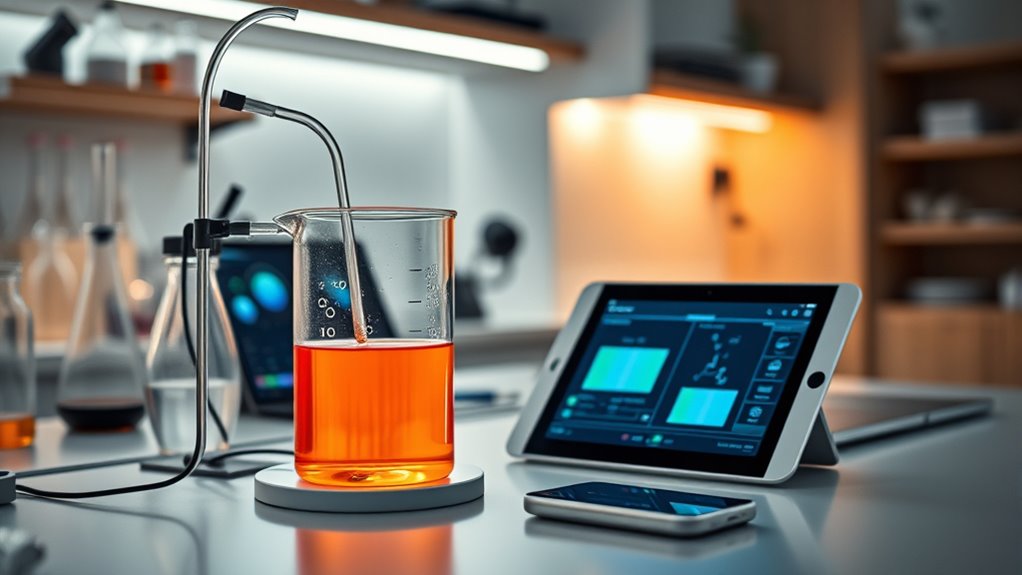
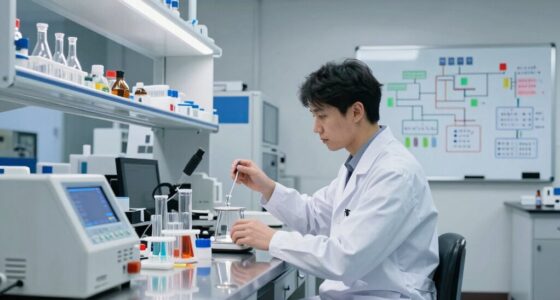
Remote labs for chemistry have transformed how students access and perform experiments, making hands-on learning possible from anywhere. With the rise of online education, you no longer need to be physically present in a lab to gain practical experience. Instead, virtual safety protocols guarantee you can explore chemical reactions without risking harm, giving you confidence while handling complex experiments.
Remote chemistry labs enable safe, hands-on experiments from anywhere, building confidence without physical presence.
These platforms incorporate equipment simulation, which allows you to interact with virtual lab tools that mimic real-world devices. You can measure, mix, and observe reactions as if you were in a traditional lab, but without the hazards or limitations of physical space.
When working with virtual safety features, you’re guided through proper procedures and safety measures, enhancing your understanding of lab protocols. These simulations often include interactive prompts and warnings that remind you to wear safety gear or handle substances carefully. This focus on virtual safety helps you learn to prioritize safety without the actual risks involved in working with chemicals. It’s like having a digital safety net that prepares you for real-world lab work, instilling good habits before you ever handle actual chemicals.
Equipment simulation adds another layer of realism to your online experiments. You can manipulate virtual burettes, pipettes, and microscopes with precision, gaining familiarity with their functions. This hands-on digital experience translates well to physical labs, as you develop skills in measurement, titration, and observation.
The simulations are designed to be intuitive, allowing you to experiment freely and make mistakes without wasting resources or risking accidents. You can repeat experiments multiple times, refine your technique, and deepen your understanding of chemical processes—all from your computer or tablet.
Moreover, these virtual labs often include detailed feedback and analytics that help you identify errors and improve your techniques. You’re encouraged to troubleshoot and think critically about your results, fostering a deeper grasp of chemistry concepts. This kind of experiential learning promotes engagement and retention, making remote labs more than just a visual aid.
It’s an interactive environment where you can practice real lab skills safely and efficiently. In essence, virtual safety measures and equipment simulation are at the core of the remote lab experience, bridging the gap between theory and practice. They enable you to perform complex experiments with confidence, safety, and precision—all from a remote location.
This innovative approach not only democratizes access to chemistry education but also prepares you for real-world laboratory work, where safety and accuracy are paramount. The rise of remote labs proves that you can indeed do meaningful, hands-on chemistry online—it’s just a matter of leveraging the right tools and technology. Understanding safety protocols enhances your preparedness and ensures responsible experimentation in both virtual and physical environments.
Frequently Asked Questions
How Accurate Are Remote Chemistry Experiments Compared to Traditional Labs?
You might wonder how accurate remote chemistry experiments are compared to traditional labs. While virtual data can be precise, experiment reliability often depends on the quality of simulations and digital tools used.
Remote experiments can provide valuable insights, but they may not fully replicate hands-on results. You should consider these factors to assess their accuracy, recognizing that they offer a practical alternative, especially when physical lab access is limited.
What Safety Measures Are in Place During Virtual Chemistry Experiments?
Think of virtual chemistry experiments as a well-guarded fortress. You follow strict laboratory protocols and undergo safety training, just like soldiers preparing for battle. These measures make certain your safety by guiding you through procedures carefully, preventing accidents even in a digital environment.
Safety measures include detailed instructions, real-time monitoring, and secure platforms, all designed to keep you safe while exploring chemistry’s wonders remotely, like a protected explorer venturing into new worlds.
Can Remote Labs Replace Hands-On Experience for Chemistry Certifications?
You might wonder if remote labs can fully replace hands-on skills for chemistry certifications. While virtual labs offer valuable simulations, they’ve limitations like missing tactile experiences and real-time troubleshooting.
Hands-on skills develop through physical interaction with equipment, which virtual environments can’t fully replicate. So, for thorough certification, combining virtual experiments with in-person practice ensures you gain the necessary practical understanding and confidence.
How Interactive Are the Remote Chemistry Simulations for Students?
Think of remote chemistry simulations as a lively kitchen where you’re the chef. They offer impressive virtual engagement, making complex experiments feel real.
The simulation realism has improved greatly, allowing you to manipulate virtual chemicals with confidence. While not identical to hands-on work, these interactive tools keep you actively involved, helping you grasp key concepts and develop skills.
In an engaging, dynamic environment that sparks curiosity and learning.
Are Remote Chemistry Labs Suitable for Advanced Research Projects?
Remote chemistry labs aren’t suitable for advanced research projects due to virtual lab limitations. You can’t fully replicate complex experiments or nuanced observations online.
While remote labs facilitate research collaboration across locations, they lack the hands-on control and precision needed for cutting-edge work.
For your advanced projects, in-person lab access remains essential, ensuring accuracy and thorough analysis that virtual environments just can’t provide.
Conclusion
As you explore remote labs, remember they’re like bridges connecting you to the world of chemistry without leaving your home. While they may not replace hands-on experience entirely, they open new doors for learning and experimentation. Embrace this digital frontier as an exciting pathway, not just a shortcut. With the right mindset, remote labs become a launchpad, propelling you into the fascinating universe of chemistry, one virtual experiment at a time.