To choose the right spectroscopy course, focus on programs that align with your career goals and offer practical, hands-on experience. Make sure they cover techniques relevant to your industry, like UV-Vis, IR, or NMR, and are taught by instructors with real-world expertise. Look for accredited courses with positive student feedback and modern instrumentation. When you know what’s most valuable for your future, you’ll find the perfect match that boosts your skills and confidence—keep exploring to learn more.
Key Takeaways
- Align course selection with your career goals and industry interests for targeted skill development.
- Prioritize courses covering techniques most relevant to your desired field, like IR, NMR, or mass spectrometry.
- Choose programs led by experienced instructors with practical, real-world research backgrounds.
- Ensure courses include hands-on laboratory work and case studies to build technical competence.
- Verify accreditation and review student feedback to assess course credibility and effectiveness.

Selecting the right spectroscopy course can considerably impact your understanding and skills in this essential analytical field. As you evaluate options, consider how the course’s focus aligns with your goals, whether you’re aiming to strengthen your laboratory techniques or explore specific career pathways.
Choosing the right spectroscopy course shapes your skills and future career opportunities in analytical science.
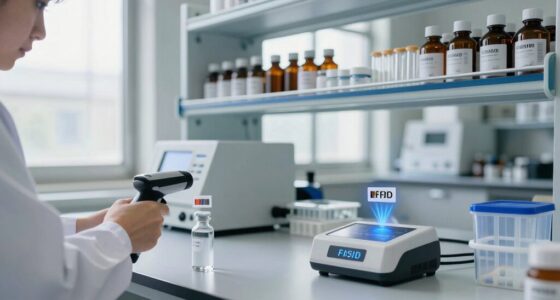
A well-chosen course offers hands-on experience that builds confidence in operating complex instruments, interpreting data accurately, and troubleshooting common issues. These practical skills are vital not only for academic success but also for making a strong impression in professional settings. When selecting a course, look for programs that emphasize real-world applications and provide ample laboratory time, as these experiences solidify your theoretical knowledge and improve your technical competence.
Your choice of course can also have significant career implications. Different spectroscopic techniques—such as UV-Vis, IR, NMR, and mass spectrometry—are valued across various industries like pharmaceuticals, environmental science, food safety, and materials development.
Picking a course that covers the techniques most relevant to your desired industry will give you a competitive edge. For example, if you’re interested in pharmaceuticals, a course focusing on NMR and mass spectrometry might be more advantageous. On the other hand, if environmental analysis intrigues you, courses emphasizing IR and UV-Vis spectroscopy could be more beneficial.
By tailoring your coursework to industry demands, you’ll enhance your employability and position yourself as a valuable candidate for future employers. Additionally, understanding the analysis techniques in depth can help you better interpret complex data sets and improve your overall research capabilities.
Another crucial factor to consider is the instructor’s expertise and the course structure. Look for programs led by instructors with practical experience and active research backgrounds, as they can provide insights beyond textbook theory.
Additionally, courses that include project work or case studies allow you to apply what you learn in realistic scenarios, reinforcing your laboratory techniques and analytical thinking. Understanding the importance of contrast ratio and the impact it has on image quality can help you choose equipment that produces the best visual results. Flexibility in scheduling and access to modern instrumentation also matter—these features ensure you gain relevant, up-to-date skills that will serve you well in your career.
Finally, don’t underestimate the importance of accreditation and reviews. A reputable course backed by recognized institutions or professional organizations can add credibility to your resume.
Reading feedback from former students can help you gauge the course’s effectiveness and whether it meets your learning needs. Remember, choosing the right spectroscopy course isn’t just about acquiring technical skills; it’s about strategically positioning yourself for future opportunities and advancing your career in this dynamic, technology-driven field.
Frequently Asked Questions
What Are the Prerequisites for Advanced Spectroscopy Courses?
To take advanced spectroscopy courses, you need a solid foundation in basic concepts like atomic and molecular structures.
You should also develop strong technical skills in data analysis and instrumentation operation.
Familiarity with principles such as UV-Vis, IR, and NMR spectroscopy will help you succeed.
These prerequisites guarantee you’re prepared to grasp complex techniques and interpret sophisticated data, making your learning experience more effective and rewarding.
How Do Online Spectroscopy Courses Compare to In-Person Classes?
Online spectroscopy courses often offer flexibility, but they differ from in-person classes in key ways. You might enjoy virtual labs that let you practice techniques remotely, but you could miss out on face-to-face instructor interaction, which can be vital for complex concepts.
While online courses suit self-paced learners, in-person classes provide real-time feedback and hands-on experience, making them ideal for those wanting more direct engagement.
Are There Scholarships Available for Spectroscopy Training Programs?
You can find scholarships for spectroscopy training programs by exploring various funding opportunities. Many institutions and organizations offer scholarship applications specifically for students pursuing spectroscopy courses.
Be proactive by researching these options early, preparing your application materials thoroughly, and demonstrating your passion and commitment.
Securing scholarships can reduce costs and help you access quality education, so don’t hesitate to reach out to program coordinators or visit scholarship websites for detailed information.
What Career Opportunities Require Spectroscopy Expertise?
Spectroscopy expertise opens doors to diverse career opportunities across various industry applications, including pharmaceuticals, environmental monitoring, food safety, and petrochemicals.
Your skill development in spectroscopy allows you to work in research, quality control, and product development, making you valuable to employers.
How Can I Assess the Quality of a Spectroscopy Course?
You can assess a spectroscopy course by examining its accreditation, instructor credentials, and curriculum quality. Look for recognized accrediting bodies that guarantee standards are met, and verify that instructors have relevant expertise and experience.
Evaluate whether the course offers practical training, up-to-date content, and clear learning outcomes. By comparing these elements, you ensure the course’s quality, relevance, and your preparedness to apply spectroscopy skills confidently.
Conclusion
Think of selecting a spectroscopy course as charting your own voyage across uncharted waters. Each course is a vessel, guiding you through the depths of molecular mysteries. Choose wisely, armed with curiosity and clarity, so your journey becomes a voyage of discovery rather than a stormy drift. With the right course as your compass, you’ll navigate the intricate seas of spectroscopy and reach the shores of knowledge with confidence and purpose.