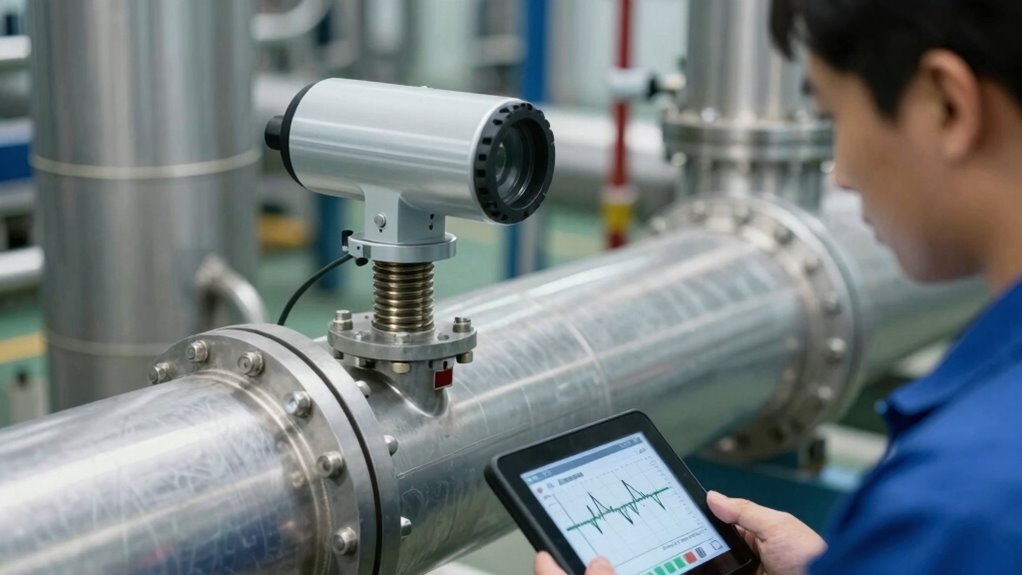

Vibration analysis helps you monitor the health of rotating equipment in chemical plants by detecting early signs of problems like imbalance or worn bearings. You’ll use sensors to collect vibration data, then analyze the spectra for unusual patterns or spikes. Regularly comparing this data to baseline readings helps you spot issues before they become costly or unsafe. Keep learning, and you’ll gain the skills to improve machinery reliability and plant safety efficiently.
Key Takeaways
- Learn to interpret basic vibration spectra and identify common fault signatures like imbalance and bearing faults.
- Ensure proper placement and calibration of sensors for accurate vibration data collection.
- Establish baseline vibration patterns during normal operation to detect deviations early.
- Focus on recognizing early signs of abnormalities to prevent equipment failure and downtime.
- Use diagnostic tools and continuous monitoring to improve fault detection and maintenance planning.

Have you ever wondered how chemical plants guarantee their machinery runs smoothly and safely? The answer often lies in vibration analysis, a essential technique used to monitor the health of rotating equipment. In these environments, rotating equipment includes pumps, turbines, compressors, and motors—components that keep the plant operational. When these machines develop faults, it can lead to costly downtime, safety hazards, or even environmental incidents. That’s why fault detection through vibration analysis becomes vital; it allows you to catch issues early before they escalate into serious problems.
Vibration analysis involves measuring the oscillations produced by machinery during operation. Every piece of rotating equipment has a unique vibration signature, and by analyzing these signals, you can identify abnormalities. For beginners, understanding what normal vibration looks like is key, as deviations often indicate issues like imbalance, misalignment, bearing faults, or looseness. The process starts with installing sensors—typically accelerometers—on strategic points of the equipment. These sensors pick up vibrations and send data to a monitor or computer for analysis. Additionally, proper sensor placement and calibration are essential for obtaining accurate data.
Measuring vibrations helps identify abnormalities like imbalance, misalignment, and bearing faults early.
Once the data is collected, the real work begins. You examine vibration spectra, which display how much energy is associated with different frequencies. Certain fault types produce characteristic signatures; for example, a bearing defect might show up as a spike at a specific frequency, while imbalance often manifests as increased amplitude at the rotational frequency. By recognizing these patterns, you can diagnose problems early and plan maintenance accordingly, reducing unplanned outages and extending equipment life. Additionally, understanding the vibration signatures helps in identifying the root causes of faults more accurately. Developing a solid foundation in vibration analysis techniques is essential for effective fault detection.
Regular monitoring and baseline readings are crucial for comparing current data against normal operating conditions, enabling more precise fault diagnosis. Vibration analysis isn’t a one-time task—it’s an ongoing process that helps maintain ideal operation. Regular monitoring allows you to establish baseline readings and track changes over time. If you notice a sudden increase in vibration levels or the emergence of abnormal frequencies, that’s a clear sign you need to investigate further. Fault detection becomes more straightforward as you gain experience, enabling you to prioritize repairs and avoid catastrophic failures. Additionally, understanding the root cause of vibration issues helps in implementing corrective measures, whether it’s balancing the rotor, realigning shafts, or replacing worn bearings. Incorporating advanced diagnostic tools can further enhance the accuracy of fault detection and troubleshooting.
For someone new to the field, the key is to start simple: learn to interpret basic vibration spectra, understand the typical fault signatures, and get comfortable with sensor placement. As you gain experience, you’ll develop a sharper eye for subtle signs that indicate trouble. Over time, vibration analysis becomes an invaluable tool, empowering you to keep the plant running efficiently, safely, and reliably by proactively identifying and addressing issues in rotating equipment through effective fault detection.
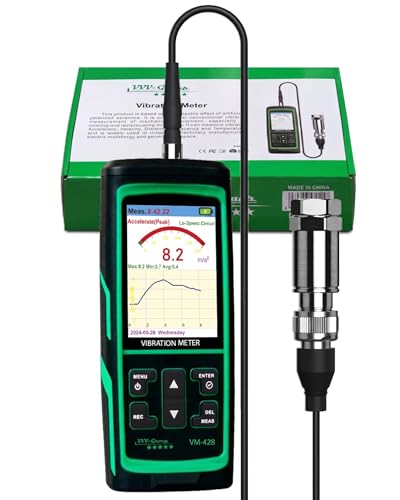
Industrial Vibration Analyzer – VM-428 with External Sensor & PC Software, Acceleration 0.1–300 m/s², Velocity 1–850 mm/s, Displacement 1–3300 µm, 30Hz–14kHz, ISO Machine Rating
- Professional Vibration Analyzer: Includes external sensor for diagnostics
- Multi-Parameter Diagnostics: Measures acceleration, velocity, displacement, frequency, temperature
- Dual Frequency Measurement: Supports structural and high-frequency vibration analysis
As an affiliate, we earn on qualifying purchases.
As an affiliate, we earn on qualifying purchases.
Frequently Asked Questions
How Often Should Vibration Analysis Be Performed in Chemical Plants?
You should perform vibration analysis regularly, typically every three to six months, depending on equipment criticality and operating conditions. Make sure equipment calibration is up to date for accurate readings. Incorporate data logging during each analysis to track trends over time. Frequent checks help identify early signs of faults, allowing you to schedule maintenance proactively and prevent costly failures, keeping your chemical plant running smoothly and safely.
What Are Common Signs of Equipment Failure Detected by Vibration Analysis?
You’ll notice signs of equipment failure through vibration analysis, such as increased vibration amplitudes indicating machinery imbalance or abnormal frequency patterns suggesting equipment wear. You might also observe unusual noise or heat, which point to these issues. By monitoring these signs regularly, you can detect early problems, prevent costly breakdowns, and plan maintenance effectively, ensuring your chemical plant runs smoothly and safely.
Can Vibration Analysis Predict Potential Safety Hazards?
Yes, vibration analysis can predict potential safety hazards by identifying abnormal equipment behavior early. By integrating vibration data into your safety protocols and equipment monitoring routines, you can spot issues like imbalances or misalignments before they escalate. This proactive approach helps prevent accidents, reduces downtime, and guarantees a safer working environment. Regular vibration assessments are essential for maintaining equipment integrity and safeguarding your team.
What Training Is Required to Interpret Vibration Data Accurately?
To interpret vibration data accurately, you need proper training in sensor calibration and data interpretation techniques. You should learn how to calibrate sensors correctly to guarantee precise readings. Additionally, understanding vibration signatures and their implications helps you analyze data effectively. Hands-on experience, combined with coursework on machinery behavior and diagnostic methods, will boost your skills in making accurate assessments and preventing potential equipment failures in chemical plants.
How Does Temperature Affect Vibration Analysis Results?
You might be surprised how temperature influences your vibration analysis results. As thermal expansion occurs, machinery components shift, altering vibration patterns and potentially masking issues. Higher temperatures can also increase vibration damping, reducing the sensitivity of measurements. If you don’t account for these effects, you risk misinterpreting data, overlooking early signs of failure. Always consider temperature’s impact to guarantee your analysis remains accurate and reliable under varying thermal conditions.
Conclusion
As you step into the world of vibration analysis, imagine yourself as a detective, tuning into the subtle whispers of machinery behind the scenes. With each vibration reading, you’re uncovering clues that keep the plant running smoothly, like a conductor guiding an orchestra. Embrace this journey, and soon you’ll see the machinery dance in harmony, preventing breakdowns and ensuring safety. Your keen ears and watchful eye are the keys to a resilient, thriving chemical plant.