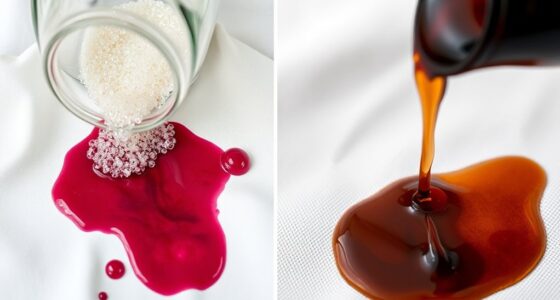

The chemistry of coffee roasting involves heating green beans, which triggers reactions like the Maillard reaction and caramelization. These processes create the rich aromas and flavors you love, by transforming sugars and amino acids into complex compounds. Temperature and time control are key to balancing these reactions, influencing whether your coffee develops bright acidity or deep, smoky notes. To understand how these reactions craft each unique cup, keep exploring how precise roasting shapes flavor profiles.
Key Takeaways
- Coffee roasting induces chemical reactions like Maillard and caramelization, which develop aroma and flavor compounds.
- The Maillard reaction occurs between 150°C and 180°C, producing brown pigments and initial aromatic complexity.
- Caramelization begins above 180°C, creating deep caramel notes and enhancing aroma depth.
- Temperature and time control are vital to balance reactions, influencing aroma profiles from bright to smoky.
- Hundreds of volatile compounds form during roasting, shaping the coffee’s distinctive scent and flavor characteristics.
Coffee roasting is a complex chemical process that transforms green beans into the aromatic, flavorful beans we enjoy. During roasting, heat triggers a series of chemical reactions that develop the beans’ rich aroma and taste. Two key processes involved are the Maillard reaction and caramelization processes, both essential for creating the complex flavor profile of roasted coffee.
As you roast, the Maillard reaction kicks in early on, usually between 300°F and 355°F (150°C to 180°C). This reaction occurs when amino acids and reducing sugars in the beans interact under heat, producing a variety of new compounds. These compounds are responsible for much of the coffee’s brown color and its initial aroma. The Maillard reaction is pivotal because it not only adds depth to the flavor but also forms melanoidins, which contribute to the body and mouthfeel of the brewed coffee. This process is highly sensitive to temperature and time—if you roast too quickly or at too high a temperature, you risk burning these delicate compounds, resulting in a bitter taste.
As the temperature rises further, caramelization processes come into play, typically above 355°F (180°C). During caramelization, sugars within the beans break down and undergo a series of complex reactions, creating new aromatic compounds and deepening the color of the beans. This process is responsible for the sweet, caramel-like notes that develop in darker roasts. You can think of caramelization as the same process that gives caramel candies their rich flavor, but happening inside the coffee beans. It’s a delicate balance—over-roasting can lead to burnt flavors, while under-roasting leaves the beans underdeveloped and flat in aroma.
Throughout roasting, these reactions are interconnected, shaping the final aroma and flavor profile. The Maillard reaction and caramelization processes generate hundreds of volatile compounds, each contributing to the coffee’s complex scent—notes of nuts, chocolate, fruit, or spice. The timing and temperature control during roasting are paramount because they determine which reactions dominate, influencing whether your coffee tastes bright and acidic or deep and smoky. Controlling temperature and time is crucial for achieving the desired flavor profile, underscoring the importance of precision in roasting.
Frequently Asked Questions
How Does Altitude Affect Coffee Roasting Chemistry?
Altitude effects profoundly influence roasting chemistry because higher elevations have lower boiling points and cooler temperatures. You’ll notice that beans from higher altitudes develop differently during roasting, often requiring adjustments in time and temperature. This means the roasting chemistry changes, affecting flavor development and aroma. By understanding altitude effects, you can fine-tune your roasting process to optimize the beans’ natural qualities and achieve the desired flavor profile.
What Role Do Minerals Play in Aroma Development?
Minerals play a vital role in aroma modulation during coffee processing. They influence the chemical reactions that develop aroma compounds, enhancing or suppressing certain notes. Your water’s mineral content, like calcium and magnesium, can affect extraction and flavor development, ultimately shaping the coffee’s aroma profile. By adjusting mineral levels, you can modulate aroma intensity and complexity, allowing you to fine-tune your coffee’s sensory experience for a richer, more nuanced cup.
Can Roasting Temperature Influence Caffeine Levels?
Roasting temperature directly influences caffeine levels in your coffee. As you increase the temperature, caffeine undergoes degradation, which slightly reduces its content. While caffeine is relatively stable compared to other compounds, higher roasting temps can cause some loss. So, if you prefer a caffeine boost, lighter roasts with lower roasting temperatures retain more caffeine, whereas darker roasts with higher temperatures may have marginally less.
How Do Different Bean Varieties Impact Chemical Reactions?
Different bean varieties, influenced by bean genetics, profoundly impact chemical reactions during roasting. You’ll notice that unique genetic traits lead to distinct flavor profiles and chemical compositions. For example, Arabica beans often develop sweeter, more complex flavors, while Robusta beans produce stronger, more bitter notes. These variations affect how chemical reactions like Maillard reactions and caramelization occur, ultimately shaping the aroma and taste you experience in your brewed coffee.
What Is the Impact of Aging on Roasted Coffee Chemistry?
Aging affects roasted coffee chemistry by causing chemical aging, which can alter flavor stability over time. As coffee ages, volatile compounds break down, leading to diminished freshness and aroma. You might notice a flat or dull taste as the chemical reactions change, reducing the vibrant flavors you once enjoyed. To preserve flavor stability, it’s best to store coffee in airtight containers and consume it within a few weeks of roasting.
Conclusion
As you finish roasting your coffee, remember that its aroma is like a symphony of complex notes, each representing chemical changes you’ve guided. Just as a painter’s brush strokes create a masterpiece, your roasting decisions develop flavors and scents that delight the senses. Embrace the process, knowing that every crack and color shift shapes the final brew. With patience and care, you uncover coffee’s rich story—like turning raw ingredients into a fragrant, unforgettable experience.