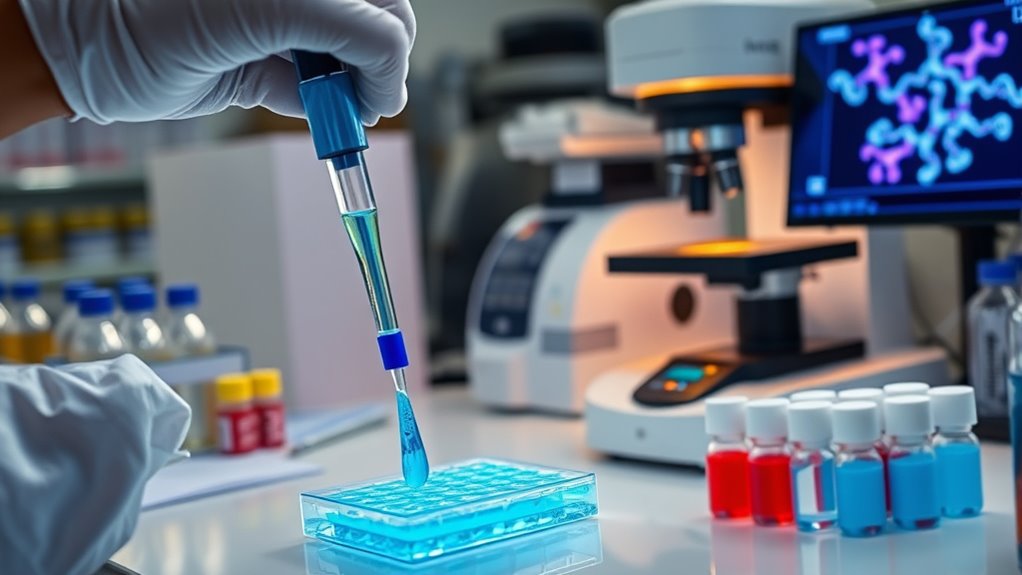

To make diagnostic antibodies, scientists immunize animals with the target antigen, then harvest B cells that produce the desired antibodies. They fuse these cells with myeloma cells to create hybridomas that can produce consistent, monoclonal antibodies. These antibodies are then mapped to identify their exact binding sites, guaranteeing high specificity. They undergo rigorous validation, testing across different conditions and samples to confirm accuracy and reliability. Keep exploring to learn how this process ensures diagnostic precision and effectiveness.
Key Takeaways
- Monoclonal antibodies are produced by immunizing animals, fusing B cells with myeloma cells, and selecting clones that produce desired antibodies.
- Epitope mapping identifies the exact binding site, ensuring high specificity and reducing cross-reactivity.
- Validation involves testing antibodies across various assays and against related antigens to confirm sensitivity and specificity.
- Consistency is maintained through monoclonal production, rigorous validation, and batch testing to ensure reliable diagnostic performance.
- Properly developed and validated diagnostic antibodies enable accurate, early disease detection, improving patient outcomes.

Diagnostic antibodies are indispensable tools in modern medicine, enabling precise detection of diseases and pathogens. Their production involves a series of meticulous steps to guarantee specificity, consistency, and reliability. One of the most common methods is monoclonal production, where a single clone of immune cells is used to generate antibodies that target a specific epitope on an antigen. This process begins by immunizing an animal, typically a mouse, with the target antigen. After the animal’s immune system responds, B cells producing the desired antibody are harvested. These B cells are then fused with myeloma cells, creating hybridomas that can be cultured indefinitely. This fusion ensures a continuous supply of identical, or monoclonal, antibodies, which are crucial for diagnostic accuracy. Monoclonal production guarantees high specificity because all antibodies derived from a single clone recognize the same epitope.
To refine the precision of these antibodies further, epitope mapping plays a fundamental role. Epitope mapping involves identifying the exact part of the antigen that the antibody binds to. This step is essential because it helps confirm that the antibody recognizes a unique and relevant site on the target, reducing cross-reactivity and false positives. Techniques such as peptide arrays, alanine scanning, or structural analysis are used to pinpoint these binding sites. Once the epitope is mapped, scientists can optimize the antibody’s design or select the most appropriate antibody for diagnostic purposes. This process guarantees that the antibody not only binds specifically but also that it performs consistently across different batches and detection platforms. Additionally, understanding antibody-antigen interactions can help improve the development process by enhancing binding affinity and specificity.
Validation is the final critical phase, where the antibody’s performance is rigorously tested. You evaluate its sensitivity, specificity, reproducibility, and stability under various conditions. Validation involves testing the antibody against a panel of related and unrelated antigens to confirm that it only recognizes its intended target. You also assess its performance in different assay formats, such as ELISA, immunohistochemistry, or lateral flow tests. This thorough validation guarantees that the antibody will deliver reliable results in real-world diagnostic scenarios. By combining monoclonal production with precise epitope mapping and rigorous validation, you can develop diagnostic antibodies that are both highly specific and consistent. This meticulous process guarantees that healthcare professionals can rely on these tools to accurately detect diseases, leading to earlier diagnoses and better patient outcomes.
Frequently Asked Questions
What Are the Latest Technological Advances in Antibody Production?
You should know that recent advances in antibody production include improved monoclonal techniques and recombinant methods. These innovations enable you to generate highly specific antibodies more efficiently and with greater consistency. Recombinant technology allows for faster development and customization, reducing reliance on traditional hybridoma methods. As a result, you benefit from increased precision, scalability, and reduced costs, making diagnostic antibodies more accessible and reliable for various medical applications.
How Do Regulatory Standards Vary Globally for Diagnostic Antibodies?
Imagine steering a vast, shifting sea of regulations—that’s what you face with diagnostic antibodies. Regulatory standards vary globally, like different islands with unique rules. You need to meet specific requirements for regulatory compliance, depending on the region, whether it’s the strict FDA in the U.S. or the varied standards in Europe and Asia. Staying aligned with these global standards ensures your diagnostics are trusted everywhere, safeguarding patient lives worldwide.
Can Diagnostic Antibodies Be Reused or Recycled?
You generally can’t reuse or recycle diagnostic antibodies because antibody recycling isn’t practical or recommended. Reuse protocols are rarely applicable since antibodies are often used as single-use reagents to prevent contamination and ensure accuracy. While recycling might sound efficient, it risks compromising test validity. Instead, focus on proper storage and handling to maintain antibody effectiveness, and follow manufacturer guidelines for best results in diagnostic applications.
What Are the Cost Factors Influencing Antibody Validation?
You should consider cost analysis and validation challenges when validating diagnostic antibodies. The expenses include reagent costs, equipment, and labor, which can be substantial. Validation challenges like guaranteeing specificity, sensitivity, and reproducibility also drive costs, as multiple tests and iterations are often required. Addressing these factors upfront helps streamline validation, minimizes waste, and ensures reliable diagnostic performance without overspending.
How Do Antibody Mutations Affect Diagnostic Accuracy?
Imagine you’re in a sci-fi movie, but it’s your lab! Mutations can alter antibody specificity, which might cause diagnostic inaccuracies. When mutations impact the antibody’s binding site, they diminish its ability to recognize the target accurately. This can lead to false positives or negatives, compromising test reliability. So, understanding mutation impact is essential to guarantee diagnostic antibodies remain precise and effective, safeguarding patient health and diagnosis integrity.
Conclusion
In summary, developing diagnostic antibodies demands dedication, diligence, and detailed design. By diligently designing, testing, and validating these antibodies, you guarantee precise, powerful pinpointing of pathogens. Your careful craftsmanship creates credible, consistent tools that clinicians can confidently rely on. Ultimately, your meticulous mastery makes making meaningful medical markers possible, maximizing accuracy and minimizing mistakes. So, stay steadfast, sharpen your skills, and succeed in shaping the science of safe, specific, and sensitive diagnostic solutions.