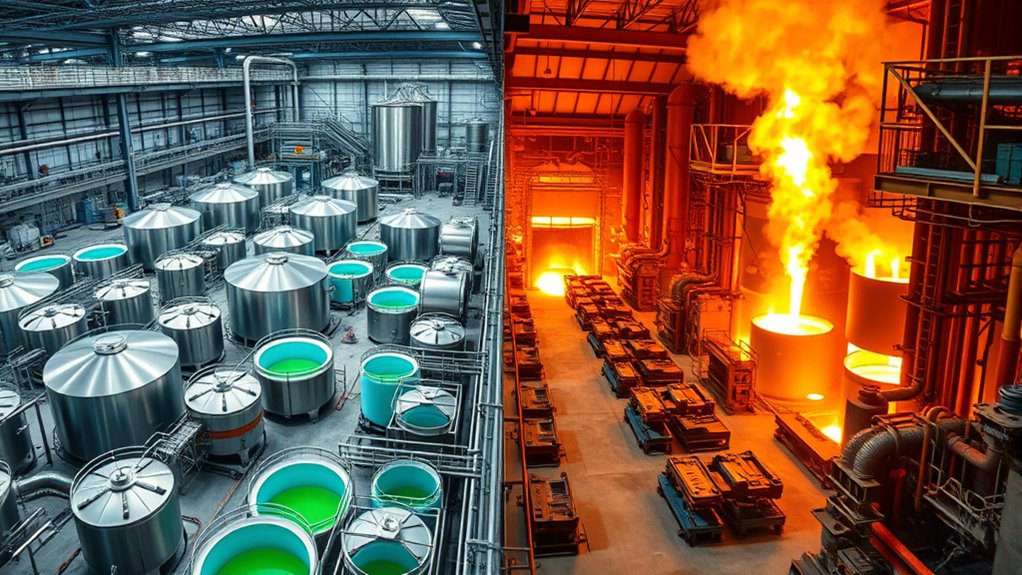

When comparing hydrometallurgy and pyrometallurgy for scalable battery recycling, hydrometallurgy often costs less in energy and offers higher purity metal recovery, making it more economical at large volumes. Pyrometallurgy, on the other hand, provides faster processing and higher recovery rates, but at higher energy costs and environmental impact. To make informed decisions about the best approach for your needs, you’ll find the insights in the upcoming analysis quite useful.
Key Takeaways
- Hydrometallurgy consumes less energy, reducing operational costs, especially at large-scale processing.
- Pyrometallurgy offers higher metal recovery rates and faster throughput, justifying higher energy expenses.
- Hydrometallurgy is more environmentally friendly due to lower energy use and easier waste management.
- Pyrometallurgy’s rapid processing suits high-volume, high-efficiency recycling operations.
- Strategic choice depends on balancing energy costs, recovery efficiency, environmental impact, and scale requirements.

As electric vehicles and portable electronics become more widespread, the economics of battery recycling have gained increasing importance. You’re likely aware that recycling lithium-ion batteries isn’t just about reducing waste; it’s about creating value through second life applications and streamlining the supply chain. When considering hydrometallurgical and pyrometallurgical methods, understanding their economic implications helps you decide which approach best fits your goals and resources.
Hydrometallurgy involves using aqueous solutions to extract valuable metals from spent batteries. This method often requires lower energy input compared to pyrometallurgy, which relies on high-temperature smelting. Because of its lower energy consumption, hydrometallurgy can be more cost-effective, especially when scaled up for large-volume processing. It also lends itself well to second life applications, where batteries still hold usable capacity. Reusing these batteries in less demanding roles—like stationary energy storage—can offset recycling costs and extend their lifecycle, making hydrometallurgy a strategic choice for supply chain optimization. You can recover a broad spectrum of metals with high purity, which can be directly reused in manufacturing new batteries or other electronic components, hence closing the loop and reducing raw material dependency.
Pyrometallurgy, on the other hand, involves high-temperature processing that smelts batteries to recover metals like cobalt, nickel, and copper. This process is generally faster and can handle a wider variety of battery types, but it comes with higher energy costs and environmental considerations. These costs can be a barrier unless you operate at a high throughput or have access to cheap energy sources. However, the high recovery rate and ability to process complex alloys make pyrometallurgy attractive for large-scale operations where efficiency and throughput are critical. If you’re focused on high-volume recycling and want to maximize metal recovery with less concern about second life applications, pyrometallurgy might be the better route.
Ultimately, your choice hinges on balancing initial investment, operational costs, environmental impact, and the future of your supply chain. Hydrometallurgy’s flexibility with second life applications and lower energy demands make it attractive for optimizing long-term supply chains and sustainability. Pyrometallurgy’s speed and high recovery rates suit large-scale facilities aiming for maximum throughput. Both methods contribute to a resilient, sustainable battery economy, but understanding their economic nuances helps you make smarter decisions that align with your strategic priorities.
Frequently Asked Questions
How Do Regulatory Policies Impact Recycling Technology Choices?
Regulatory policies heavily influence your recycling technology choices by shaping the landscape through policy incentives and regulatory compliance requirements. When policies favor hydromet processes, you’re more likely to adopt them to benefit from incentives and meet regulations efficiently. Conversely, strict regulations on environmental impact might steer you toward pyromet methods. Staying compliant and leveraging policy incentives help you optimize costs and sustainability in your recycling operations.
What Are the Safety Concerns in Large-Scale Recycling Facilities?
Imagine a large-scale recycling plant where workplace hazards like chemical spills and fire risks are real concerns. You need to prioritize safety protocols, proper ventilation, and fire suppression systems to prevent accidents. Fire risks, especially from flammable solvents used in hydromet processes or high-temperature pyromet methods, pose significant dangers. Regular training, safety gear, and emergency plans help protect workers and keep the facility safe from catastrophic incidents.
How Does Supply Chain Variability Affect Recycling Economics?
Supply chain variability impacts your recycling economics by causing supply chain disruptions and market price fluctuations. When disruptions occur, you face delays and increased costs, reducing profit margins. Market price fluctuations make it harder to predict revenue, forcing you to adapt quickly. To stay resilient, you should diversify suppliers, build stockpiles, and stay updated on market trends, ensuring your recycling operations remain efficient despite these uncertainties.
What Innovations Are Emerging to Improve Recycling Process Efficiency?
You can enhance recycling process efficiency by adopting innovative catalysts that speed up metal extraction and improve recovery rates. Additionally, process automation plays a vital role by reducing manual labor, minimizing errors, and increasing throughput. Together, these innovations streamline operations, lower costs, and make large-scale recycling more sustainable. Embracing such advancements helps you stay competitive and aligns with the evolving demands of battery material recovery.
How Do Environmental Impacts Compare Between Hydromet and Pyromet Methods?
You’ll find that hydromet methods generally have a smaller environmental footprint because they use less energy and produce fewer emissions, making them better for resource conservation. Pyromet processes, however, tend to emit more greenhouse gases and require higher energy inputs, increasing their ecological impact. So, if minimizing environmental harm is your priority, hydromet recycling offers a more sustainable approach, aligning well with resource conservation goals.
Conclusion
When choosing between hydrometallurgical and pyrometallurgical recycling, consider not just costs but also environmental impact. Did you know that hydromet methods can recover up to 95% of valuable metals, making them more efficient and sustainable? By supporting scalable, eco-friendly recycling solutions, you help reduce mining’s footprint and conserve resources. Every step toward better recycling practices counts—your choices can drive a cleaner, greener future for battery technology.