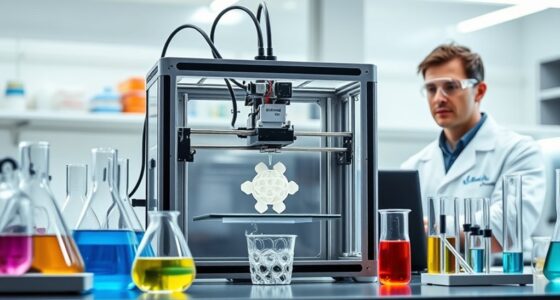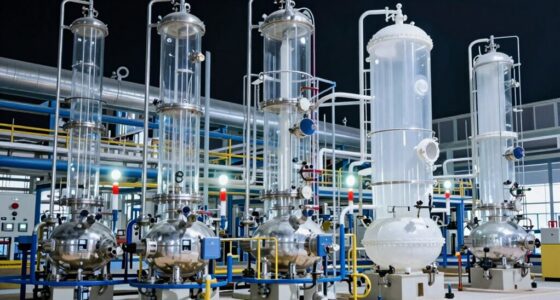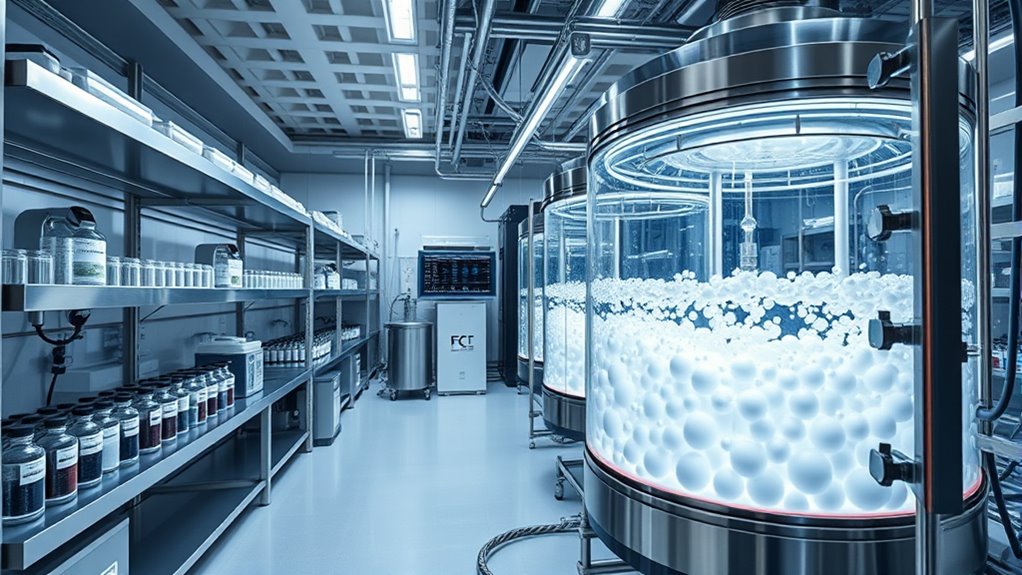

The shift to continuous manufacturing in biopharma hinges on advancements in process chemistry that enable seamless, real-time production. You benefit from improved efficiency, consistent product quality, and faster development times through better control and automation. This approach reduces downtime and long-term costs while facilitating real-time adjustments for quality assurance. As this transformation accelerates, understanding the chemistry behind continuous manufacturing reveals how innovations are shaping the future of therapy production—so keep exploring to learn more.
Key Takeaways
- Continuous manufacturing relies on precise control of chemical reactions and process parameters to ensure consistent product quality.
- Advanced sensors and real-time analytics optimize reaction conditions, enabling dynamic adjustments during production.
- Process chemistry benefits from streamlined reaction pathways that can be monitored continuously for improved efficiency.
- Integration of automation reduces variability, enhances safety, and accelerates the development of biopharmaceutical products.
- Regulatory frameworks are evolving to accommodate the complex chemistry of continuous processes, emphasizing validation and quality assurance.
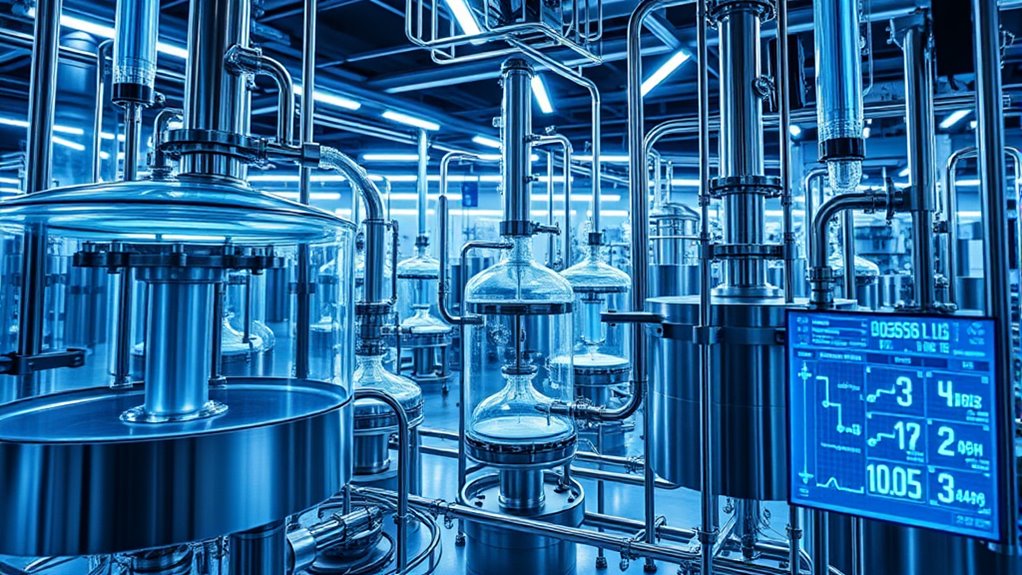
As biopharmaceutical companies seek to improve efficiency and guarantee faster delivery of essential therapies, many are shifting from traditional batch manufacturing to continuous processes. This shift hinges on process optimization, where every step is fine-tuned to enhance product quality, reduce waste, and streamline production.
Continuous manufacturing allows you to operate your facilities more efficiently, minimizing downtime and increasing output consistency. However, this shift isn’t without its hurdles. Regulatory challenges play a significant role, as authorities must adapt their frameworks to accommodate these innovative methods.
Continuous manufacturing boosts efficiency and output consistency but faces regulatory hurdles requiring adaptive frameworks and validation strategies.
You need to navigate new compliance requirements, validate continuous processes, and demonstrate consistent product quality to regulators used to batch-based paradigms. Embracing a comprehensive understanding of the entire process becomes essential to meet these evolving standards.
Process optimization in continuous manufacturing demands a detailed understanding of each stage, from upstream bioreactor operations to downstream purification. You focus on real-time monitoring and control, enabling immediate adjustments that maintain ideal conditions. This approach reduces variability and accelerates troubleshooting, ensuring your product remains within strict quality parameters.
The challenge lies in integrating advanced sensors, data analytics, and automation into your existing systems. You must develop robust control strategies that can respond swiftly to process deviations, which requires significant technical expertise and investment.
On the regulatory front, you face the task of convincing agencies that continuous processes can meet or exceed the safety and efficacy standards set by traditional methods. Regulatory challenges include establishing appropriate validation protocols, documentation practices, and quality assurance measures tailored for continuous workflows.
You’ll need to collaborate closely with regulators, providing detailed data and demonstrating that continuous manufacturing can deliver consistent, high-quality products. This often involves engaging with agencies early in development to clarify expectations and guarantee your process design aligns with evolving regulatory frameworks.
Despite these hurdles, the advantages of adopting continuous manufacturing are compelling. You gain the ability to shorten development timelines, respond more quickly to market demands, and reduce production costs in the long run.
Process optimization tools, coupled with regulatory adaptability, enable you to open the full potential of continuous bioprocessing. You must also stay informed about regulatory updates that influence how continuous processes are validated and approved, which can significantly impact your implementation strategy. Staying current on regulatory guidance ensures your approach remains compliant and competitive.
The journey demands upfront investment and a willingness to innovate, but the payoff lies in a more agile, efficient manufacturing landscape.
As the industry evolves, embracing these changes positions you ahead of the curve, guaranteeing you can deliver life-saving therapies faster, more reliably, and with higher quality standards.
Frequently Asked Questions
How Does Continuous Manufacturing Impact Product Quality Control?
Continuous manufacturing greatly improves product quality control by enabling real-time monitoring, which helps you detect issues instantly. This proactive approach enhances quality assurance, reducing variability and ensuring consistent product standards.
You can quickly make adjustments during production, minimizing waste and delays. Overall, continuous manufacturing empowers you to maintain higher quality levels, increase efficiency, and meet stringent regulatory requirements more effectively.
What Are the Biggest Regulatory Hurdles for Continuous Biomanufacturing?
You face significant regulatory hurdles with continuous biomanufacturing, mainly around obtaining regulatory approval and meeting compliance standards.
Authorities require extensive data to demonstrate consistent quality and safety. You need to adapt your validation processes, ensuring real-time monitoring aligns with regulatory expectations.
Managing these hurdles demands transparency, thorough documentation, and proactive communication to streamline approval and maintain compliance throughout the manufacturing shift.
How Cost-Effective Is Continuous Manufacturing Compared to Traditional Methods?
You’ll find that continuous manufacturing offers significant cost savings through improved production efficiency. By streamlining processes and reducing downtime, you cut labor and material costs, which enhances overall profitability.
Although initial investments can be higher, the long-term gains in efficiency make it more cost-effective than traditional batch methods. This approach allows you to produce more consistently, with less waste, ultimately improving your bottom line.
What Skills Are Needed for Workforce Transition to Continuous Processes?
Imagine your team transforming overnight into a sleek, high-tech factory—skills development is your key. You need to master advanced process control, data analytics, and automation to guarantee seamless workforce adaptation.
Critical thinking, problem-solving, and a willingness to learn new tech become your superpowers. By investing in training and fostering agility, you prepare your workforce for continuous processes.
Making your operation more efficient, flexible, and ready to lead in the future of biopharma manufacturing.
How Does Continuous Manufacturing Affect Supply Chain Management?
You’ll find that continuous manufacturing streamlines supply chain management by enhancing inventory optimization, reducing excess stock, and improving responsiveness.
It enables you to better synchronize production with demand, minimizing delays. Additionally, it fosters stronger supplier integration, allowing real-time data sharing and faster adjustments.
This shift helps you achieve a more agile, reliable supply chain, ultimately lowering costs and improving product availability for your customers.
Conclusion
As you embrace this shift to continuous manufacturing, you’re witnessing a revolution that could transform biopharma forever. It’s not just an upgrade; it’s a game-changer that promises to slash costs, boost efficiency, and accelerate innovation at a pace that feels almost unbelievable. By harnessing the chemistry behind this move, you’re stepping into a future where biopharma manufacturing is faster, smarter, and more resilient than ever before—truly a seismic shift in the industry’s very foundation.