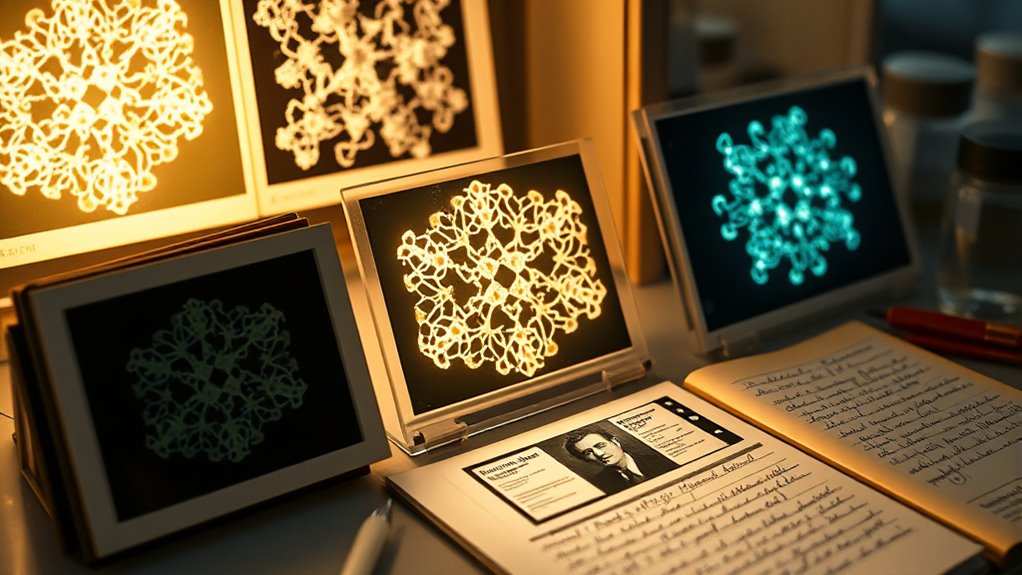

Rosalind Franklin’s crystallography work revolutionized how you understand DNA’s structure. Her detailed X-ray images, especially Photo 51, provided critical evidence confirming the double helix model. Her expertise in crystallography uncovered the regularity and symmetry of DNA, influencing genetics and molecular biology forever. Although she wasn’t fully recognized during her lifetime, her legacy endures, inspiring how meticulous techniques can unseal life’s secrets. Continuing further will reveal the full scope of her groundbreaking contributions.
Key Takeaways
- Franklin’s X-ray diffraction images, especially Photo 51, were crucial in confirming the DNA double helix structure.
- Her expertise in crystallography unveiled DNA’s helical symmetry and regularity, advancing molecular biology.
- Despite initial lack of recognition, her detailed images laid the foundation for understanding genetic material.
- Franklin’s meticulous work set a precedent for using crystallography to analyze complex biological molecules.
- Her legacy continues to inspire scientific research, highlighting the importance of precision and perseverance in discovery.
Although her contributions were often overlooked during her lifetime, Rosalind Franklin’s work in crystallography fundamentally shaped our understanding of DNA’s structure. You might not realize it, but her meticulous X-ray diffraction images provided pivotal evidence that led scientists to decode the double helix. Franklin’s expertise in crystallography allowed her to capture high-quality images of DNA fibers, which revealed the repeating patterns and helical nature of the molecule. These images, especially Photo 51, became instrumental in confirming the double-helix model proposed by Watson and Crick. Without her precise data, their scientific breakthroughs might have taken much longer or been less accurate. Franklin’s work didn’t just support their theories; it laid a solid foundation for understanding DNA’s intricate structure. Her ability to interpret diffraction patterns and translate them into meaningful structural information was a game-changer in molecular biology. Her detailed analysis enabled the scientific community to visualize the DNA molecule in ways previously thought impossible, demonstrating the importance of scientific imaging techniques in modern research. Franklin’s crystallography techniques uncovered the regularity and symmetry of the DNA strands, revealing insights into how genetic information is stored and replicated. This understanding sparked further research into DNA’s function, influencing fields like genetics, medicine, and biotechnology. Her contributions exemplify how careful experimentation and technical skill can lead to groundbreaking discoveries. Yet, during her lifetime, recognition was often denied her, overshadowed by her male colleagues. Despite this, her work persisted as a cornerstone of molecular biology. Today, her legacy endures, and her images are celebrated as some of the most important scientific breakthroughs in understanding life itself. You might also see her as a pioneer who bridged the gap between physics and biology. Her crystallography expertise allowed her to explore complex biological molecules, transforming them into tangible, visual data. Franklin’s dedication to precision and clarity helped unseal the secrets of DNA, setting a precedent for future scientists. Her legacy underscores the importance of detailed observation, perseverance, and technical mastery in scientific discovery. While her name might not have been as prominent during her lifetime, her influence is undeniable now. Her work continues to inspire researchers and students alike, reminding you that meticulous work and passion for science can lead to revolutionary insights. Rosalind Franklin’s legacy in crystallography is a testament to how scientific breakthroughs often rest on the shoulders of diligent, often underappreciated, pioneers.
Frequently Asked Questions
How Did Franklin’s Work Influence Modern X-Ray Crystallography Techniques?
Your understanding of modern crystallography techniques owes a lot to Franklin’s work. She pioneered X-ray crystallography methods, capturing clear images of DNA fibers that helped unbolt their structure. Her scientific influence guided subsequent researchers, enabling more precise and sophisticated techniques today. Franklin’s meticulous approach to crystal imaging and data analysis continues to shape how scientists analyze molecular structures, making her an enduring figure in the evolution of crystallography techniques.
What Ethical Issues Surrounded the Recognition of Franklin’s Contributions?
You see, the ethical issues around Franklin’s recognition highlight how academic integrity sometimes gets overlooked. Many argue she didn’t receive proper acknowledgment for her crucial contributions, raising questions about fairness and respect in science. This situation emphasizes the importance of ethical recognition, ensuring all researchers get credit for their work. Upholding academic integrity means valuing everyone’s input, so Franklin’s pivotal role is rightfully acknowledged in scientific history.
Are There Any Ongoing Controversies About Franklin’s Role in DNA Discovery?
You might wonder if any ongoing controversies surround Franklin’s role in DNA discovery. While most agree she made essential contributions, some debate her recognition, considering her personal life and Franklin’s political views, which may have influenced her career. However, current discussions mainly focus on historical acknowledgment rather than new disputes. Franklin’s legacy remains a proof to her scientific talent, though debates about recognition highlight ongoing conversations about ethics in science.
How Has Franklin’s Legacy Impacted Women in Science Today?
Your awareness of Rosalind Franklin’s legacy highlights how her work inspires women in science today. Her contributions promote women empowerment and gender equality, encouraging more women to pursue STEM fields. Franklin’s story reminds you that perseverance and talent can break barriers, inspiring future generations. As a result, her legacy continues to uplift women, fostering an environment where gender equality thrives and women feel empowered to achieve their scientific dreams.
What Are Some Lesser-Known Aspects of Franklin’s Scientific Career?
You might not know that Franklin applied her crystallography skills to archaeological applications, helping to analyze ancient artifacts. She also engaged in interdisciplinary collaborations, working with biologists and chemists to deepen her understanding of molecular structures. Her innovative approaches extended beyond DNA, demonstrating her versatility and curiosity. These lesser-known aspects highlight her broad scientific interests and contributions, showcasing her as a pioneering researcher who pushed boundaries across multiple fields.
Conclusion
Remember, a picture is worth a thousand words, and Franklin’s crystallography work speaks volumes. Her meticulous research laid the foundation for groundbreaking discoveries, even if her name wasn’t always in the spotlight. By recognizing her contributions, you see that perseverance and precision truly pay off. Franklin’s legacy reminds you that sometimes, the smallest details can reveal the biggest truths—proof that every piece of the puzzle matters in the grand picture of science.