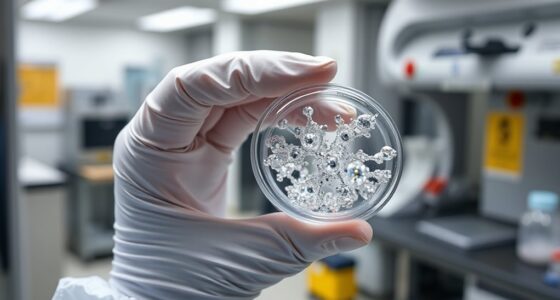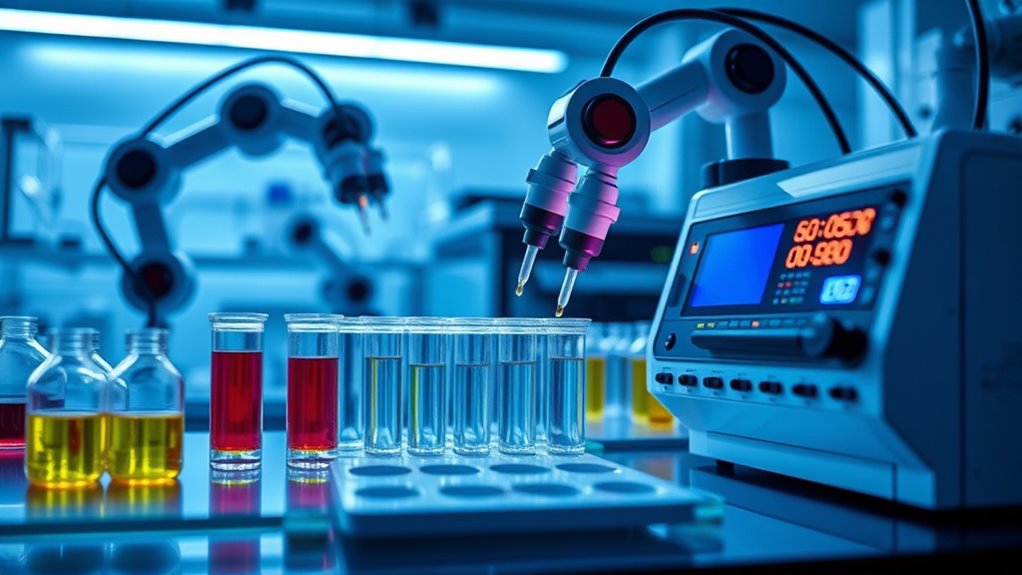

Salt-free workups and smart separations transform traditional chemical purification by using ionic liquids and membrane technologies. These methods eliminate the need for adding salts and extensive separations, making processes cleaner, faster, and more environmentally friendly. By minimizing waste and energy consumption, you’ll improve product purity while reducing costs. If you continue exploring, you’ll discover how these innovative techniques can make your workflows more sustainable and scalable for modern chemical synthesis.

Get school and study supplies delivered free — and shop member deals
- Fast, free delivery on millions of items
- Access to Prime Big Deal Days deals on October 6–7
- Prime Video, Amazon Music and more included
Key Takeaways
- Ionic liquids enable salt-free workups by replacing traditional salts with recyclable, tunable solvents.
- Membrane separation technologies facilitate efficient, energy-saving purification without extensive salt addition.
- Combining ionic liquids and membranes streamlines workflows, reducing purification steps and waste generation.
- Smart separation methods enhance green chemistry principles by lowering environmental impact and resource consumption.
- These techniques improve scalability, yield, and product purity while minimizing reliance on traditional, waste-producing purification methods.
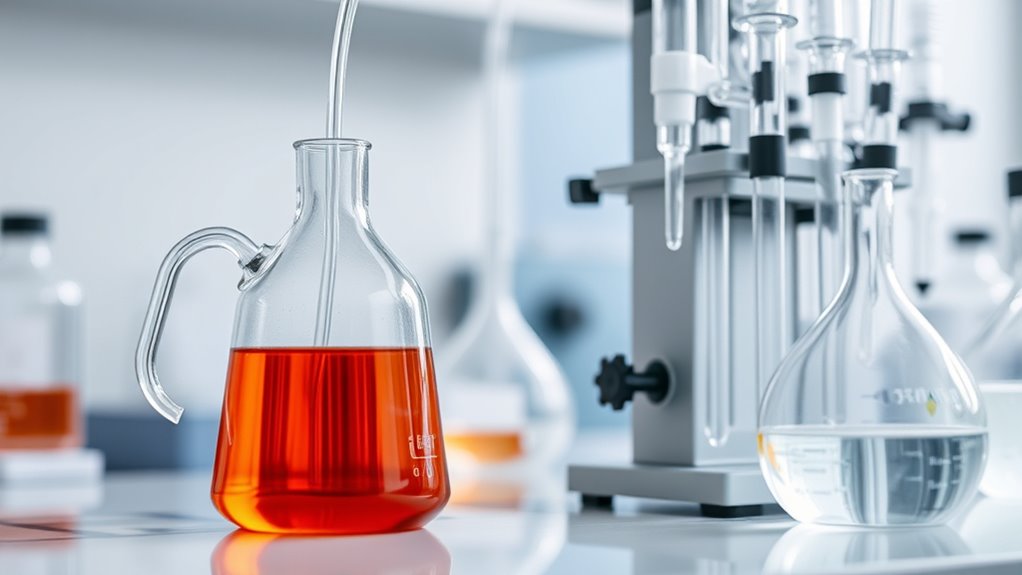
Traditional workup procedures in chemical synthesis often rely heavily on salt addition and extensive separations, which can be time-consuming and environmentally taxing. These methods generate large amounts of waste, require multiple purification steps, and consume significant energy. To address these issues, chemists are increasingly turning to innovative techniques like ionic liquids and membrane separation, offering more sustainable and efficient alternatives.
Traditional workups rely on salts and extensive separations, leading to waste and inefficiency.
Ionic liquids are salts that remain liquid at relatively low temperatures, often below 100°C. They have unique properties, such as negligible vapor pressure, high thermal stability, and tunable polarity, making them ideal for greener workups. Instead of adding salts to facilitate phase separations, you can use ionic liquids to directly extract or dissolve target compounds. Their ability to selectively interact with specific molecules reduces the need for traditional solvent extraction and minimizes waste. Furthermore, ionic liquids can often be reused multiple times, lowering the environmental footprint of your process. Research supports their use in developing environmentally friendly separation methods.
Membrane separation is another promising technology that complements the use of ionic liquids. Unlike traditional filtration or distillation, membrane separation employs selective barriers that allow certain molecules to pass while retaining others. This process is energy-efficient and can be seamlessly integrated into continuous workflows. When coupled with ionic liquids, membrane separation enables you to perform solvent exchange, remove impurities, or recover catalysts without the need for extensive centrifugation or phase separations. For example, after a reaction, you might use a membrane to filter out residual ionic liquids or other impurities, streamlining the purification process.
By combining ionic liquids with membrane separation, you can develop salt-free workup procedures that are faster, cleaner, and more environmentally friendly. This approach reduces the reliance on traditional salts, which often complicate waste disposal and pose environmental hazards. Instead, you utilize the inherent properties of ionic liquids to facilitate separation and purification, minimizing the number of steps needed. As a result, your process becomes more scalable and less resource-intensive.
Adopting these smart separation techniques not only aligns with green chemistry principles but also enhances your overall efficiency. You’ll save time, reduce waste, and lower energy consumption—all while maintaining high purity and yield. These innovations are transforming chemical synthesis, offering practical solutions that meet modern environmental standards. Moving forward, integrating ionic liquids and membrane separation into your workflows can help you achieve more sustainable and streamlined workups, making your processes more resilient and cost-effective.
ionic liquids for chemical purification
As an affiliate, we earn on qualifying purchases.
As an affiliate, we earn on qualifying purchases.
Frequently Asked Questions
What Are the Environmental Benefits of Salt-Free Workups?
You benefit from salt-free workups because they reduce environmental impact by lowering energy consumption and avoiding harmful chemicals. Using biodegradable solvents minimizes pollution and makes waste easier to manage. Without salt, you decrease the risk of water contamination and hazardous waste generation. This approach promotes greener chemistry, helping you create more sustainable processes while protecting ecosystems and conserving resources.
How Do Salt-Free Methods Compare in Cost to Traditional Separations?
You’ll find that salt-free methods often have a favorable cost comparison, especially over time, because they reduce the need for expensive salt reagents and waste disposal. While initial setup costs might be higher, the overall economic feasibility improves with lower operational and environmental costs. This makes salt-free approaches a cost-effective alternative, helping you save money while supporting sustainable practices.
Are Salt-Free Techniques Applicable to Industrial-Scale Processes?
Sure, salt-free techniques are ready for industrial scale—if you enjoy tackling scalability challenges and equipment compatibility issues. While these methods promise sustainability and cost savings, their application to large processes isn’t straightforward. You’ll find that adapting existing equipment or designing new systems can be complex and costly. Still, with innovation, these eco-friendly approaches could someday become mainstream, making you the hero of greener industrial practices.
What Are the Limitations of Smart Separation Technologies?
Smart separation technologies face limitations like scalability challenges and selectivity issues. You might find it difficult to adapt these methods for large-scale industrial processes due to cost or equipment constraints. Additionally, their selectivity can sometimes be insufficient for complex mixtures, leading to lower purity or yield. You should carefully evaluate these factors to determine if smart separation suits your specific application, especially when considering scale-up or complex separations.
How Do Salt-Free Workups Impact Overall Reaction Efficiency?
Salt-free workups improve reaction efficiency by reducing the need for extensive purification steps, which streamlines your process and minimizes waste. They simplify the overall process, saving you time and resources, and decrease the risk of side reactions caused by residual salts. By eliminating salt removal, you can achieve cleaner products more quickly, making your reactions more efficient while supporting greener, more sustainable practices.
Conclusion
By embracing salt-free workups and smart separations, you’re revolutionizing your chemistry process—saving time, reducing waste, and skyrocketing efficiency. These techniques are like having a secret weapon in your lab arsenal, turning complex separations into smooth, streamlined operations. Immerse yourself in these innovative methods, and you’ll wonder how you ever worked without them. With such game-changing tools at your fingertips, you’re not just keeping up—you’re leading the charge into a cleaner, smarter future.
Halloween Picks
halloween
As an affiliate, we earn on qualifying purchases.