Digital laboratory scales vary most in the balance between capacity and readability: a 5,000 g model that reads to 0.01 g offers range, while a 500–1,000 g model may better suit smaller, precise batches. My best overall pick is the CGOLDENWALL 5000 g x 0.01 g, which pairs broad capacity with fine increments. The MEIYA 1000 g x 0.01 g is a more focused choice for smaller loads, while the Bonvoisin 600 g x 0.01 g suits work where compact capacity matters more than range. The main tradeoffs are capacity, readability, calibration support, and ease of use—not the word “laboratory” in a product title. Continue reading for the full comparison and guidance on matching a scale to your actual weighing tasks.

Prime made for students and young adults
- Fast, free delivery for dorm and study essentials
- Prime Video and Amazon Music included
- Member-only deals
Key Takeaways
- High capacity does not automatically mean better precision: the 5,000 g x 0.1 g Bonvoisin gives up fine readability compared with 0.01 g models, making it a better fit for heavier loads where hundredths of a gram are unnecessary.
- The 5,000 g x 0.01 g group offers the broadest range of use: CGOLDENWALL, UXILAII, and several generic models combine substantial capacity with fine display increments, though features and calibration support differ.
- Lower-capacity scales can be the more sensible choice: the 500–1,000 g models, including MEIYA and the 500 g school-use balance, avoid paying for capacity a small-batch user may never need.
- Calibration details help separate similar-looking models: the UXILAII lists calibration, while the 1,000 g digital scale includes a 100 g calibration weight; buyers should check whether the supplied weight suits the scale’s calibration procedure.
- Unit selection varies more than the basic form factor: the Bonvoisin 6000 g model offers six units, the 13-unit 5,000 g model covers more conversions, and the FLB adds DWT for users who need that specific unit.


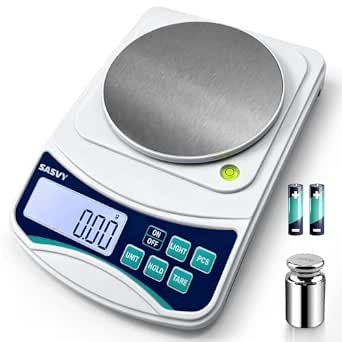


| digital laboratory scale | Display | Power | Units | Capacity |
|---|---|---|---|---|
| CGOLDENWALL Precision Lab Scal | Backlit LCD | 110V | g, ct, oz, lb, % | — |
| Bonvoisin Digital Gram Scale 6 | LCD | Adapter or 2 AA batteries | g, oz, lb, kg, tl, ct | — |
| Digital Lab Scale 0.01g Accura | Backlit LCD | USB, AC/DC adapter, or 2 x 1.5V AA batteries | oz, g, ct, dwt, tael troy, grain, pieces | — |
| MEIYA Digital Lab Scale | LCD | 2 AAA batteries, included | oz, g, ct, dwt, tl, gn, ozt | — |
| Lab Scale 5000g x 0.01g Digita | Backlit LCD | AC adapter or 9V battery | — | — |
| Bonvoisin Digital Lab Scale 60 | LCD | AC adapter or 2 AA batteries | g, oz, ct, dwt, T, gr | 600g |
| UXILAII Lab Scale 5000g x 0.01 | Large LCD | — | g, kg, ct, oz, ozt, lb, dwt, %, tol, mm | — |
| FLB Lab Scale Digital Precisio | LCD | AC adapter or 7.4V lithium battery (not included) | — | 2,000g |
| Digital Lab Scale with 0.01g P | LCD | USB, AC/DC adapter, or 2 AAA batteries | — | 600g |
| Lab Scale 5000g x 0.01g Digita | LCD | 110V AC with 9V battery backup | g, ct, oz, ozt, N, lb, dr, GN, dwt, %, t/T, T, T/A/R | 5,000g |
| Digital Lab Scale 5000g x 0.1g | Backlit LCD | Rechargeable battery, USB, or 2 AAA batteries | oz, lb, g, kg | 5,000g |
| Digital Lab Scale 1000g x 0.01 | Backlit LCD | 2 AAA batteries | — | 1,000g |
| Digital Lab Scale Balance 500g | Backlit LCD | 2 AAA batteries | — | 500g |
| High Precision Digital Analyti | LCD | — | — | 5,000g |
| Digital Lab Scale | Large LCD | 2 x 1.5V AA batteries or AC adapter | gram, grain, carat, pennyweight, troy ounce, ounce, piece | 600g |
More Details on Our Top Picks
CGOLDENWALL Precision Lab Scale 5000g x 0.01g Digital Laboratory Balance
The 5,000 g capacity paired with 0.01 g readability makes this a fit for buyers weighing larger loads who still need fine increments. Compared with the Bonvoisin 6000g x 0.1g, it reads in smaller steps, though Bonvoisin offers slightly more capacity and can run on batteries as well as its adapter. The stainless steel pan, backlit LCD, tare, and calibration functions support routine bench work and make switching between containers and units easier. Its main compromise is power flexibility: this model is listed for 110V only, so buyers in other regions should check compatibility before use. The 5 kg version also lacks included calibration weights, which adds a setup task for labs that need to verify readings.
Pros:- 0.01 g readability across a stated 5,000 g capacity
- Stainless steel pan with tare and calibration functions
- Backlit LCD supports easier reading
- Multiple units include grams, carats, ounces, pounds, and percent
Cons:- Calibration weights are not included with the 5,000 g model
- 110V power limitation may require a compatible converter in some regions
- No battery power option is listed
Best for: Small labs and jewelry workshops weighing items up to 5 kg that prioritize 0.01 g readability and have compatible 110V power.
Not ideal for: Users outside 110V regions or buyers who need included calibration weights and battery-powered portability.
- Maximum capacity:5,000 g
- Division:0.01 g
- Units:g, ct, oz, lb, %
- Power:110V
- Platform:Stainless steel pan
- Display:Backlit LCD
- Functions:Tare and calibration
Our verdict“Choose this CGOLDENWALL when you need 0.01 g readability at up to 5 kg and can accommodate its 110V power requirement.”
Bonvoisin Digital Gram Scale 6000g x 0.1g Lab Scale with 6 Units
The Bonvoisin’s case is portability and 6,000 g capacity, not the finest readability in this group. Its 0.1 g increments are coarser than the CGOLDENWALL 5000g x 0.01g, so I’d favor CGOLDENWALL for work where smaller displayed increments matter. Bonvoisin makes more sense when loads are heavier and the scale may need to move between work areas: it measures 8.07 by 5.91 inches and includes both an adapter and two AA batteries. Six units, tare, counting, and adjustable auto-off cover practical bench tasks without a complicated feature list. The compact footprint can restrict larger objects, however, and the product data cautions that careful handling is needed to maintain accuracy. Its 0.1 g readability also limits fine-detail use.
Pros:- 6,000 g capacity for loads beyond the CGOLDENWALL model’s 5,000 g limit
- Adapter and two AA batteries support plugged-in or portable use
- Six units, tare, and counting functions
- Adjustable auto-off and compact dimensions
Cons:- 0.1 g readability is coarser than the 0.01 g options in this roundup
- Compact size may constrain larger items
- Careful handling is needed to maintain accuracy
Best for: Field technicians, teaching labs, and small workshops that need a portable scale for loads up to 6 kg and can work with 0.1 g readability.
Not ideal for: Jewelry or lab users who need 0.01 g increments, or buyers weighing bulky objects that do not fit its compact platform.
- Weight capacity:6,000 g
- Readability:0.1 g
- Units:g, oz, lb, kg, tl, ct
- Dimensions:8.07 x 5.91 in
- Display:LCD
- Power:Adapter or 2 AA batteries
- Auto-off:Adjustable
- Functions:Tare and counting
Our verdict“Pick Bonvoisin for portable weighing up to 6 kg when 0.1 g readability is sufficient and battery operation is useful.”
Digital Lab Scale 0.01g Accuracy Weighing Device
With a 600 g maximum and 0.01 g readout, this scale favors smaller samples rather than high-capacity batches. That makes it a more natural fit for education, hobby work, or small scientific tasks than the MEIYA 1000g x 0.01g, which offers more headroom at the same stated readout. In return, this model weighs just 494 g and provides an unusually flexible power mix: USB, AC/DC adapter, or two AA batteries. Its seven listed units, including pennyweight, grain, and piece counting, suit varied measurement routines, while the backlit LCD aids quick readings. The tradeoffs are a narrow 600 g ceiling, batteries that are not included, and a note that calibration may be needed after shipping despite the pre-calibrated feature listing.
Pros:- 0.01 g readout for small-sample measurements
- USB, AC/DC, and AA battery power options
- Seven units, including dwt, grain, and piece counting
- Backlit LCD and 3.9-inch-diameter pan
Cons:- 600 g maximum capacity is substantially below the 1,000 g MEIYA and 5,000 g models
- AA batteries are not included
- Calibration may be required after shipping
Best for: Students, hobbyists, and small-sample users who value 0.01 g readout, several unit choices, and flexible power.
Not ideal for: Labs weighing containers or samples above 600 g, or users who need calibration weights and batteries supplied.
- Weight capacity:600 g
- Readout accuracy:0.01 g
- Units:oz, g, ct, dwt, tael troy, grain, pieces
- Pan diameter:3.9 in
- Item weight:494 g
- Materials:Plastic and stainless steel
- Display:Backlit LCD
- Power:USB, AC/DC adapter, or 2 x 1.5V AA batteries
Our verdict“Choose this compact scale for small samples and flexible power, but step up to the MEIYA if your routine needs more than 600 g capacity.”
MEIYA Digital Lab Scale, 1000g by 0.01g Balance Scale & Laboratory Scale
The MEIYA pairs 1,000 g capacity with 0.01 g readout, giving small-sample users more room than the 600 g Digital Lab Scale in this lineup without jumping to a 5 kg model. It also arrives with batteries and a calibration weight, a practical advantage for buyers who want a more complete setup out of the box. Stainless steel and ABS construction, tare, piece counting, and several specialist units suit a compact lab or jewelry bench. The tradeoff is a battery-only power listing, so it lacks the USB and adapter flexibility of the 600 g model. Its LCD is described as basic and may be harder to see in bright conditions. For heavier work, the CGOLDENWALL’s 5,000 g capacity is the clearer choice.
Pros:- 0.01 g readout with a 1,000 g capacity
- Calibration weight and two AAA batteries included
- Stainless steel and ABS construction
- Tare, PCS counting, and multiple unit options
Cons:- 1,000 g capacity falls short of the 5,000 g CGOLDENWALL
- Power is limited to two AAA batteries in the listed specs
- Basic LCD may be less visible in bright surroundings
Best for: Students, jewelry makers, and small labs seeking 0.01 g readout up to 1 kg with a calibration weight and batteries included.
Not ideal for: Users weighing loads above 1,000 g, working in bright environments, or needing adapter or USB power.
- Weight capacity:1,000 g
- Readout accuracy:0.01 g
- Units:oz, g, ct, dwt, tl, gn, ozt
- Materials:ABS and stainless steel
- Display:LCD
- Power:2 AAA batteries, included
- Functions:Tare, PCS counting, and auto power-off
- Included accessory:Calibration weight
Our verdict“Choose the MEIYA for a ready-to-use 1 kg bench scale with fine readout, but select a higher-capacity model for heavier loads.”
Lab Scale 5000g x 0.01g Digital Analytical Balance
This model combines 5,000 g capacity and 0.01 g accuracy with auto-calibration and a backlit LCD, making it a feature-rich option for buyers who need both range and fine increments. Against the CGOLDENWALL 5000g x 0.01g, it lists auto-calibration and a 175 x 155 mm platform, while CGOLDENWALL specifies a stainless steel pan and several functions. The stated stainless steel platform and unit conversion support repeated lab, jewelry, or kitchen weighing; smart counting is also listed among its features. Power is less flexible than Bonvoisin’s adapter-plus-AA setup: this scale uses an AC adapter or a 9V battery, which is not included. At 2,000 g, it is also a heavier choice for anyone who needs to carry a scale between work sites.
Pros:- 5,000 g capacity with stated 0.01 g accuracy
- Auto-calibration and backlit LCD
- 175 x 155 mm stainless steel platform
- Unit conversion and smart counting features are listed
Cons:- 9V battery is not included
- Power options are limited to AC adapter or 9V battery
- 2,000 g item weight makes it less convenient to carry than the Bonvoisin
Best for: Bench-based users weighing loads up to 5 kg who want 0.01 g accuracy, auto-calibration, and a larger stated platform.
Not ideal for: Mobile users prioritizing a lightweight scale, or buyers who need a battery included or a broader battery choice.
- Weight capacity:5,000 g
- Accuracy:0.01 g
- Platform size:175 x 155 mm
- Platform material:Stainless steel
- Display:Backlit LCD
- Power:AC adapter or 9V battery
- Item weight:2,000 g
- Features:Auto-calibration, auto shut-off, unit conversion, smart counting
Our verdict“Pick this model for a stationary 5 kg setup with auto-calibration and a substantial platform, not for frequent transport.”
Bonvoisin Digital Lab Scale 600g x 0.01g Precision Electronic Scale LCD Display Analytical Balance Jewelry Scale Scientific Scale
The Bonvoisin 600g x 0.01g suits bench work where a small footprint and fine readability matter more than weighing larger samples. Its 600g capacity is enough for many jewelry, classroom, and small-sample tasks, while gram, carat, pennyweight, and other unit options make it useful across different workflows. Compared with the UXILAII 5000g, it gives up substantial capacity and RS-232 connectivity, but its mini form factor is easier to place in a crowded workspace. Power from an AC adapter or AA batteries offers some flexibility, though batteries and calibration weights are not included. I would choose it for compact, routine measurements, not for heavier samples or setups that require included calibration gear and data connections.
Pros:- 0.01g readability for small, precise measurements
- Compact mini form factor suits limited bench space
- Multiple units include jewelry-relevant carat and pennyweight
- Runs from an AC adapter or two AA batteries
Cons:- 600g maximum capacity is restrictive for larger samples
- Calibration weights and batteries are not included
- No data interface is listed
Best for: Jewelry makers, students, and lab users weighing small samples who need 0.01g readability in a compact scale.
Not ideal for: Users weighing containers or samples near or above 600g, or labs that need included calibration weights or RS-232 data output.
- Capacity:600g
- Readout accuracy:0.01g
- Units:g, oz, ct, dwt, T, gr
- Power:AC adapter or 2 AA batteries
- Display:LCD
- Material:ABS
- Form factor:Mini
Our verdict“Choose this Bonvoisin for compact, low-capacity weighing; pick the UXILAII or the 5000g Lab Scale if your work needs more headroom.”
UXILAII Lab Scale 5000g x 0.01g Analytical Balance with Calibration
The UXILAII 5000g stands out for combining a broad weighing range with 0.01g readability, included calibration weights, and an RS-232 interface. That combination better fits a fixed lab bench than the Bonvoisin 600g, which is smaller but lacks listed data connectivity and included weights. Its tare, auto-correct, and memory functions add useful workflow support when measurements repeat or need to be recorded. The tradeoff is portability: this model is described as primarily for laboratory use, and the RS-232 cable is not included, so connecting it may take extra setup. The product data also says calibration may require additional weights despite listing calibration weights as included, so buyers should verify what the package supports for their calibration procedure.
Pros:- 5,000g capacity paired with 0.01g readability
- Calibration weights are listed as included
- RS-232 interface supports connection to compatible equipment
- Tare, auto-correct, and memory functions support repeat work
Cons:- RS-232 connection cable is not included
- Primarily intended for stationary laboratory use
- Calibration requirements may call for additional weights
Best for: Lab technicians and small production teams who weigh samples up to 5kg, need fine readability, and can use an RS-232 workflow.
Not ideal for: Mobile users or labs needing a ready-to-connect serial setup, since the scale is not positioned as portable and its RS-232 cable is not included.
- Maximum capacity:5,000g
- Readability:0.01g
- Display:Large LCD
- Units:g, kg, ct, oz, ozt, lb, dwt, %, tol, mm
- Pan and housing materials:Stainless steel pan, aluminum bottom, ABS shell
- Calibration weights:Included
- Interface:RS-232
Our verdict“Choose the UXILAII when high capacity, fine readability, and serial connectivity matter more than portability or a complete cable setup.”
FLB Lab Scale Digital Precision Balance with DWT Unit 2000g x 0.01g
The FLB 2000g x 0.01g occupies the useful middle ground between compact 600g balances and the 5kg models in this lineup. It keeps fine readability while allowing substantially heavier samples than the Bonvoisin Digital Lab Scale 600g, and it includes an external calibration weight plus RS232 connectivity. Its backlit LCD and choice of AC power or a separately purchased lithium battery suit a bench that may need occasional relocation, although the listed 7.9-pound weight makes frequent carrying less appealing. Compared with the UXILAII, its capacity is lower, but its desktop format and included calibration weight make it a more moderate-capacity option. Buyers should also account for the battery not being included and confirm that 2kg is enough for their sample-and-container combinations.
Pros:- 2,000g capacity offers more headroom than 600g models
- 0.01g readability for fine measurements
- External calibration weight and RS232 connectivity are listed
- Backlit LCD and AC or lithium-battery power options
Cons:- 7.9-pound listed weight limits portability
- Lithium battery is not included
- Capacity is below the 5,000g UXILAII and Lab Scale models
Best for: Lab, industrial, or home users who need 0.01g readability up to 2kg, calibration weight inclusion, and RS232 connectivity.
Not ideal for: Users who regularly weigh loads above 2kg or need a lightweight scale for frequent transport.
- Capacity:2,000g
- Readout accuracy:0.01g
- Display:LCD
- Weighing units:17
- Power:AC adapter or 7.4V lithium battery (not included)
- Calibration weight:Included
- Connectivity:RS232
- Item weight:7.9 pounds
Our verdict“Pick the FLB if 2kg covers your workload and you want included calibration weight and RS232 without moving to a 5kg balance.”
Digital Lab Scale with 0.01g Precision and Multiple Units
This 600g precision scale is the most flexible option here for powering a compact weighing setup: it lists USB, an AC/DC adapter, and two AAA batteries. A backlit LCD helps with visibility in dim work areas, while tare and hold functions suit quick checks in hobby, teaching, or light lab tasks. Like the Bonvoisin 600g, it tops out at 600g and reads to 0.01g; the differentiators are this model’s stated 4.7-inch diameter and broader power choices. It does not list included calibration weights, and its product data says calibration is needed for optimal accuracy, so buyers should plan for setup rather than assume it is ready for demanding measurement work. The 1.15-pound weight is still portable, but it is not the lightest compact choice.
Pros:- 0.01g readout for small-scale measurements
- USB, AC/DC adapter, and AAA battery power options
- Backlit LCD supports reading in low-light settings
- Tare and hold functions suit quick weighing tasks
Cons:- 600g capacity limits use with heavier samples
- Batteries are not included
- Calibration is required for optimal accuracy, with no included weight listed
Best for: Teachers, hobbyists, and light-duty lab users who want a portable 600g scale with USB and battery power options.
Not ideal for: Users weighing heavy samples or requiring documented calibration support and included calibration weights.
- Capacity:600g
- Readout accuracy:0.01g
- Display:LCD
- Power:USB, AC/DC adapter, or 2 AAA batteries
- Size:4.7-inch diameter
- Materials:Plastic and stainless steel
- Item weight:1.15 pounds
Our verdict“Choose this model over the Bonvoisin if USB power and a backlit display matter more than included calibration equipment.”
Lab Scale 5000g x 0.01g Digital Gram Scale Precision Balance
For buyers who need to weigh bulky or heavier items without giving up 0.01g readability, this 5,000g Lab Scale offers the widest stated capacity in this batch alongside the UXILAII. Its large stainless steel pan makes placing larger samples easier, and adjustable leveling feet help establish a stable position on a bench. The listed unit range also includes percentage and several weight units, giving it more flexibility than the simpler 600g Bonvoisin. The catch is calibration: a 2,000g calibration weight is required but sold separately, and the battery backup is listed as lasting only about 30 minutes. Compared with the UXILAII, it offers leveling feet and a large pan, while the UXILAII lists included calibration weights and RS-232 connectivity.
Pros:- 5,000g capacity with 0.01g readability
- Large stainless steel pan accommodates bigger items
- Adjustable leveling feet support stable placement
- Broad unit selection includes percentage and multiple weight units
Cons:- Required 2,000g calibration weight is sold separately
- Battery backup is listed for only about 30 minutes
- 2.11kg item weight makes it less convenient to move often
Best for: Lab, craft, jewelry, or industrial users weighing larger items up to 5kg who can set up a stable, mains-powered bench station.
Not ideal for: Users who need included calibration weights, longer battery operation, or a portable scale for field work.
- Capacity:5,000g
- Readability:0.01g
- Units:g, ct, oz, ozt, N, lb, dr, GN, dwt, %, t/T, T, T/A/R
- Display:LCD
- Materials:ABS and stainless steel
- Power:110V AC with 9V battery backup
- Calibration:Requires a 2,000g calibration weight, sold separately
- Item weight:2.11kg
Our verdict“Choose this 5kg scale for larger samples and a roomy pan, but favor the UXILAII if included calibration weights or RS-232 matter more.”
Digital Lab Scale 5000g x 0.1g Electronic Scientific Balance for Laboratory Jewelry Kitchen
I’d choose this model when capacity matters more than hundredth-gram resolution. Its 5,000g limit handles larger samples and containers than the 1,000g B0F3Y2NDH4, while its 0.1g increments are less suited to very small quantities than that scale’s 0.01g increments. The 5.9-inch stainless steel plate gives room for everyday lab, jewelry, or kitchen items, and the backlit LCD is easier to read in varied lighting. Power flexibility is another advantage: rechargeable battery, USB, or two AAA batteries gives more options than the AAA-only B0F3Y2NDH4. The tradeoff is clear: this is a broad-use balance, not the fine-resolution choice for tiny samples. Calibration is supported, but the process may take some patience, and batteries are not included.
Pros:- 5,000g capacity accommodates larger loads than the 1,000g B0F3Y2NDH4.
- Multiple power options allow use with USB, rechargeable power, or AAA batteries.
- Backlit LCD supports reading in dimmer work areas.
- Stainless steel weighing plate offers a practical surface for varied tasks.
Cons:- 0.1g increments are less precise than the 0.01g options in this roundup.
- Calibration can be complicated for users unfamiliar with the process.
- Batteries are not included.
Best for: Lab and teaching users who routinely weigh larger samples or containers up to 5,000g and can work with 0.1g increments.
Not ideal for: Jewelry makers and lab users measuring very small quantities who need 0.01g resolution, or buyers who want calibration to be simple out of the box.
- Capacity:5,000g
- Accuracy:0.1g
- Display:Backlit LCD
- Power:Rechargeable battery, USB, or 2 AAA batteries
- Weighing plate:5.9 x 5.9 inches
- Units:oz, lb, g, kg
- Form factor:Countertop
- Color:Blue
Our verdict“Pick this scale for versatile, higher-capacity weighing when 0.1g resolution is sufficient.”
Digital Lab Scale 1000g x 0.01g Precision Electronic Scientific Balance for Laboratory Jewelry Kitchen Includes 100g Calibration Weight and Batteries
This is the more practical choice for small, detail-focused measurements than the 5,000g B0F3XX1SP4: it reads in 0.01g increments, though its capacity stops at 1,000g. The included 100g calibration weight gives buyers a reference for checking or recalibrating the scale without sourcing one separately, a useful advantage over the 600g B094FP1ZFX, which includes a heavier 200g weight but offers less capacity. Its 4.9-inch stainless steel plate and backlit display suit powders, jewelry, and small lab items, while the 0.6kg body is easy to move between work areas. The tradeoffs are its narrow capacity range and AAA-only power. I’d skip it for bulky containers or users who prefer a plug-in option.
Pros:- 0.01g increments suit small, detail-oriented measurements.
- Includes a 100g calibration weight for checking or adjusting the scale.
- Backlit LCD and stainless steel plate support routine bench work.
- Lightweight 0.6kg design is easy to relocate.
Cons:- 1,000g capacity rules out many larger samples and containers.
- AAA batteries require replacement and are the only listed power source.
- The 4.9-inch plate may be restrictive for larger items.
Best for: Jewelry makers, educators, and lab users weighing powders or small components who want 0.01g increments and an included calibration weight.
Not ideal for: Users weighing large vessels or heavier samples, and anyone who needs rechargeable or USB power rather than replaceable AAA batteries.
- Capacity:1,000g
- Accuracy:0.01g
- Display:Backlit LCD
- Power:2 AAA batteries
- Calibration:Includes 100g calibration weight
- Weighing plate:4.9-inch diameter
- Material:Stainless steel
- Item weight:0.6kg
Our verdict“Choose this compact balance for fine measurements up to 1,000g when having a calibration weight included matters.”
Digital Lab Scale Balance 500g×0.01g High Precision for Laboratory and School Use
With a 500g capacity and 0.01g resolution, this is the compact option for lessons, small samples, and piece-counting tasks—not a substitute for the 5,000g B0C2ZBWXVV when workloads include larger quantities. Its tare and piece-counting functions make repeated classroom or component work more convenient, while multiple unit conversions reduce the need for mental arithmetic. The handheld form and 8.48-ounce weight make it easy to carry between stations, although the plastic construction is a lighter-duty proposition than the stainless-steel surfaces on the B0F3Y2NDH4 and B094FP1ZFX. Battery operation keeps it untethered, but frequent use can mean more battery changes. I’d favor it for portability and simple educational tasks, not for heavy bench loads or users seeking a metal-bodied balance.
Pros:- 0.01g resolution supports fine measurements within its capacity.
- Compact 8.48-ounce design is convenient to carry between work areas.
- Piece counting and tare functions streamline repetitive tasks.
- Backlit LCD and multiple unit conversions support classroom use.
Cons:- 500g capacity is lower than the 1,000g B0F3Y2NDH4 and 5,000g B0C2ZBWXVV.
- Plastic construction may feel less robust than stainless-steel alternatives.
- Frequent use can increase AAA battery replacement needs.
Best for: Teachers, students, and hobbyists who need a portable scale for small samples, piece counting, and demonstrations.
Not ideal for: Labs weighing loads over 500g or buyers who want a more substantial stainless-steel build and less reliance on disposable batteries.
- Capacity:500g
- Resolution:0.01g
- Accuracy:0.01g
- Display:Backlit LCD
- Power:2 AAA batteries
- Material:Plastic
- Form factor:Handheld
- Item weight:8.48 ounces
- Additional functions:Smart tare and piece counting
Our verdict“This is a sensible classroom or hobby balance when portability and piece counting matter more than capacity.”
High Precision Digital Analytical Balance 5000g x 0.01g, 13 Units Lab Scale
This model occupies the demanding middle ground: 5,000g capacity with 0.01g accuracy, rather than the 0.1g increments of the similarly high-capacity B0F3XX1SP4. That combination suits buyers who need to weigh heavier loads without giving up finer readouts. Its 13-unit selection is broader than the smaller B094FP1ZFX’s listed unit set, which can help when work moves between grams, carats, troy ounces, and other measures. The stainless steel pan is sized at 175 x 165mm, but the 4.4-pound body and handheld form suggest a bench-oriented balance rather than a light field tool. Factory calibration supports setup on arrival; however, no calibration weight is included, so recalibration requires separate equipment. I’d choose it for capacity and unit flexibility, not portability or low-effort recalibration.
Pros:- Combines 5,000g capacity with 0.01g accuracy, unlike the 0.1g B0F3XX1SP4.
- 13 measurement units accommodate varied lab and jewelry workflows.
- Stainless steel weighing pan is suited to regular bench use and cleaning.
- Factory calibrated for use without an initial calibration setup.
Cons:- Calibration weight is not included for later recalibration.
- At 4.4 pounds, it is less convenient to carry than compact options such as the B0FQV8V2ZQ.
- Its bench-oriented build is not the best fit for frequent field use.
Best for: Jewelry, teaching, and lab users who need 0.01g readouts across loads up to 5,000g and use several measurement units.
Not ideal for: Field users who prioritize a lightweight portable scale, or buyers who expect an included weight for future recalibration.
- Capacity:5,000g
- Accuracy:0.01g
- Measurement units:g, ct, oz, ozt, N, lb, dr, GN, dwt, %, t/T, T, T/A/R
- Display:LCD
- Material:Plastic and stainless steel
- Item weight:4.4 pounds
- Weighing pan:175 x 165mm
- Calibration:Factory calibrated; calibration weight not included
Our verdict“Choose this balance when you need high capacity and 0.01g accuracy and can supply calibration equipment separately.”
Digital Lab Scale, 600g x 0.01g, Precision Scientific Balance
The B094FP1ZFX is a focused choice for small samples and jewelry work: its 600g capacity is modest, but its 0.01g accuracy, tare, and piece-counting functions cover common precision tasks. Compared with the 500g B0FQV8V2ZQ, it offers a little more capacity and adds a 200g calibration weight; unlike the AAA-only model, it can run on AA batteries or an AC adapter. That power choice suits a fixed bench while preserving battery operation when needed. Its large LCD and broad set of units, including carat and pennyweight, help with quick reading and jewelry workflows. The limit is still 600g, and the batteries are not included. Calibration is supported by the included weight, but users should be prepared to perform that step when needed.
Pros:- 0.01g accuracy suits small, detailed measurements.
- Includes a 200g calibration weight for recalibration.
- AA battery or AC adapter power supports both bench and untethered use.
- Large LCD, tare, piece counting, and jewelry-relevant units add workflow flexibility.
Cons:- 600g capacity is far below the 5,000g B0C2ZBWXVV.
- Batteries are not included.
- Recalibration may be needed to maintain accuracy over time.
Best for: Jewelry makers and small-sample lab users who want a 0.01g balance with an included calibration weight and both adapter and battery power.
Not ideal for: Users weighing loads above 600g or buyers who need a larger platform for bulky containers.
- Capacity:600g
- Accuracy:0.01g
- Units:gram, grain, carat, pennyweight, troy ounce, ounce, piece
- Power:2 x 1.5V AA batteries or AC adapter
- Display:Large LCD
- Calibration:Includes 200g calibration weight
- Functions:Tare and piece counting
Our verdict“Pick this scale for jewelry or small-sample work when an included calibration weight and AC power option are useful.”
How We Picked
I compared the 15 scales by the buyer-facing factors that matter in laboratory-style weighing: maximum capacity, displayed increment, calibration support, unit options, and stated accessories. I gave preference to models that combine a useful weighing range with 0.01 g readability, then separated close contenders by practical details such as listed calibration features or included weights. A 0.1 g scale can still be a good fit, but it ranks below a similarly sized 0.01 g option when finer readings are part of the job.
The order reflects fit for common weighing tasks, not a claim that every scale meets a particular laboratory standard. Product titles alone do not establish verified accuracy, repeatability, or suitability for regulated work, so I avoid treating a displayed increment as proof of measurement performance. Where listings provide fewer distinguishing details, I place those options behind models with clearer capacity, unit, or calibration information; buyers should confirm specifications and calibration procedures with the seller before relying on a scale for critical measurements.
| digital laboratory scale | Display |
|---|---|
| CGOLDENWALL Precision Lab Scal | Backlit LCD |
| Bonvoisin Digital Gram Scale 6 | LCD |
| Digital Lab Scale 0.01g Accura | Backlit LCD |
| MEIYA Digital Lab Scale | LCD |
| Lab Scale 5000g x 0.01g Digita | Backlit LCD |
| Bonvoisin Digital Lab Scale 60 | LCD |
| UXILAII Lab Scale 5000g x 0.01 | Large LCD |
| FLB Lab Scale Digital Precisio | LCD |
| Digital Lab Scale with 0.01g P | LCD |
| Lab Scale 5000g x 0.01g Digita | LCD |
| Digital Lab Scale 5000g x 0.1g | Backlit LCD |
| Digital Lab Scale 1000g x 0.01 | Backlit LCD |
| Digital Lab Scale Balance 500g | Backlit LCD |
| High Precision Digital Analyti | LCD |
| Digital Lab Scale | Large LCD |
Factors to Consider When Choosing Digital Laboratory Scales
Before choosing among digital laboratory scales, start with the work the scale must do, not the largest number in its title. Capacity, readability, calibration, and the surrounding conditions all affect whether a scale gives useful results. These checks can help avoid buying a model that technically fits but proves awkward or unsuitable in daily use.
Match Capacity to the Full Load
Capacity needs to cover the sample plus the container, fixture, or weighing vessel—not just the material you plan to measure. If your typical load is small, a 500 g or 1,000 g model may provide a more appropriate working range than a 5,000 g scale. A high-capacity model is useful when loads vary widely, but maximum capacity does not tell you how consistently the scale will perform near its limits. Leave headroom rather than routinely weighing at the upper boundary. A common mistake is choosing the largest capacity available and overlooking whether its readability suits the sample size.
Readability Is Not the Same as Accuracy
A display increment of 0.01 g tells you the size of the displayed steps; it does not, on its own, establish accuracy or repeatability. Those qualities depend on the instrument and conditions, and may require specifications that are not shown in a product title. Match the increment to the smallest change your work needs to detect, then look for published performance information before using the scale for consequential measurements. Choosing finer readability than your task requires can add cost without improving the quality of your process. For regulated or traceable work, confirm calibration and documentation requirements before purchase.
Check Calibration Method and Weight Compatibility
Calibration helps a scale maintain a known reference, but the procedure and required weight can vary by model. A listing that mentions calibration may refer to an included function rather than an included weight, so check exactly what comes in the box. If a calibration weight is supplied, verify that its mass is appropriate for the stated procedure; the included 100 g weight listed with one model should not be assumed suitable for every scale. Also check whether the manufacturer provides clear instructions and whether external weights are needed. Infrequent users should account for calibration effort, while frequent users may want a repeatable routine and suitable reference weights.
Choose Units You Will Actually Use
Multiple units can reduce manual conversions, but a long unit list is useful only when it includes the units your workflow requires. Check the exact options rather than relying on phrases such as “multiple units”; the lineup ranges from six units to a model listing 13, and the FLB specifically includes DWT. Unit conversions can also introduce confusion if different people record results in different formats. Agree on a standard unit for shared work and confirm that the display can show it directly. If you only weigh in grams, simpler unit controls may matter more than a larger conversion list.
Plan for the Weighing Environment
Air movement, vibration, an uneven bench, and temperature changes can all disturb readings, especially when working with small masses. A scale’s fine display cannot compensate for a drafty or unstable setup, so choose a firm, level surface and limit nearby movement. Check the product information for leveling features, draft protection, and operating guidance rather than assuming those features from the word “analytical.” If your workspace is busy or shared, a model that is easy to place and read may be more practical than one chosen only for its capacity. Build time for stable readings into the workflow.
Pay for Verified Fit, Not a Feature Count
Before paying more for higher capacity, extra units, or a calibration accessory, ask whether that feature removes a real bottleneck in your work. A school or hobby user may get more value from straightforward operation and a manageable capacity than from a broad unit menu. A lab handling varied sample sizes may benefit from a 5,000 g range, provided the performance specifications support the required measurements. For demanding work, documentation, service support, and a stated calibration process can matter more than a long list of functions. Compare the complete specifications and included items, since product titles do not always reveal the same level of detail.
Frequently Asked Questions
Is a 0.01 g digital laboratory scale accurate enough for my work?
A 0.01 g display increment may suit tasks where readings in hundredths of a gram are useful, but it does not prove the scale’s accuracy or repeatability. Look for published performance specifications and calibration instructions for the exact model. If your work has regulatory, research, or traceability requirements, confirm that the scale and its documentation meet those standards. For informal weighing, the displayed increment may be a practical starting point, provided the scale is used on a stable surface and checked as directed.
Should I choose a 5,000 g scale or a lower-capacity model?
Choose based on the heaviest complete load you expect, including the container, and allow a margin below the scale’s maximum. The 5,000 g options in this roundup suit users who need range, while the 500–1,000 g models may make more sense for small samples and routine low-load work. Do not assume the larger-capacity scale is more precise simply because it handles more weight. Compare its readability and performance specifications with those of the lower-capacity alternatives before deciding.
Does an included calibration weight mean the scale is ready for laboratory use?
No. An included weight can help with a calibration procedure, but it does not establish that the scale meets a laboratory’s accuracy, traceability, or compliance requirements. Check whether the weight’s mass matches the manufacturer’s instructions and whether the supplied documentation meets your needs. Calibration may also need to be repeated after moving the scale or under a scheduled quality process. For critical work, confirm the full calibration method and records required before purchase.
Is a scale that reads to 0.1 g a poor choice?
Not if your work does not need hundredth-of-a-gram readings. A 0.1 g model can be a sensible match for heavier loads or tasks where a coarser increment is acceptable, such as the 6,000 g Bonvoisin in this lineup. The tradeoff is that it cannot display smaller changes as finely as the 0.01 g options. Decide from the smallest change that matters to your work rather than treating the finest display as automatically best.
What should I verify before using one of these scales for regulated or shared lab work?
Confirm documented accuracy and repeatability, calibration procedures, traceability options, operating limits, and any relevant certification or compliance requirements. Product titles and feature lists do not establish that a model is approved for a particular regulated application. For shared use, also set a common unit, a routine for calibration checks, and instructions for handling containers and recording results. If the listing does not provide the required technical documents, ask the seller or manufacturer before relying on the scale for controlled measurements.
Conclusion
For the broadest combination of capacity and fine display increments, my best overall recommendation is the CGOLDENWALL 5000 g x 0.01 g. The best value for smaller workloads is the MEIYA 1000 g x 0.01 g, while the 500 g x 0.01 g school-use model is my best for beginners who do not need a large range. For buyers prioritizing listed calibration support, the UXILAII 5000 g x 0.01 g is the best premium-leaning pick in this lineup, though its title alone does not verify laboratory certification. For specific needs, choose the 6,000 g Bonvoisin when capacity matters more than 0.01 g readability, the 13-unit model for broader unit conversion, or the FLB if DWT is required. Before ordering any option, check its full technical specifications and confirm that its performance and documentation suit your work.
Fall Picks
fall essentials
As an affiliate, we earn on qualifying purchases.