Choosing the right media in bead mills is essential because it directly impacts grinding efficiency, product quality, and cost. Proper media size, shape, and material optimize particle fineness, reduce energy consumption, and extend equipment life. Smaller, well-chosen beads improve consistency and minimize equipment wear. If you want to maximize performance while controlling costs, understanding media selection is key—stick with us to discover how the right choices can transform your process.

Get school and study supplies delivered free — and shop member deals
- Fast, free delivery on millions of items
- Access to Prime Big Deal Days deals on October 6–7
- Prime Video, Amazon Music and more included
Key Takeaways
- Proper media selection ensures efficient grinding, achieving desired fineness with fewer passes and reducing processing time.
- The choice of media material affects product purity, especially in sensitive industries like pharmaceuticals and food.
- Optimized media size and shape enhance energy transfer, improving overall grinding efficiency and consistency.
- Media density influences grinding power and equipment wear, impacting process stability and longevity.
- Selecting durable, well-characterized media minimizes downtime, reduces costs, and ensures high-quality, uniform final products.
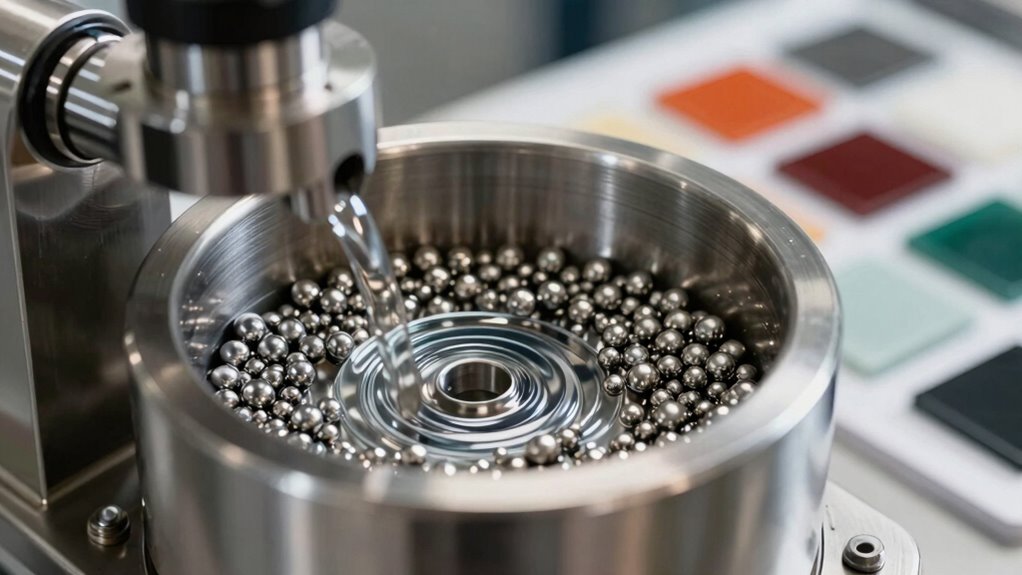
Choosing the right media for your bead mill is essential because it directly impacts grinding efficiency, product quality, and equipment lifespan. When selecting media, you want to focus on nano scale optimization, which allows you to achieve finer particle sizes more consistently. Smaller beads increase the surface area in contact with your material, leading to more effective grinding at a microscopic level. This not only improves the uniformity of your product but also guarantees that you’re reaching the desired fineness with fewer passes. As a result, you reduce overall processing time and minimize unnecessary wear on your equipment.
Choosing optimal media for your bead mill enhances efficiency, product quality, and equipment longevity through nano scale optimization.
Nano scale optimization also plays a critical role in reducing energy consumption. When you use the appropriate media size, the mill doesn’t have to work as hard to break down particles, which means less energy is wasted during operation. Smaller, optimized beads facilitate more efficient energy transfer, allowing you to get the same or better results with less power. This not only cuts costs on energy but also extends the lifespan of your mill, since it’s subjected to less mechanical stress over time. By carefully choosing media that promotes nano scale optimization, you’re effectively balancing performance with operational economy. Incorporating media size considerations helps tailor the grinding process to specific material requirements, ultimately improving overall efficiency.
Additionally, the material of your beads influences not just grinding efficiency but also the quality of your final product. For example, ceramic beads are resilient and less likely to introduce contamination, making them ideal for pharmaceutical or food-grade applications. On the other hand, zirconia beads offer superior durability and chemical resistance, suitable for aggressive formulations. Selecting the right media material ensures that your process remains consistent and free from impurities, ultimately contributing to a higher-quality output.
You should also consider the density and shape of your media. Denser beads tend to impart more energy, which can be advantageous for breaking down tough materials, but they also increase wear on your equipment. Spherical beads promote uniform grinding and reduce wear, extending your mill’s service life. Combining these factors—size, material, shape—aligns with your goals of nano scale optimization and energy efficiency, helping you fine-tune your process for maximum performance. Understanding media density and shape helps in tailoring the grinding process to specific material requirements, enhancing overall efficiency. Proper consideration of media durability can further ensure consistent performance over time without frequent replacements. Additionally, optimizing the media dispersion can help prevent agglomeration and improve the distribution of particles in your product. Incorporating media characterization techniques can also assist in selecting the most suitable media for your unique application. In essence, your choice of media isn’t just about achieving a finer grind; it’s about optimizing the entire process. It affects everything from energy consumption and equipment longevity to product consistency and purity. When you select the right media, you’re setting the stage for a more efficient, cost-effective, and high-quality production cycle.
As an affiliate, we earn on qualifying purchases.
Frequently Asked Questions
How Does Bead Size Affect Milling Efficiency?
You’ll notice that smaller bead size generally increases milling efficiency because it provides a larger surface area for particle contact, leading to faster grinding. However, very small beads may require more energy and might cause over-grinding or increased wear. Conversely, larger beads can handle higher loads but might reduce the efficiency of particle size reduction. Balancing bead size is essential to optimize your milling efficiency and achieve the desired product quality.
Can Media Type Influence Product Contamination?
Yes, media type can influence product contamination. You need to contemplate chemical compatibility to prevent unwanted reactions or impurities from leaching into your product. Also, different media types vary in cost; choosing the right one balances quality and budget. Using incompatible media might contaminate your formulation, affecting both safety and performance. Thus, selecting appropriate, compatible media is essential to maintain product purity and control costs.
What Is the Ideal Media Density for Specific Materials?
The ideal media density depends on your specific material and its compatibility with the media. Generally, lower media densities around 2.4-2.8 g/cm³ work well for delicate materials, while higher densities, like 3.0-4.0 g/cm³, suit tougher substances. You must consider material compatibility to prevent contamination or damage, ensuring efficient milling. Adjusting media density helps optimize your process, balancing energy input and product quality effectively.
How Often Should Bead Media Be Replaced?
You should replace bead media when it reaches the end of its media lifespan, which typically happens after several hundred hours of use or when it shows signs of wear like broken or frayed beads. The replacement frequency depends on your materials and operating conditions, but generally, inspecting the media regularly and replacing it once it deteriorates guarantees peak milling performance. Consistent replacement helps maintain efficiency and prevents contamination.
Are There Eco-Friendly Media Options Available?
Sure, eco-friendly alternatives exist, turning your bead mill into a champion of sustainability. Imagine swapping out toxic media for sustainable options that dance gently through your process, leaving a greener footprint. These sustainable media options reduce environmental impact and promote responsible manufacturing. So, yes, you can choose eco-friendly media options, making your process not just efficient but also kind to the planet. It’s a win-win for your formula and Mother Earth.
Conclusion
Choosing the right media for your bead mill is essential—it’s the difference between a flawless formula and a wasted effort. Did you know that improper media selection can reduce grinding efficiency by up to 50%? By understanding your materials and process needs, you can optimize performance and save costs. Don’t underestimate the power of the right media; it truly makes or breaks your results. Make informed choices, and watch your production quality soar.
Halloween Picks
halloween
As an affiliate, we earn on qualifying purchases.