

Choosing the right media size in bead milling can dramatically impact your dispersion quality. Smaller beads create finer particles and better uniformity but may increase process time and energy use. Larger beads handle higher throughput but might produce coarser results. Balancing media size with your process parameters guarantees *effective* particle size control and stability while minimizing wear and heat. Keep exploring further to understand how selecting the ideal media size can transform your dispersion outcomes.
Key Takeaways
- Smaller media increase surface area for finer, more uniform particle dispersion but may raise viscosity and equipment wear.
- Larger beads enable higher throughput and lower energy consumption but result in coarser particle sizes.
- Optimizing media size balances energy efficiency, dispersion quality, and process stability, directly impacting final product attributes.
- Fine media produce quicker particle size reduction but can generate heat, affecting dispersion stability and viscosity control.
- Proper media selection ensures consistent viscosity, stable dispersions, and adherence to industry standards for targeted product performance.

Bead milling dispersions are essential in producing uniform, high-quality suspensions for various industries, including paints, ceramics, and pharmaceuticals. Your goal is to achieve consistent particle size reduction, which directly impacts the final product’s performance and appearance. The choice of media size plays a crucial role here, as it influences how effectively you can break down particles and control viscosity. Smaller beads tend to create finer dispersions by providing a larger surface area for grinding, but they also require more energy and time. Conversely, larger beads can handle higher throughput but might not reach the same level of fineness, affecting the particle size distribution. Striking the right balance between media size and process parameters is vital for optimizing your dispersion quality.
When working with bead milling, you need to pay close attention to how media size impacts viscosity control. Particle size reduction often leads to a decrease in viscosity because smaller particles pack more densely, reducing flow resistance. However, if the beads are too small or the milling process is overly aggressive, you risk over-grinding, which can cause excessive viscosity rise or destabilize the suspension. This delicate interplay means you must carefully tailor the media size based on the material’s properties and the desired final particle size. Proper control over particle size ensures that your dispersion remains stable, flows smoothly, and maintains the right consistency throughout processing and application. Additionally, understanding the relationship between media size and essential oil properties can help optimize formulations for specific industry needs.
Your choice of media size also affects energy consumption and processing efficiency. Larger beads can reduce energy demand but may require longer milling times to reach your target particle size, which could impact productivity. Smaller beads, while more effective at producing finer particles quickly, can increase wear on equipment and generate more heat, potentially affecting product stability. Monitoring viscosity during milling helps you identify optimal conditions, preventing issues like gelation or phase separation. The goal is to achieve a narrow particle size distribution that enhances the dispersion’s stability, flow characteristics, and end-use performance.
Ultimately, selecting the appropriate media size isn’t just about achieving the smallest particle size—it’s about balancing efficiency, energy use, and viscosity control to produce a dispersion that meets your specific quality standards. You need to consider your material’s nature, the target particle size, and process constraints. Fine-tuning these parameters ensures you create a high-quality dispersion that performs reliably in its final application, whether in coatings, ceramics, or pharmaceuticals. Mastering media size choices empowers you to control particle size and viscosity effectively, transforming the bead milling process into a precise tool for superior dispersion quality.
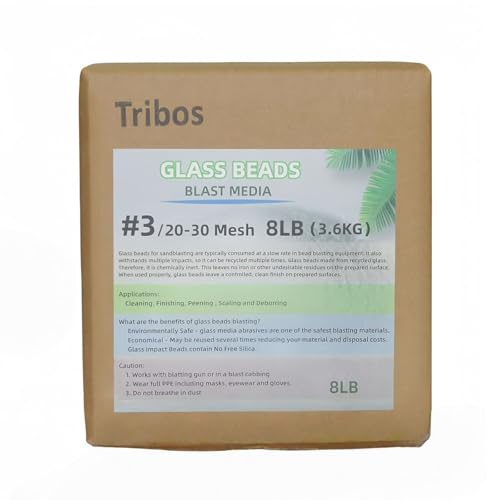
Glass Bead Media for Sandblasting – 8LB Non-Silica Reusable Blasting Abrasive for Rust Removal & Surface Finishing – Multiple Mesh Options (# 3 (20~30Mesh))
- Mesh Range for Precise Control: 20–240 mesh for various tasks
- Gentle Cleaning, No Surface Damage: Effective yet gentle on surfaces
- Compatible with Standard Equipment: Works with blasting cabinets and compressors
As an affiliate, we earn on qualifying purchases.
As an affiliate, we earn on qualifying purchases.
Frequently Asked Questions
How Does Media Size Affect Dispersion Stability Over Time?
You’ll find that smaller media size enhances dispersion stability over time by reducing particle attrition, which prevents the generation of fines that can cause aggregation. Smaller media also promotes better dispersion uniformity, ensuring particles stay evenly distributed. Larger media may cause more attrition, leading to inconsistent dispersions and potential instability. Thus, selecting the appropriate media size is vital for maintaining long-term stability and a uniform dispersion in your process.
What Are the Environmental Impacts of Different Bead Sizes?
You might think smaller beads are eco-friendly, but they often require more energy to produce and generate more waste, complicating waste management. Larger beads, while seemingly less resource-intensive, can cause more abrasion and release microplastics, harming ecosystems. Choosing eco-friendly materials for bead milling minimizes environmental impact. Ultimately, your decision impacts waste management strategies and the planet’s health, reminding you that size isn’t always the greener choice.
Can Smaller Beads Reduce Processing Time Significantly?
Yes, smaller beads can substantially reduce processing time because they create more intense shear forces, breaking down particles faster. When selecting bead material, guarantee compatibility with your dispersant to prevent contamination or damage. Additionally, consider dispersant compatibility, as it influences the efficiency of milling. Using smaller beads with suitable material and dispersant can optimize your process, saving time and improving dispersion quality.
How Do Media Size Choices Influence Energy Consumption?
While choosing smaller media can seem like a gentle touch, it actually influences energy consumption through media density and shape. Smaller beads often require less energy to move, reducing overall use, yet their shape can either optimize or hinder this effect. You’ll find that carefully selecting media size and shape balances energy efficiency with effective dispersion, making your process more sustainable and cost-effective.
Are There Industry Standards for Optimal Bead Sizes?
Yes, industry benchmarks guide your choice of ideal bead sizes, typically ranging from 0.1 to 1 mm for most dispersions. You should consider size selection criteria like particle size reduction goals, energy efficiency, and dispersion stability. Smaller beads provide finer dispersions but may increase energy consumption, while larger beads can reduce energy use but might not achieve the desired fineness. Balancing these factors helps maximize your milling process effectively.
Conclusion
Choosing the right bead size isn’t just a detail—it’s the difference between a smooth, uniform dispersion and a chaotic, inconsistent one. Smaller beads may offer finer finishes, but larger beads can speed up processing and reduce wear. It’s a balancing act, where precision meets efficiency. When you understand how media size alters your results, you gain control over quality and productivity—proving that in bead milling, the smallest choices can make the biggest impact.