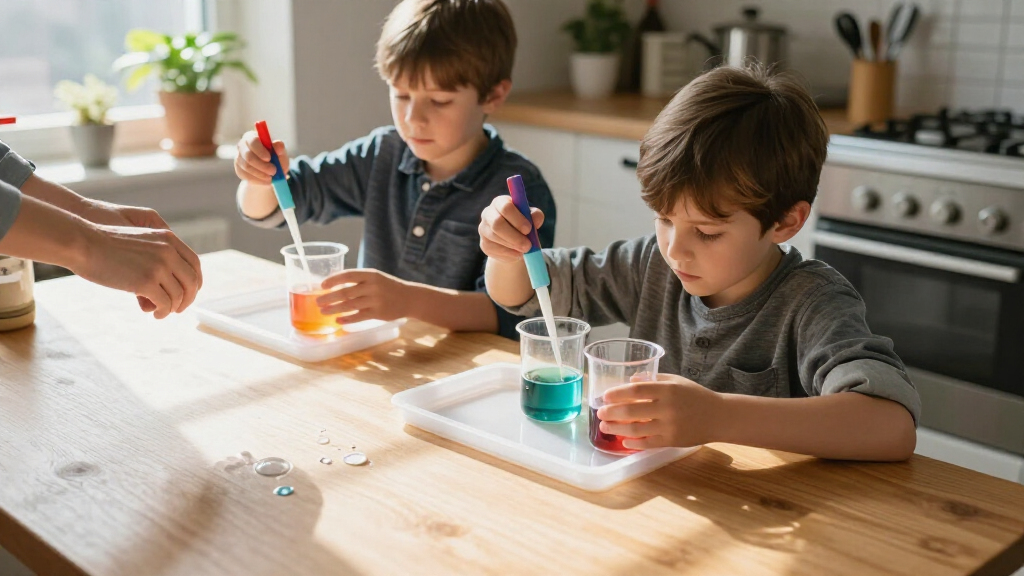

Choose a science experiment kit your child can use safely, then set up and complete one activity together. This guide is for adults helping children explore science at home, including first-time kit users. Allow about 30 minutes for a simple activity or up to two hours for experiments that need setup, waiting time, or cleanup. By the end, you should have a finished experiment, a child’s observations, and a clear idea of what to try next.

Get school and study supplies delivered free — and shop member deals
- Fast, free delivery on millions of items
- Access to Prime Big Deal Days deals on October 6–7
- Prime Video, Amazon Music and more included

VATOS Space Science Circuit Kit for Kids, 31 Pieces
- ✔ Recommended age: 6+
- ✔ Pieces: 31
- ✔ Project ideas: More than 100

Butterfly EduFields My First Light & Optics Science Kit
- ✔ Age range: 6 years and up
- ✔ Missions: 20
- ✔ Mission book: 72-page illustrated book

LUCKY GUESS 8-in-1 STEM Science Kit for Kids
- ✔ Age range: 8–14 years
- ✔ Models: 8
- ✔ Materials: Wood and plastic
Difficulty: Beginner | Time: 30 minutes to 2 hours, depending on the experiment
What You’ll Need
Tools & Materials:
- A science experiment kit with its instruction booklet and all listed parts
- The kit’s recommended safety equipment, such as goggles or gloves
- A stable, easy-to-clean work surface
- Paper towels, a small rubbish bag, and a notebook or paper
- A timer, measuring cup, or other household item if the instructions request one
Knowledge:
- An adult should be able to read and follow the kit instructions before starting
- The child should be able to follow simple directions with age-appropriate adult supervision
Check the box for the age range, supervision guidance, safety labels, and any materials you must provide. Read the full instructions before opening packets or mixing materials. Set aside enough uninterrupted time to finish the activity and clean up; some experiments need extra time for growing, cooling, drying, or other changes.
VATOS Space Science Circuit Kit for Kids, 31 Pieces
For a child who wants to make something light up, spin, or launch, VATOS puts basic circuits at the center of the activity. Its 31 snap-together pieces are presented as the basis for more than 100 space-themed projects, including a rocket launcher, light-up astronaut, and rotating radar. That project-led format gives children many ways to recombine familiar components, while the illustrated guide can help them follow each build without tools or soldering.Compared with Butterfly EduFields, VATOS ranges across many circuit configurations rather than taking a deeper tour through one science subject. Compared with LUCKY GUESS, it stays more focused on electricity and interactive builds instead of mixing in optics, solar energy, and magnetic levitation. Its age guidance begins at six, but adult supervision is called for as appropriate to the child’s age. The ABS components and circuit focus also make it less suited to families seeking open-ended natural science experiments or tactile materials such as wood.
Pros:
- Modular parts support many different circuit builds
- Illustrated guide provides step-by-step project direction
- Snap-together assembly needs no tools or soldering
- Space-themed creations make electrical concepts tangible
Cons:
- The activities concentrate on circuits rather than a broad range of sciences
- Adult supervision is recommended according to the child’s age
Best for: Children who enjoy building, lights, and space-themed circuit projects, with an adult nearby when their age or experience calls for supervision.
Not ideal for: Families looking for a broad mix of science topics, experiments based on reusable optics materials, or a kit without an adult-supervision consideration.
Bottom line: We rank VATOS first for children who learn by building, because its modular circuit projects offer more repeated hands-on variation than the topic-focused optics missions or LUCKY GUESS model set.
“We rank VATOS first for children who learn by building, because its modular circuit projects offer more repeated hands-on variation than the topic-focused optics missions or LUCKY GUESS model set.”
Butterfly EduFields My First Light & Optics Science Kit
Butterfly EduFields is the most coherent choice when a child is curious about how light behaves. Its 20 missions connect reflection, refraction, color, and optical illusions through materials such as mirrors, color films, illusion cards, and spy tools. The 72-page illustrated mission book gives the activities a structured, story-driven path, which can help a young learner stay engaged beyond a single demonstration.Unlike VATOS, this kit does not offer a wide menu of circuit builds; its strength is returning to one field from several angles. That focus also distinguishes it from LUCKY GUESS, which mixes optics with solar power and magnetic levitation but offers fewer described learning areas in its model set. The reusable materials suit repeat exploration, though the kit’s narrow subject scope is a real limitation for children who want to switch between unrelated types of science. Its listed age range starts at six, making it a more explicitly younger-child option than LUCKY GUESS.
Pros:
- Twenty missions explore several connected optics concepts
- Illustrated 72-page mission book gives activities a story-led structure
- Reusable materials support repeating and comparing experiments
- Includes mirrors, color films, illusion cards, and spy tools
Cons:
- The subject is limited to light and optics
- Children wanting circuits or broad engineering projects may prefer VATOS or LUCKY GUESS
Best for: Children aged six and up who enjoy visual puzzles, secret codes, and guided activities about light, color, and optical effects.
Not ideal for: Children seeking circuits, a broad set of unrelated science topics, or an emphasis on constructing many different mechanical models.
Bottom line: We place Butterfly EduFields second because it offers the strongest guided exploration of a single science topic, though it has less subject variety than the other two kits.
“We place Butterfly EduFields second because it offers the strongest guided exploration of a single science topic, though it has less subject variety than the other two kits.”
LUCKY GUESS 8-in-1 STEM Science Kit for Kids
LUCKY GUESS is for families who want a child to move between different kinds of STEM ideas within one kit. Its eight wooden models and experiments include a solar-powered car, fan, periscope, and magnetic levitation project, introducing concepts from energy, optics, and magnetism. Snap-fit parts and the no-tools setup lower the barrier to starting a build, while the included manual and coloring markers add a simple creative element.Compared with VATOS, LUCKY GUESS offers more subject variety but fewer stated project possibilities; it is a set of eight models rather than a large collection of circuit combinations. Compared with Butterfly EduFields, it touches optics as one component of a wider assortment, while the latter provides a more sustained sequence of optics missions and reusable investigation materials. The 8–14 age range makes this better suited to older children than the two options listed for ages six and up. Solar-powered projects also depend on suitable sunlight, and the materials include plastic as well as wood.
Pros:
- Eight projects span multiple STEM concepts
- Includes solar, optics, and magnetic levitation activities
- Snap-fit assembly requires no tools or batteries
- Can suit independent building or parent-child activities
Cons:
- Some solar projects depend on suitable sunlight
- Materials include plastic as well as wood
- Its listed age range starts higher than the other two kits
Best for: Children aged 8–14 who like assembling models and want to explore several areas, including solar energy, optics, and magnetic levitation.
Not ideal for: Younger children seeking an explicitly age-six-and-up kit, families wanting extensive circuit combinations, or learners who prefer a deep dive into optics.
Bottom line: We rank LUCKY GUESS third because it gives older children a useful cross-topic model set, but VATOS offers more circuit variety and Butterfly EduFields more depth in a single science area.
“We rank LUCKY GUESS third because it gives older children a useful cross-topic model set, but VATOS offers more circuit variety and Butterfly EduFields more depth in a single science area.”
As an Amazon Associate we earn from qualifying purchases.
Before You Start
Pick an activity that fits the child’s age, attention span, and interests. The age label is a useful starting point, but adult judgment matters too: small parts, heat, glass, sharp tools, powders, and liquids may need close supervision or may be unsuitable for a particular child. Do not use a kit with missing safety information, damaged containers, or materials that have spilled or changed unexpectedly.
Keep food and drinks away from the experiment area. Do not taste kit materials, mix substances from different activities, or use household chemicals as substitutes unless the instructions explicitly allow them. Follow the booklet’s disposal directions and local rules. If the instructions are unclear about safe handling or disposal, skip that activity and contact the kit maker for guidance.
Step-by-Step Instructions
Step 1: Choose one suitable activity
Choose one experiment from the booklet that matches the child’s age, interests, and available time. Read the activity from beginning to end, including its safety notes, material list, and cleanup directions. Identify any adult-only tasks, such as heating water or using a tool. If the child is new to experiments, choose an activity with a few clear steps and visible results.
Tip: Let the child choose between two activities you have already checked for age and safety. Too many choices can make it harder to get started.
Check: You can explain what the activity will test, how long it may take, and which parts require adult help.
Step 2: Check the kit and gather supplies
Compare the activity’s material list with the kit contents and the items at home that the booklet requests. Count small pieces, check that containers are closed and intact, and set out only the supplies needed for this experiment. Keep materials from other activities packed away so they cannot be mixed by mistake. If a required part is missing, pause and contact the seller or manufacturer; do not guess at a replacement for a measuring, safety, or chemical component.
Tip: Take a quick photo of the parts before the activity. It can help you return them to the right compartments afterward.
Check: Every listed item is present, and you have identified any household supplies the instructions require.
Step 3: Prepare a safe work area
Choose a level surface with enough room for the instructions, materials, and the child to work without reaching across active parts. Move food, drinks, pets, and unrelated objects away. Cover the surface if the booklet recommends it or if spills are likely. Place paper towels and a rubbish bag within adult reach, and put on the safety equipment the instructions specify. Keep younger children who are not taking part away from small parts and experiment materials.
Tip: If the activity involves liquids, work near a sink or on a tray, but do not use a sink as the work surface unless the instructions say to.
Check: The child has room to follow directions, and safety supplies and cleanup materials are easy to reach.
Step 4: Explain the question and make a prediction
Read the experiment’s question together. Ask the child what they think will happen and why. Write down the prediction in their own words before beginning; it does not need to be correct. If the activity compares two conditions, such as warm and cool water, point out what will change and what should stay the same. Keep the explanation short enough that the child can repeat the main question.
Tip: Try prompts such as “What do you notice?” and “What do you think will happen next?” Avoid telling the child what the result should be.
Check: The child can describe the question and has made a prediction before seeing the result.
Step 5: Follow the instructions in order
Work through one instruction at a time. Let the child do the safe parts, such as counting pieces, pouring a permitted amount, or starting a timer, while you handle any adult-only task. Measure as directed rather than estimating. Use only the quantities and materials named in the booklet, and wait for each stated time before moving on. Stop if a container leaks, a material behaves unexpectedly, or a step does not match what you see.
Tip: Keep the booklet open to the current step. Do not combine steps to save time; order and waiting periods can affect the result.
Check: The activity has followed the booklet’s sequence, with the specified amounts and timing.
Step 6: Observe and record what happens
Ask the child to describe what they see, hear, or measure at each observation point in the instructions. Write down the result, including a number or time if the activity asks for one. Add a simple drawing or use comparison words such as “larger,” “cloudier,” or “slower.” Record what actually happened, even when it differs from the prediction. Do not change a measurement to make it fit the expected result.
Tip: Use the same measuring method for each comparison. For example, read a ruler from the same starting point each time.
Check: You have at least one observation recorded, and it reflects the result rather than what you expected.
Step 7: Discuss the result and clean up
Compare the observation with the original prediction. Ask the child what surprised them and what they might change in another trial. Read the disposal directions before emptying or washing anything; some materials should not go down a drain. Have an adult handle disposal when the booklet directs it. Put reusable pieces away only after they are clean and dry as instructed, and wash hands after handling experiment materials.
Tip: A different result does not mean the experiment failed. Check whether the directions were followed, then treat the observation as something to investigate.
Check: The child can describe what happened, and the materials and work area have been cleaned up according to the booklet.
Common Mistakes to Avoid
- Choosing a kit because of its pictures without checking the age label or adult supervision notes. — Read the age range and safety information on the box and for the specific activity. Choose a different experiment if its materials or steps are not suitable for the child.
- Starting before checking the full material list. — Read the activity through first and gather every required item. This avoids leaving a mixture waiting while you search for a timer or household supply.
- Changing quantities, timing, or materials to get a faster or more dramatic result. — Follow the stated amounts and wait periods. If you want to test a change, finish the original procedure first and make only one planned change in a later trial.
- Treating a prediction as the correct answer and overlooking the actual observation. — Record what happened in plain words or numbers before discussing why. Use unexpected results as a reason to check the steps or repeat the activity.
Troubleshooting
Problem: A listed component is missing or damaged.
Solution: Stop before starting that activity. Check the package compartments and packing materials, then contact the kit maker or seller for the correct replacement. Do not improvise a substitute for a safety item or measured material.
Problem: The result looks different from the booklet’s example.
Solution: Check the order, quantities, temperature guidance, and waiting time against the instructions. Record the result you saw. If the activity remains safe, repeat it with the same materials and measurements; change one condition only if the booklet supports that comparison.
Problem: The child loses interest while waiting for a result.
Solution: Use the waiting time to draw the setup, read the next instruction, or write down a prediction about what may happen. Stay nearby if the experiment needs supervision, and do not leave active materials unattended.
Problem: A spill or unexpected reaction occurs.
Solution: Move the child away from the material and follow the kit’s spill or emergency directions. Ask an adult to handle cleanup using the specified protection. If the booklet gives no safe cleanup guidance, avoid touching the material and contact the manufacturer or local emergency service as appropriate.
What Success Looks Like
The activity is complete when the child has followed the instructions with the required adult supervision, made at least one observation, and discussed how the result compared with the prediction. The experiment does not have to match a picture or produce a dramatic change. A clear written note, number, or drawing of what actually happened counts as a useful result. The work area should be clean, materials should be stored or disposed of as directed, and the child should know which parts an adult handled for safety.
Next Steps
Store the booklet with the kit and note any used-up supplies before putting the box away. Ask the child to choose one question raised by the result, then check whether the booklet offers another activity that explores it. Repeat an experiment only when the instructions allow it and you have enough materials for a fair comparison. If the child wants to change one condition, write down the change first and keep the other steps the same. Replace missing safety equipment before using the kit again, and follow the manufacturer’s guidance for storing any remaining materials.
Frequently Asked Questions
Should I do the experiment before my child?
Read the instructions in advance. A trial run can help with unfamiliar timing or setup, but do not use materials in a way the booklet prohibits. For a simple activity, reading the full procedure may be enough.
What should I do if the experiment does not work?
Record what happened, then compare each step with the booklet. Check amounts, timing, and any stated conditions. Repeat only if the directions permit it and the materials remain safe to use. A result that differs from the example can still lead to a useful discussion.
Can I replace a missing kit material with something from home?
Use a household substitute only when the instructions name it or the manufacturer confirms it is suitable. A substitute may change the result or create a safety concern, especially for measured materials and protective equipment.
How closely should I supervise my child?
Follow the supervision guidance on the box and in the activity instructions. Stay close enough to manage any adult-only steps and respond to spills or unexpected changes. Increase supervision when the child is young or the activity includes small parts, tools, heat, or liquids.
How can I make the activity feel like science instead of a craft?
Have the child state a question, make a prediction, observe a result, and describe what the result suggests. A drawing or measurement helps them compare the prediction with what happened, even when the experiment also involves building or decorating.
Halloween Picks
halloween
As an affiliate, we earn on qualifying purchases.