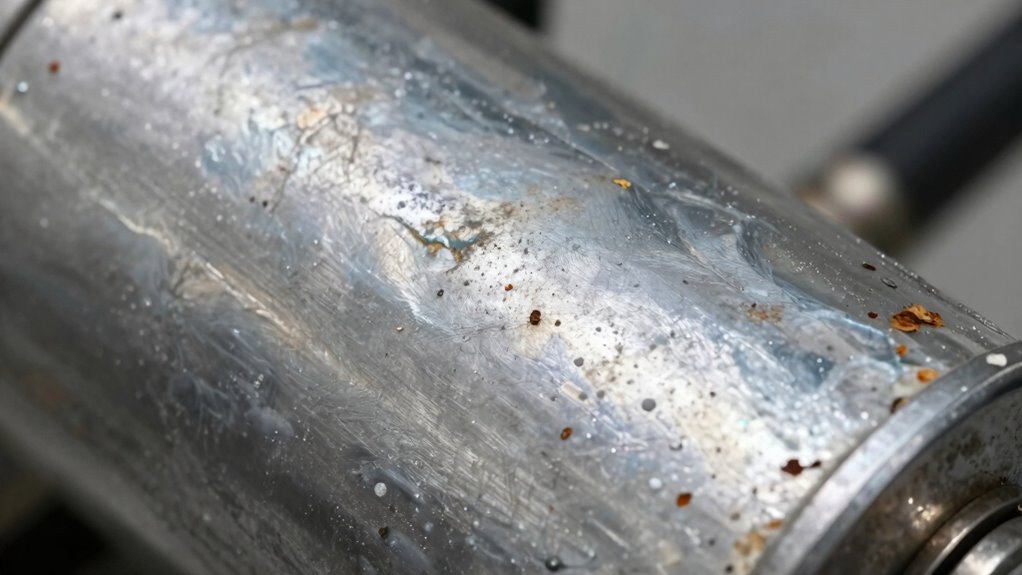

Salt spray test results show how coatings resist corrosion in controlled, surface-level conditions, but they don’t guarantee long-term durability in real-world environments. Passing these tests can be misleading because they don’t account for complex corrosion processes, environmental factors, or aging of the coating. Many coatings can appear fine initially but develop problems over time. If you want to understand why this happens and how to better evaluate coatings, there’s more to uncover below.

Get school and study supplies delivered free — and shop member deals
- Fast, free delivery on millions of items
- Access to Prime Big Deal Days deals on October 6–7
- Prime Video, Amazon Music and more included
Key Takeaways
- Salt spray tests only assess surface corrosion, not long-term or internal damage that can develop later.
- Passing results reflect initial resistance; environmental factors and mechanical wear can cause failure over time.
- Laboratory conditions differ from real-world environments, which include pollutants and climate stresses accelerating deterioration.
- Coatings may develop microcracks or flaws after application, allowing corrosion to initiate despite a “pass” score.
- Test outcomes should be part of a broader evaluation, as they do not guarantee durability under actual field conditions.

Understanding salt spray results is essential to evaluating how well a material resists corrosion in harsh environments. When you look at test outcomes, it’s tempting to assume that a coating labeled as “pass” guarantees long-term durability. However, these results often don’t tell the full story, because corrosion mechanisms can be complex, and coating degradation can occur in ways that aren’t immediately visible during testing. Salt spray tests simulate a corrosive environment by exposing coated samples to a continuous salt fog, but they primarily measure surface-level corrosion resistance. While a coating may withstand this initial exposure, that doesn’t necessarily mean it will perform well in real-world conditions, where factors like mechanical wear, temperature fluctuations, and exposure to pollutants come into play.
Salt spray tests assess surface corrosion but don’t guarantee long-term durability in real-world conditions.
One key aspect to understand is that corrosion mechanisms can be different from what the salt spray test reveals. Corrosion isn’t just about rust forming on the surface; it involves chemical reactions that penetrate beneath the coating, often leading to hidden damage. For example, pitting corrosion or underfilm corrosion can occur even if the surface appears intact during a salt spray test. This means a coating might seem to pass initially because it resists surface corrosion, but it could still be vulnerable to coating degradation over time. The test mainly measures early-stage resistance, not the long-term resilience of the coating system.
Coating degradation can happen in multiple stages. Initially, the coating might resist the salt fog effectively, but microscopic flaws or microcracks can develop over time, especially if the coating wasn’t applied properly or if it’s subjected to mechanical stress. These flaws allow chloride ions to penetrate, accelerating corrosion beneath the surface. As corrosion progresses, it can cause the coating to delaminate, crack, or peel — all of which aren’t always visible in short-term salt spray tests. That’s why a coating that “passes” the test isn’t necessarily immune to failure in the field. The test provides valuable data about initial resistance, but it doesn’t account for the full spectrum of environmental stresses that can lead to coating breakdown.
Additionally, testing conditions can vary significantly from actual field environments, which can influence the durability of coatings in ways not captured during laboratory assessments. Field performance depends on many factors, including application quality, environmental conditions, and the specific corrosion mechanisms at play. Recognizing that coatings can degrade in ways not captured by these tests helps you make better decisions about material selection, maintenance, and long-term protection strategies. A “pass” in a salt spray test is a good starting point, but it shouldn’t be the sole measure of a coating’s durability or its ability to withstand real-world challenges.
corrosion resistant coating spray
As an affiliate, we earn on qualifying purchases.
As an affiliate, we earn on qualifying purchases.
Frequently Asked Questions
How Does Environmental Exposure Affect Coating Longevity?
Environmental exposure accelerates coating degradation by exposing it to factors like humidity, temperature fluctuations, and pollutants, which influence corrosion mechanisms. These environmental factors can cause coatings to weaken or crack over time, allowing moisture and corrosive elements to reach the substrate. Even if a coating passes salt spray tests, prolonged real-world exposure can still lead to failure, especially if it doesn’t effectively resist these environmental challenges.
What Are the Best Practices for Coating Maintenance?
To guarantee coating longevity, you should follow regular maintenance schedules and conduct coating inspections routinely. Clean surfaces thoroughly to remove dirt and salt, and promptly address any signs of damage or corrosion. Reapply protective coatings as needed, especially in high-exposure areas. Consistent inspection and maintenance help catch issues early, preventing costly failures. By staying proactive, you extend the life of your coatings and improve their overall performance in harsh environments.
Can Salt Spray Test Results Predict Real-World Corrosion?
You might think salt spray tests predict real-world corrosion, but they can be misleading. Coincidentally, these tests focus on specific corrosion mechanisms, yet testing limitations mean they don’t account for all field conditions. While a coating may pass, it doesn’t guarantee long-term protection. You should supplement salt spray results with actual field testing, understanding that real-world environments introduce variables that laboratory tests can’t fully replicate.
How Do Different Coating Materials Compare in Corrosion Resistance?
You’ll find that different coating materials vary in corrosion resistance mainly because of surface porosity and coating adhesion. A coating with low porosity prevents salt and moisture from reaching the substrate, enhancing durability. Strong coating adhesion guarantees the coating stays intact during exposure. Materials like epoxy often outperform paints with higher porosity, offering better protection. Always consider both factors when selecting coatings for corrosion-prone environments to guarantee long-lasting performance.
What Role Do Application Techniques Play in Coating Performance?
Applying coatings is like painting a masterpiece—you need precision to guarantee even coverage. Your application techniques directly affect coating uniformity, which is vital for maximum corrosion resistance. If you rush or skip steps, uneven layers can develop weak spots, leading to failures despite a good formulation. Focus on application precision, control spray parameters, and maintain proper conditions to maximize performance and longevity of your coatings.
Conclusion
While a coating may pass salt spray tests, it doesn’t guarantee lifelong protection. You might see no corrosion in the lab, but real-world conditions—UV rays, temperature fluctuations, and mechanical wear—can still cause failure. So, don’t rely solely on test results. Instead, understand that passing a salt spray test is just one piece of the puzzle; actual field performance depends on multiple factors working together, reminding you that perfection in the lab doesn’t always translate to durability in the field.
Halloween Picks
halloween
As an affiliate, we earn on qualifying purchases.