
UV-curable resins for 3D printing are specialized materials that harden quickly when exposed to UV light, allowing you to create detailed and complex parts fast. These resins include photoinitiators, monomers, and additives that enable customization for flexibility, strength, or transparency. Their rapid curing reduces post-processing and waste, providing precise control over your prints. If you’re interested, you’ll discover more about how formulation choices impact quality and application possibilities as you explore further.
Key Takeaways
- UV-curable resins contain photoinitiators, monomers, oligomers, and additives for rapid solidification under UV light.
- They enable high-precision, detailed 3D prints with smooth surface finishes.
- Formulations can be customized for flexibility, rigidity, transparency, or high-temperature resistance.
- Rapid curing times reduce post-processing and support complex geometries.
- Advances in resin formulations improve print quality, durability, and expand application possibilities.
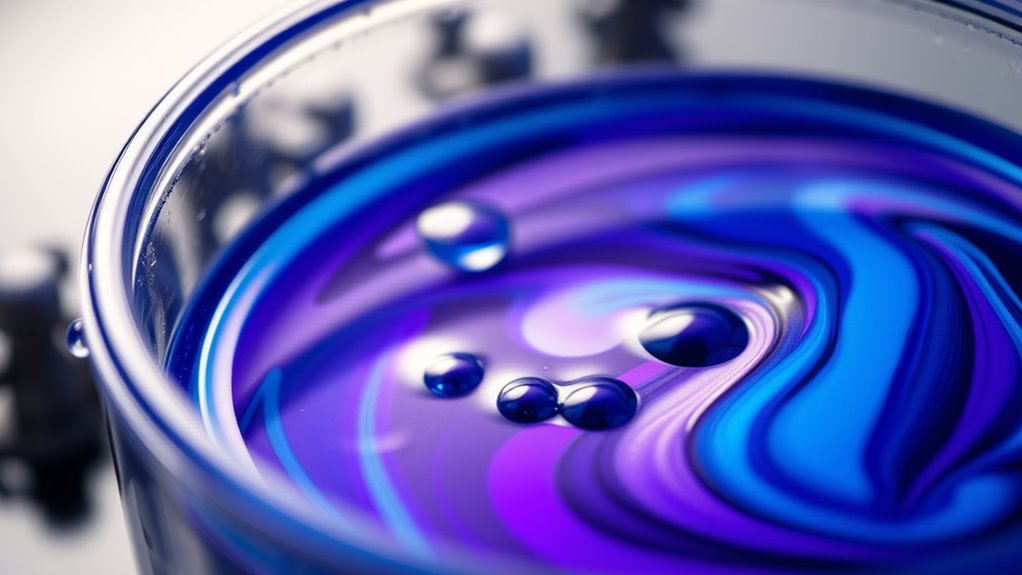
Have you ever wondered how UV-curable resins revolutionize 3D printing? These advanced materials have transformed the way you create intricate, high-precision objects with speed and accuracy. At the core of this technology are specially designed resin formulations that enable rapid curing when exposed to ultraviolet light. These formulations contain photoinitiators, monomers, oligomers, and additives that work together to produce a resin that’s both adaptable and durable. The choice of resin formulation directly influences the quality, flexibility, and strength of your finished print, giving you the power to customize materials based on specific project requirements.
UV-curable resins enable rapid, precise 3D printing with customizable formulations for durability and flexibility.
When you start a print, the curing process kicks off almost instantly once the UV light hits the resin surface. This process involves the photoinitiators absorbing UV energy, which then triggers polymerization—turning the liquid resin into a solid. The speed of this curing process is one of the key advantages of UV-curable resins. Unlike traditional thermoplastic or thermoset processes, UV curing occurs in seconds to minutes, allowing you to produce complex geometries rapidly without lengthy post-processing. This quick turnaround saves you time and reduces waste, making it ideal for rapid prototyping, dental applications, jewelry, and even small-batch manufacturing.
The precision of the curing process means you can achieve highly detailed features and smooth surface finishes, especially when you fine-tune the resin formulations for specific tasks. For example, some resins are developed to offer flexibility while others are optimized for rigidity and high-temperature resistance. You can select formulations that best suit your project, whether you need a transparent, impact-resistant component or a highly elastic part. Additionally, the curing process can be controlled by adjusting parameters like light intensity, exposure time, and layer thickness, giving you a level of control that enhances the accuracy and consistency of your prints.
Understanding resin formulations and curing processes empowers you to optimize your 3D printing workflow. By choosing the right resin for your application, you guarantee that the curing is thorough and uniform, reducing defects and improving overall quality. As UV-curable resins continue to evolve, their formulations become even more sophisticated, offering better performance, faster curing times, and a broader range of material properties. With this knowledge, you can push the boundaries of your designs, producing highly detailed, functional parts in a fraction of the time traditional methods require. Additionally, proper formulation plays a crucial role in achieving desired material properties and ensuring the success of your print.
Frequently Asked Questions
Are Uv-Curable Resins Environmentally Friendly?
UV-curable resins aren’t entirely eco-friendly due to biodegradability concerns, as many contain chemicals that persist in the environment. You can look for eco-friendly alternatives made from biodegradable or less toxic materials, which help reduce environmental impact. While some resins are designed to be safer, it’s essential to handle and dispose of them responsibly to minimize harm to ecosystems. Choosing greener options supports sustainability in 3D printing practices.
How Do Uv-Curable Resins Affect Long-Term Durability?
UV-curable resins generally provide good long-term durability, but you should watch for material aging that can cause brittleness or cracks over time. Their mechanical properties may degrade with prolonged exposure to sunlight or moisture, impacting the strength and flexibility of your prints. To guarantee lasting performance, consider applying protective coatings or choosing resins specifically designed for enhanced durability, especially for applications requiring long-term stability.
Can Uv-Curable Resins Be Recycled or Reused?
They say “waste not, want not,” but UV-curable resins are tricky to recycle or reuse. You can try recycling methods like filtering and reprocessing, but reuse challenges remain due to resin degradation and loss of properties. Reusing them isn’t straightforward; often, the resin’s quality diminishes after initial use. So, while some steps exist, fully recycling UV-curable resins still needs more development.
What Are the Safety Precautions During Handling?
When handling UV-curable resins, you should always wear personal protective equipment like gloves and goggles to prevent skin and eye contact. Make certain proper ventilation in your workspace to avoid inhaling fumes. Keep containers sealed when not in use, and wash your hands thoroughly afterward. Follow manufacturer instructions for safe handling, and store resins away from heat or direct sunlight to maintain safety during use.
How Do Different Resin Formulations Impact Print Quality?
Different resin formulations markedly impact your print quality. Higher resin viscosity may cause difficulty in flow, leading to imperfect details, while lower viscosity guarantees smoother layer formation. Color stability plays an essential role in maintaining consistent appearance, especially for detailed models. Choosing the right formulation balances viscosity and color stability, resulting in sharper prints with vibrant, consistent colors. Always test different formulations to optimize your printing results effectively.
Conclusion
In the world of 3D printing, UV-curable resins are your secret weapon, offering precision and speed like a well-tuned orchestra. As you explore their potential, remember they’re the brush and canvas of your creative masterpiece. With these resins, you’re not just building objects—you’re sculpting innovation. Embrace their versatility, and watch your ideas come to life with the effortless grace of a bird in flight, transforming your visions into tangible reality.