

Your screen’s chemistry differs greatly between OLED and LCD displays. OLEDs use organic compounds that emit light when electricity passes through, allowing for deep blacks and vibrant colors. LCDs rely on liquid crystals and a backlight to create images, which limits contrast and causes color shifts. Understanding these chemical and structural differences explains why OLEDs offer better contrast and wider angles, while LCDs excel in brightness—if you wish to know more about their inner workings, keep exploring.

Get school and study supplies delivered free — and shop member deals
- Fast, free delivery on millions of items
- Access to Prime Big Deal Days deals on October 6–7
- Prime Video, Amazon Music and more included
Key Takeaways
- OLEDs use organic carbon-based molecules that emit light when electrically excited, enabling self-emissive pixels.
- LCDs rely on liquid crystal molecules that change orientation to modulate light passing through color filters.
- OLED organic layers include emissive compounds like polyfluorene and phosphorescent complexes, which produce light at the chemical level.
- Charge transport layers in OLEDs are made from aromatic amine derivatives that facilitate electron and hole movement chemically.
- Encapsulation in OLEDs involves thin-film barriers protecting sensitive organic materials from oxygen and water that cause chemical degradation.
Understanding OLED and LCD Structures
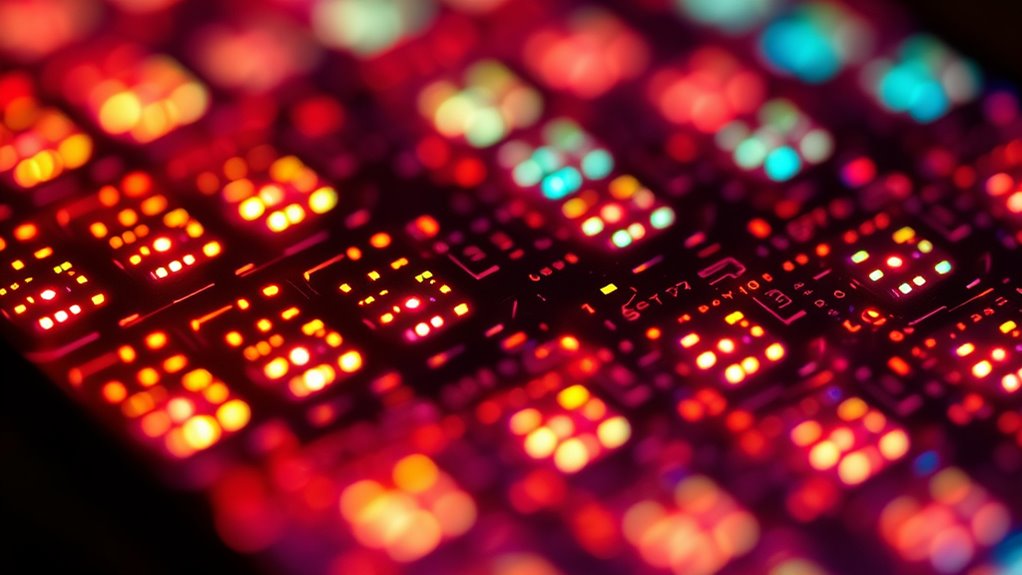
To understand the differences between OLED and LCD displays, it’s *essential* to examine their structures. OLED screens consist of an organic material layer that emits light when an electric current passes through it. They’ve electrode layers—anode and cathode—that apply voltage to this organic layer. The substrate, usually glass or flexible plastic, supports the components and allows for bending. Each pixel contains red, green, and blue subpixels, enabling vibrant colors and high contrast. Because OLEDs are self-emissive, they don’t need a backlight, resulting in thinner, more flexible displays. In contrast, LCDs rely on a backlight source, typically LED, to illuminate the liquid crystal layer. They include polarizing layers and drive circuits to control light passage, making them generally thicker but more durable. OLEDs are more susceptible to burn-in caused by static images, which is an important consideration in display design. Additionally, the liquid crystal technology used in LCDs is sensitive to temperature variations, impacting their performance in different environments.
How Light Is Emitted and Controlled
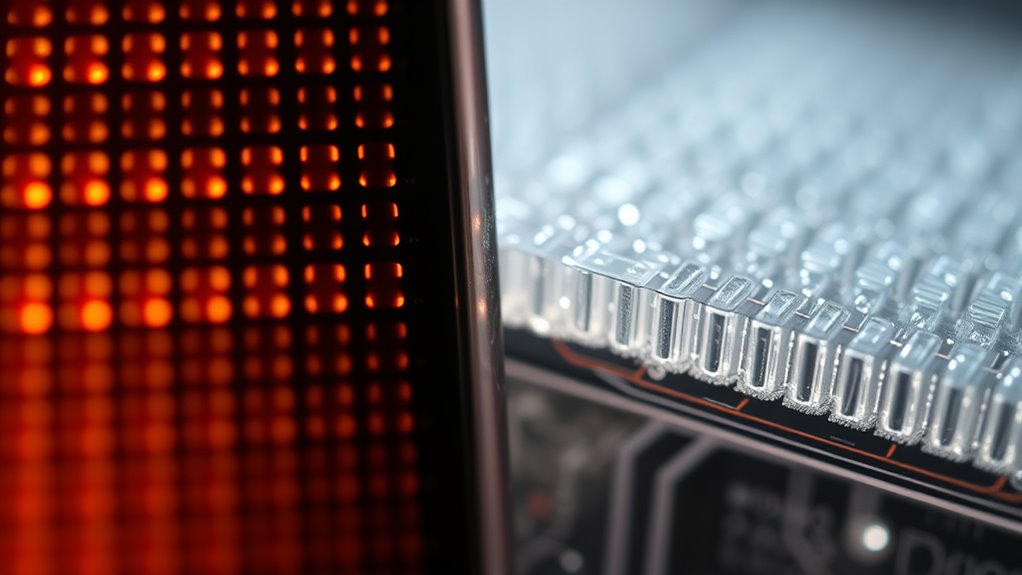
Understanding how light is emitted and controlled in LCD displays reveals the fundamental differences from OLEDs. In LCDs, a backlight shines through liquid crystals that modulate light to create images. You depend on this backlight, which remains on regardless of what’s displayed, affecting contrast and energy efficiency. The backlight can be of different types, such as LED or CCFL, influencing display quality and power consumption. Unlike OLEDs, LCDs can’t turn off individual pixels completely, limiting their contrast ratio. They also tend to emit more blue light, which can cause eye strain. The blue light emitted by LCDs can contribute to digital eye strain and sleep disturbances. Viewing angles are sometimes narrower, although improvements like IPS panels help. Power consumption varies: LCDs use more energy for bright scenes due to backlight, but less for dark scenes. In contrast, OLEDs emit light through organic compounds, allowing pixels to be independently controlled, resulting in better contrast, wider angles, and lower power use in dark scenes.
Material Components and Chemical Reactions

The materials used in LCD and OLED displays are fundamental to their operation and durability. In LCDs, liquid crystals—complex organic compounds—refract light when aligned by polarizing films, with color filters adding hues to each pixel. Glass substrates provide a sturdy enclosure, while LED backlights or older CCFLs illuminate the screen. The liquid crystal molecules can be reoriented by applying an electric field, which modulates light passing through the display. This process relies heavily on precise chemical properties to maintain consistent performance over time. OLEDs rely on organic emitter layers made of carbon-based molecules like polyfluorene or phosphorescent iridium complexes, sandwiched between electrodes such as indium tin oxide and aluminum. Charge transport layers, composed of aromatic amine derivatives and metal chelates, facilitate electron and hole movement. Encapsulation with thin-film barriers protects organic layers from oxygen and water, which can degrade the materials. These material choices, combined with specific chemical reactions, determine each display’s performance and lifespan.
Energy Efficiency and Display Lifespan

Energy efficiency and lifespan are key factors influencing your choice between OLED and LCD displays. OLED pixels emit their own light and can turn off completely, saving energy during dark scenes. However, they consume more power with bright or white images, as each pixel emits light individually. This allows OLEDs to be more energy-efficient in certain scenarios. LCDs rely on a constant backlight, making their energy consumption more stable, especially in bright environments. While LCDs are generally more energy-efficient for high-brightness content, OLEDs excel in darker settings, thanks to pixel-level control. Regarding lifespan, OLEDs are prone to burn-in and organic material degradation, reducing longevity. LCDs don’t suffer from burn-in and tend to last longer, as their backlight components degrade more slowly. Advances in both technologies are gradually improving efficiency and durability.
Key Display Features and Advantages
OLED and LCD displays each offer distinct advantages in key visual features that impact your viewing experience. OLED screens excel at producing true blacks because each pixel can turn off completely, resulting in higher contrast ratios and richer image depth. They also offer wider viewing angles with minimal color shift, making group viewing more comfortable. Their organic materials deliver vibrant, accurate colors that cover a broad color gamut, especially DCI-P3.
However, OLEDs typically have lower peak brightness compared to LCDs, which can produce over 1000 cd/m² thanks to powerful backlights. LCDs, with their backlight technology, excel in bright environments and HDR highlights, maintaining consistent brightness and color accuracy.
Market Trends and Technological Progress
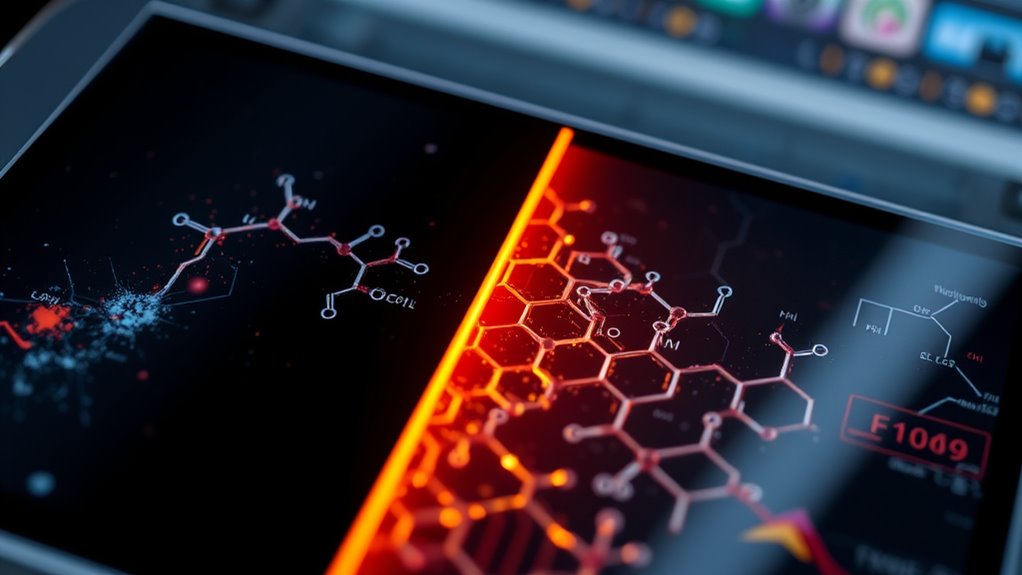
Market dynamics for display technology are rapidly evolving, driven by advancements and shifting consumer preferences. The global OLED market was valued at around USD 46 billion in 2023 and is projected to grow at a CAGR of nearly 20% through 2035, reaching over USD 400 billion. The market’s rapid growth is supported by technological innovations in manufacturing and materials. This growth is fueled by increasing adoption in smartphones, wearables, and automotive sectors, where OLED’s superior color, flexibility, and efficiency stand out. Regions like China are expanding production capacity to meet rising demand, especially for small to medium displays expected to surpass 1 billion units by 2025. Despite higher manufacturing costs and complexity, ongoing innovations aim to reduce costs and improve performance, ensuring OLED’s continued market expansion and technological progress in the coming years.
Frequently Asked Questions
How Do Blue OLED Materials Resist Degradation Over Time?
You might wonder how blue OLED materials resist degradation over time. They do this by carefully selecting stable materials, like specific fluorescent compounds, and optimizing device designs.
Researchers focus on understanding degradation pathways and improving heat management to reduce thermal stress.
What Role Do Rare Metals Play in OLED Manufacturing?
Imagine you’re designing a new OLED display, and you realize rare metals like iridium boost efficiency and brightness. These metals improve luminescence, helping your screen produce vivid colors and longer-lasting performance.
They enhance quantum efficiency and stability, making your display more reliable. However, relying on these metals increases costs and environmental concerns. That’s why researchers are exploring alternatives like TADF and quantum dots to reduce dependence on rare metals in OLED manufacturing.
Can Ink-Jet Printing Improve OLED Sustainability and Environmental Impact?
You wonder if inkjet printing can make OLED production more sustainable. It can, because it reduces material waste, lowers energy use, and minimizes contamination by printing directly onto substrates without masks.
Plus, new inks and improved printhead tech further cut emissions and waste. While challenges remain in matching traditional methods’ performance, ongoing innovations promise greener, more efficient OLED manufacturing for the future.
How Does the Organic Material Composition Affect OLED Color Accuracy?
Ever wonder what truly makes your OLED display so vivid and accurate? It all comes down to the organic materials inside. When you choose the right molecules, they emit precise wavelengths, creating pure reds, greens, and blues.
Their purity and control reduce spectral overlap, boosting color accuracy. Plus, layered structures and tailored emission properties fine-tune the colors, ensuring your screen stays vibrant, stable, and true to life over time.
What Are the Latest Innovations in Reducing OLED Screen Burn-In?
You’ll be glad to know that recent innovations focus on software and hardware to prevent OLED burn-in. Features like Pixel Refresher cycles, Screen Shift, and logo dimming automatically protect your screen from static images. Lowering brightness, managing heat, and using screen savers also help. Responsible habits, combined with these advancements, considerably reduce burn-in risk, ensuring your OLED display stays vibrant and lasts longer without image retention issues.
Conclusion
Choosing between OLED and LCD is like picking a path through a vibrant jungle—each offers unique wonders. OLED dazzles with its self-emitting pixels and deep blacks, while LCD provides reliable brightness and longevity. By understanding the chemistry behind your screen, you can make a smarter choice tailored to your needs. Remember, your display’s technology shapes your viewing experience, so pick the one that best lights up your world and keeps your tech thriving.
Fall Picks
fall essentials
As an affiliate, we earn on qualifying purchases.