
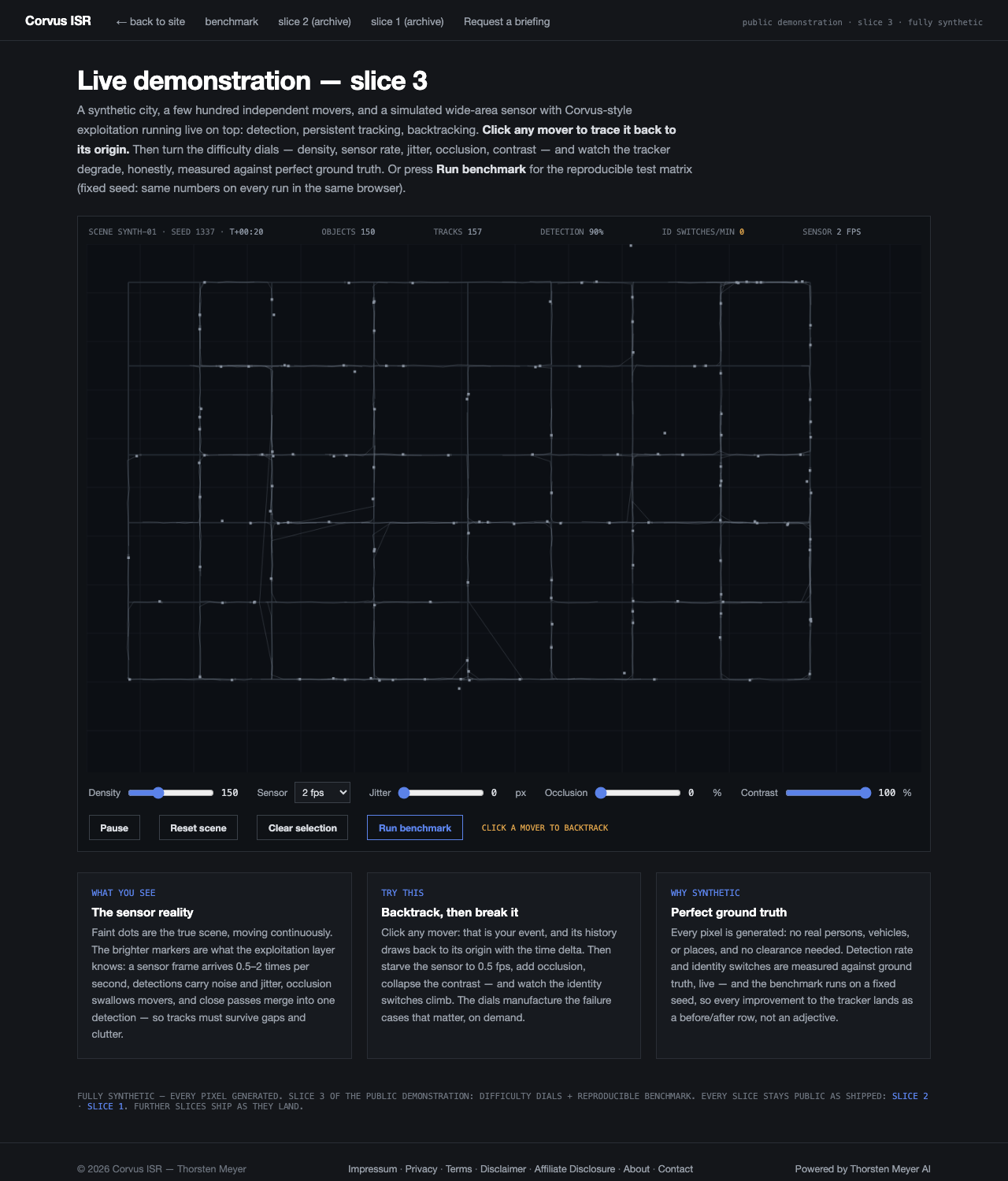
Corvus ISR has released a comprehensive public tracker’s benchmark that compares two different motion tracking models on a synthetic scene with perfect ground truth. This approach leverages the advantages of synthetic data, where every pixel is artificially generated, allowing for precise ground truth and eliminating real-world noise variables. The benchmark’s core focus is to ensure that the evaluation is entirely transparent and reproducible, offering valuable insights into each model’s performance under controlled conditions.
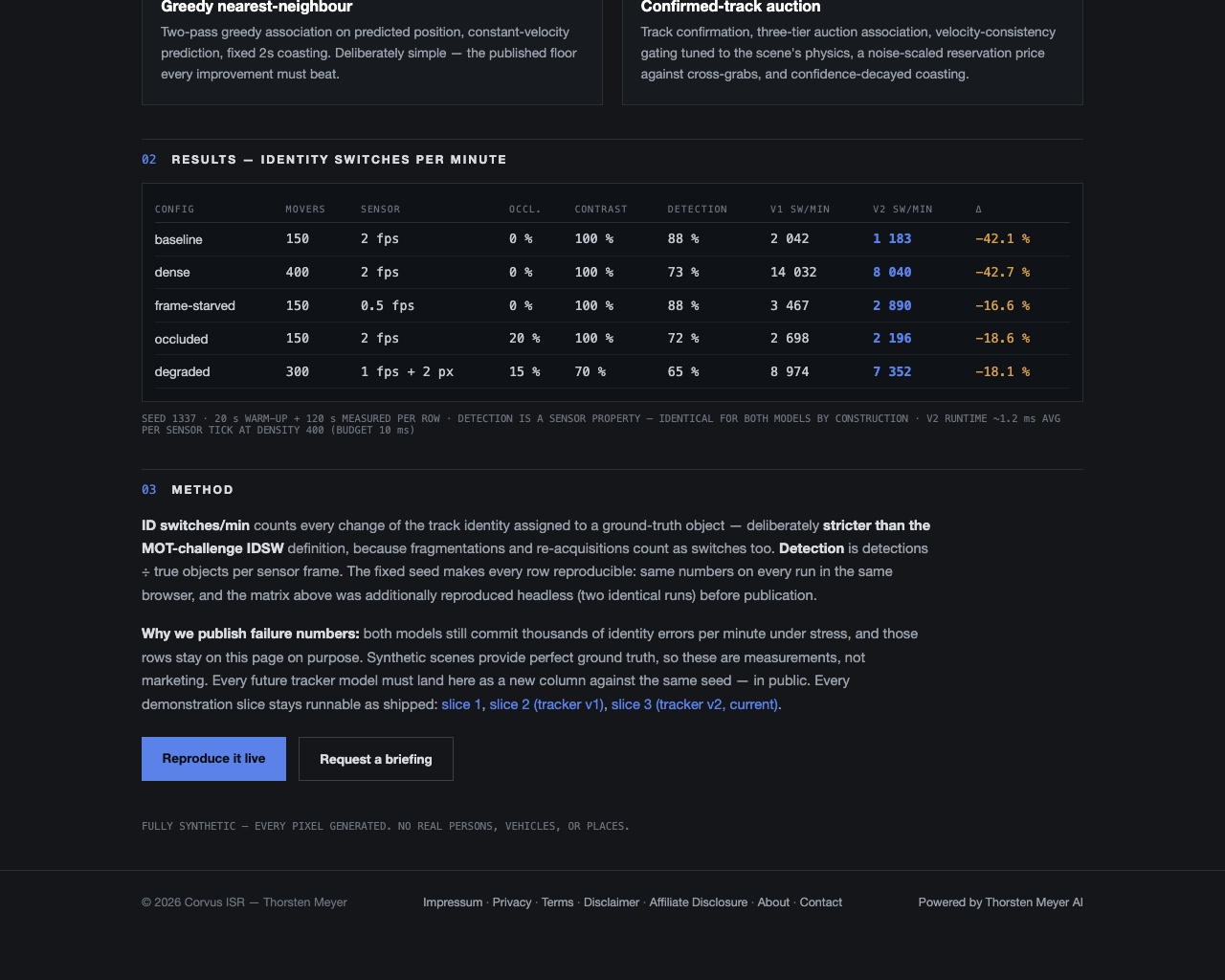
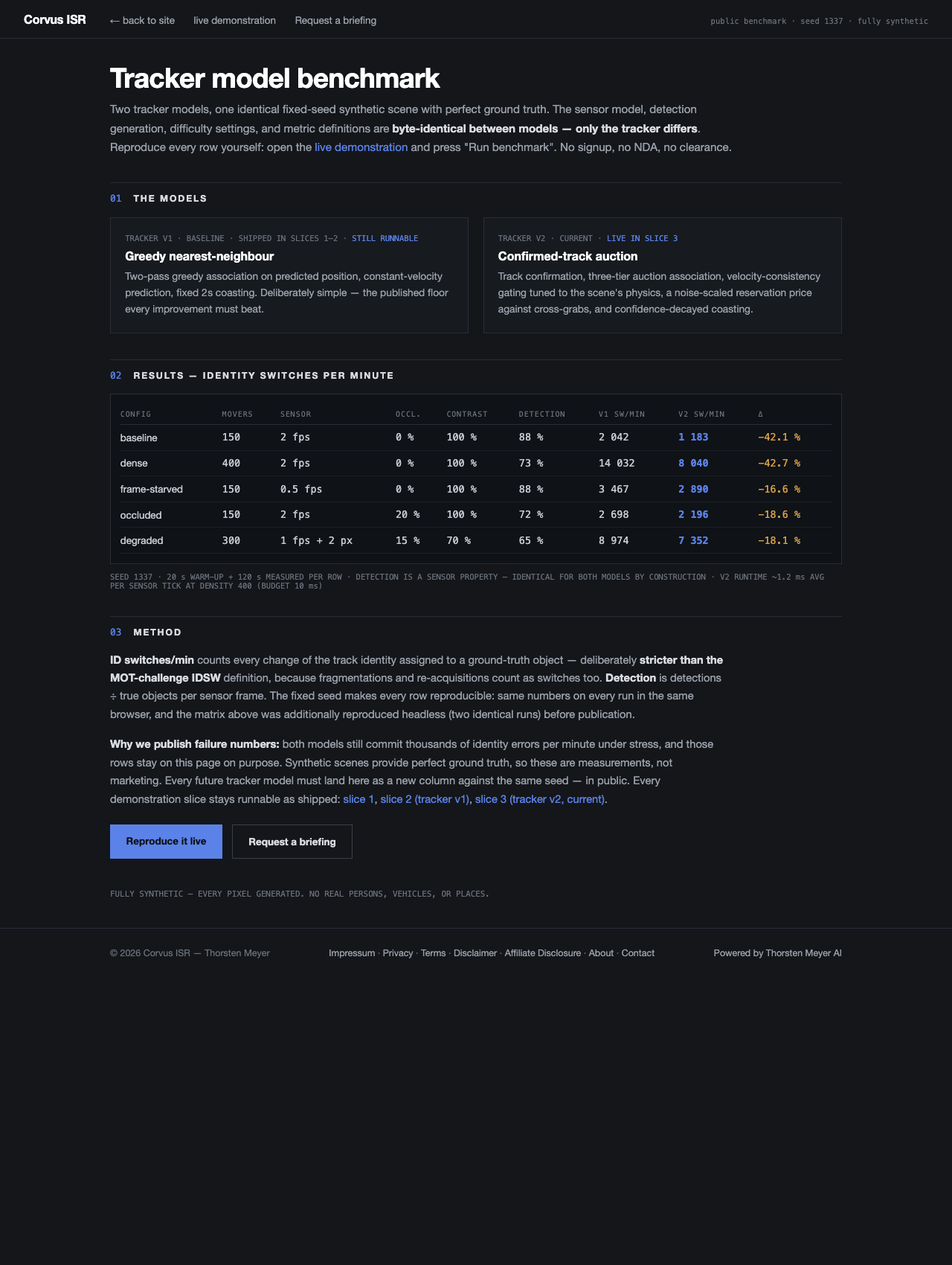
The two models under comparison are: v1, a simple greedy nearest-neighbour tracker, and v2, a more sophisticated confirmed-track auction system. The v1 baseline employs a two-pass greedy association with constant velocity prediction and a fixed 2-second coasting period, representing a deliberately minimal tracking approach. In contrast, v2 introduces a three-tier auction association, velocity-consistency gating, and confidence-decayed coasting, demonstrating a significant step forward in tracking robustness, especially amid challenging conditions.
The benchmark results reveal notable improvements with v2 over v1. For example, in the baseline scenario with 150 moving objects at 2 frames per second, ID switches per minute dropped from 2,042 to 1,183, a reduction of approximately 42.1%. Similar gains were observed with dense scenes of 400 movers, where switches decreased from 14,032 to 8,040, a 42.7% improvement. The results also considered various stress conditions, such as frame rate limitations, occlusion, and degraded image quality, with v2 consistently reducing identity errors by roughly 18%. These figures highlight the importance of publishing failure metrics—as synthetic scenes provide perfect ground truth, these are honest measures of a tracker’s robustness, not marketing hype.
By sharing these failure numbers, Corvus ISR emphasizes that every tracker, regardless of sophistication, still commits thousands of identity errors per minute under stress. The data serves as a valuable benchmark for developers to quantify progress and understand limitations. These results are publicly available and can be reviewed on the public benchmark. Anyone interested can reproduce it live by running the benchmark themselves—no signup or NDA required. The open demonstration underscores the commitment to transparency and rigorous, measurable progress in the field of motion imagery analysis.
The v2 tracker runs efficiently, averaging around 1.2 milliseconds per sensor tick at a density of 400 objects, which is within real-time processing constraints. Even under worst-case conditions (~5ms), it remains compatible with a 10ms processing window, demonstrating its practical applicability. This synthetic benchmark and its detailed failure metrics serve as a vital tool for researchers and engineers aiming to improve multi-object tracking systems with scientifically sound, verifiable data.
For science-minded readers, understanding the methodology behind such synthetic benchmarks is crucial. The perfect ground truth from synthetic scenes allows for precise measurement of tracker performance, free from the ambiguities often present in real-world data. Publishing failure metrics, rather than only successes, promotes honest assessment and encourages continued innovation. Explore the benchmark results yourself and see how your model stacks up against the latest developments in synthetic tracking evaluation.

Data Association for Multi-Object Visual Tracking (Synthesis Lectures on Computer Vision)
As an affiliate, we earn on qualifying purchases.
As an affiliate, we earn on qualifying purchases.