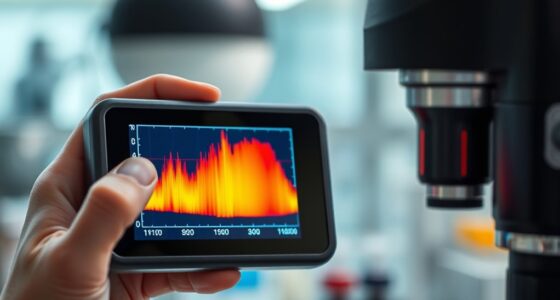
Surface plasmon resonance (SPR) lets you watch molecular handshakes in real time by detecting tiny changes in the refractive index near a sensor surface. When molecules bind or dissociate, they alter the local environment, shifting the resonance angle or light intensity. This technique provides immediate, label-free insights into interaction strength and kinetics. If you want to discover more about how SPR captures these dynamic events, there’s plenty more to explore.
Key Takeaways
- SPR detects real-time molecular interactions by measuring changes in surface refractive index during binding events.
- It excites surface plasmons at specific angles, where shifts indicate molecular “handshakes” or dissociations.
- The technique provides dynamic kinetic data without labels, capturing binding rates and interaction strength.
- Sensitive to tiny environmental changes, SPR enables monitoring of fragile or small molecules in real time.
- Applications include drug discovery, biological research, and diagnostics by analyzing molecular interactions live.

Surface Plasmon Resonance (SPR) is a sensitive technique used to detect molecular interactions in real-time without the need for labels. At its core, SPR relies on plasmon physics—the study of how free electrons in metals respond to incident light. When you shine polarized light onto a thin metal film, typically gold or silver, at a specific angle, the energy couples with the surface electrons. This creates a collective oscillation called a surface plasmon.
Surface Plasmon Resonance detects molecular interactions via surface electron oscillations excited by polarized light.
The key is that these surface plasmons are highly sensitive to changes in the local refractive index near the metal surface, making SPR an excellent tool for resonance detection of molecular events. As molecules bind to or dissociate from the sensor surface, they cause tiny shifts in the refractive index. These shifts alter the conditions for resonance detection, which you can measure as a change in the angle or intensity of reflected light.
Because these changes occur in real-time, you can monitor binding kinetics directly, gaining insights into how quickly molecules interact and how strong those interactions are. This real-time feedback is invaluable for understanding complex biological processes, drug interactions, and biomolecular functions without the need for fluorescent or radioactive labels. Real-time detection allows researchers to observe interactions as they happen, providing dynamic insights into molecular behavior. Additionally, advances in sensor surface engineering have improved the sensitivity and specificity of SPR measurements, making it a versatile tool across many fields.
The physics behind plasmon resonance detection is precise. When the incident light’s angle matches the resonance condition, surface plasmons are excited, producing a minimum in reflected light intensity. Any molecular binding event near the surface modifies the local dielectric environment, shifting this resonance condition.
By tracking these shifts, you effectively measure the molecular handshake as it happens. This process is highly sensitive—capable of detecting interactions at the picomolar to nanomolar levels—and provides quantitative data on binding strength, rate constants, and affinity.
You benefit from SPR’s label-free nature because it eliminates the potential for interference or alteration of molecules that labels can introduce. This makes it ideal for studying fragile or small molecules, where attaching a label might hinder natural interactions.
Additionally, SPR systems are adaptable to high-throughput formats, allowing you to analyze multiple interactions simultaneously. The data obtained helps you construct detailed kinetic profiles, which are essential for drug discovery, diagnostics, and understanding biological mechanisms.
Frequently Asked Questions
How Does Temperature Affect SPR Measurements?
You might notice that temperature sensitivity impacts SPR measurements because fluctuations can alter the refractive index and affect accuracy.
To minimize this, you should perform thermal calibration regularly, ensuring your instrument accounts for temperature changes.
Keeping the temperature stable during experiments helps maintain precise readings, as even small shifts can skew your results.
Can SPR Detect Very Low-Affinity Interactions?
You might wonder if SPR can detect very low-affinity interactions. It does, but with limitations.
SPR’s detection sensitivity depends on the affinity thresholds; very weak interactions often produce signals close to noise levels, making them harder to observe reliably. While advanced setups improve this, extremely low-affinity bindings may still fall below the detection threshold.
What Are Common Limitations of SPR Technology?
You should know that common limitations of SPR technology include surface contamination, which can interfere with accurate readings, and the need for precise instrument calibration to guarantee reliable results.
These issues can lead to false signals or missed interactions. Maintaining clean surfaces and regularly calibrating your instrument help mitigate these problems, allowing you to obtain more accurate, real-time measurements of molecular interactions.
How Is Data From SPR Validated?
Imagine your data as a delicate tapestry, each thread representing a measurement. To guarantee its strength, you validate it by checking data reproducibility and following strict calibration protocols. These steps act like a master weaver’s hands, confirming that each strand aligns perfectly.
Are There Alternatives to SPR for Real-Time Molecular Analysis?
You might consider alternatives to SPR for real-time molecular analysis that also offer label-free detection and enable kinetic analysis. Techniques like bio-layer interferometry (BLI), quartz crystal microbalance (QCM), and nuclear magnetic resonance (NMR) provide similar capabilities, allowing you to monitor interactions without labels and analyze binding dynamics.
These options can suit different experimental needs, offering flexibility in studying molecular interactions in real time.
Conclusion
Now that you understand surface plasmon resonance, you’ll see how it skillfully showcases molecular meetings in real time. By capturing countless captivating collisions, it creates a clear, compelling, and essential connection between chemistry and chemistry. This powerful, probing technique transforms tiny tangles into tangible truths, turning complex interactions into captivating chronicles. So, embrace this brilliant breakthrough—your journey into joyful, just, and genuine genetic and molecular gestures begins here!