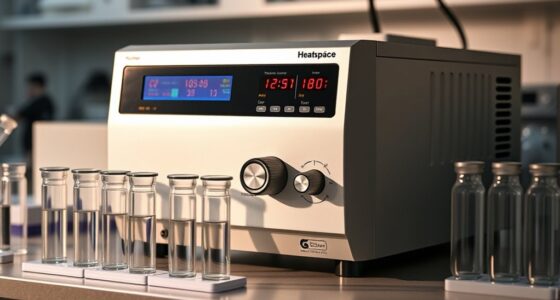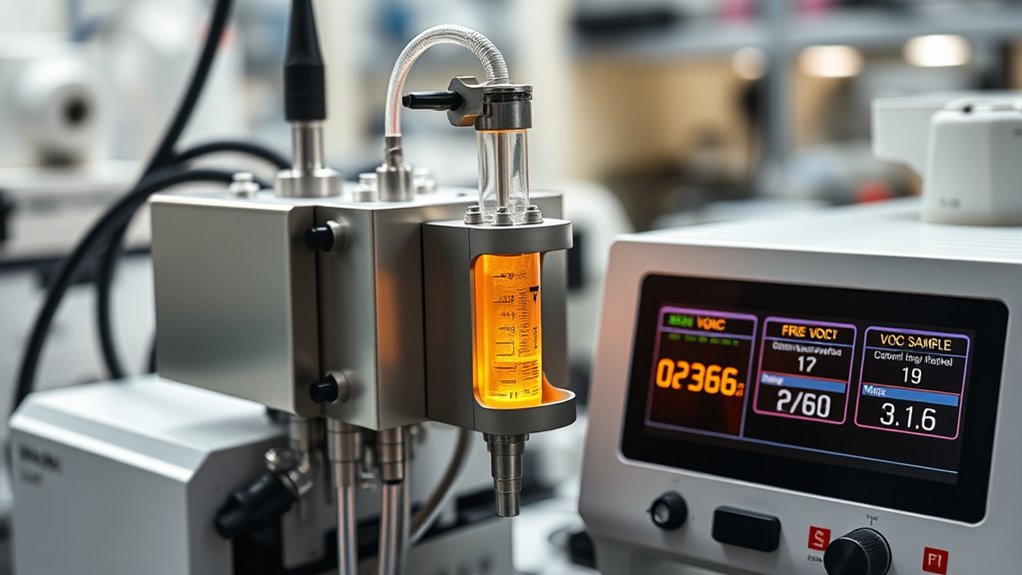

Thermal desorption GC/MS allows you to efficiently analyze VOCs by capturing samples in specialized sorbent tubes, then heating them to release concentrated compounds directly into the instrument. This process avoids solvents and minimizes contamination, boosting detection sensitivity at trace levels. Proper calibration with standards guarantees accurate results. As you continue, you’ll uncover how advanced techniques optimize precision and enable applications across environmental, industrial, and forensic fields.
Key Takeaways
- Thermal desorption efficiently releases VOCs from sample matrices for direct transfer into GC/MS, enhancing sensitivity.
- Proper sample preparation using sorbent tubes preserves VOC integrity and prevents contamination during analysis.
- Calibration with known standards ensures accurate quantification of VOCs detected by GC/MS.
- Combining thermal desorption with GC/MS allows precise identification and measurement of trace VOCs in complex samples.
- Advances in automation improve workflow, data processing, and reliability of VOC analysis using thermal desorption GC/MS.

Have you ever wondered how scientists efficiently analyze complex mixtures of trace contaminants? One of the key methods they use is thermal desorption combined with gas chromatography-mass spectrometry (GC/MS). This technique is especially effective for analyzing volatile organic compounds (VOCs) at trace levels. To achieve accurate results, the process begins with meticulous sample preparation. You need to collect your samples carefully, often using specialized sorbent tubes that trap VOCs from air, water, or soil samples. Proper sample preparation guarantees that the target compounds are concentrated and preserved without contamination or loss. Once samples are collected, they go through a thermal desorption process where they are heated in a controlled manner to release the VOCs in a pure, concentrated form directly into the GC/MS system. This step simplifies analysis by eliminating the need for solvent extraction, reducing the risk of contamination, and improving detection sensitivity.
But before running your samples, instrument calibration is vital to guarantee reliable and reproducible results. You’ll start by calibrating your GC/MS instrument with known standards that contain specific VOCs at defined concentrations. This calibration allows you to establish a response factor for each compound, which you’ll use later to quantify the VOCs in your unknown samples. Calibration also helps identify any issues with the instrument, such as fluctuations in detector response or problems with the gas flow, so you can address them before actual analysis. Regular calibration checks are vital because they maintain the accuracy and precision needed for trace analysis. You’ll often use calibration curves, plotting the signal response against known concentrations, to verify that your instrument performs consistently over time.
During the analysis, the thermal desorption process ensures that the VOCs are released in a consistent and controlled manner, so your GC/MS can separate and identify each compound accurately. The mass spectrometer detects the compounds based on their unique mass-to-charge ratios, while the gas chromatograph separates them as they travel through the column. Because you’ve prepared your samples carefully and calibrated your instrument properly, you can trust that the results reflect the true composition of your sample, down to trace levels. This combination of precise sample preparation, diligent calibration, and advanced instrumentation makes thermal desorption GC/MS a powerful tool for environmental monitoring, industrial hygiene, and forensic investigations involving VOCs. Additionally, advancements in automation in business have led to more efficient data processing and analysis workflows in laboratories utilizing this technique.
Frequently Asked Questions
What Are the Detection Limits of Thermal Desorption Gc/Ms?
You’ll find that thermal desorption GC/MS offers high detection sensitivity, typically reaching quantitative thresholds as low as 1 to 10 parts per trillion (ppt) for VOCs. This method allows you to detect even trace amounts effectively, making it ideal for environmental monitoring. Your ability to identify VOCs at these low levels depends on system calibration, sample preparation, and the specific analytes, but overall, it provides excellent detection limits.
How Long Does a Typical Analysis Take?
Imagine your analysis as a race against time—you’ll typically spend about 30 to 60 minutes on it. You start with sample preparation, which guarantees your sample is ready, then proceed to instrument calibration for accuracy. Once these steps are complete, the thermal desorption and GC/MS process itself usually take around 15 to 30 minutes, depending on the complexity of your sample and method settings.
Can Thermal Desorption Gc/Ms Analyze Liquid VOC Samples Directly?
No, thermal desorption GC/MS can’t analyze liquid VOC samples directly. You need to perform sample preparation, typically involving liquid injection or solid-phase extraction, to convert the liquid into a suitable form. This process helps you efficiently introduce the sample into the system, ensuring accurate analysis. Proper sample preparation is essential for obtaining reliable results, as thermal desorption is designed primarily for analyzing vapors or volatile compounds released from prepared samples.
What Are Common Interferences in VOC Analysis?
In VOC analysis, you often face interferences like matrix effects, which can suppress or enhance signals, affecting accuracy. To minimize these issues, you should carefully select sorbents that target specific VOCs and reduce co-adsorption of interfering compounds. Regular calibration and method validation also help identify and mitigate common interferences, ensuring reliable results. Proper sorbent choice and understanding matrix effects are essential for precise VOC detection.
How Does Temperature Programming Affect VOC Detection?
You should understand that temperature programming considerably impacts VOC detection by optimizing temperature settings to enhance analyte separation and stability. Proper temperature optimization ensures that VOCs vaporize efficiently without degrading, improving detection sensitivity and resolution. If the temperature is too low, analytes may not desorb fully; if too high, they might degrade. Carefully controlling the temperature profile helps you achieve reliable, accurate VOC analysis.
Conclusion
So, next time you think VOCs are just tiny troublemakers, remember thermal desorption GC/MS has your back—like a detective with a fancy badge. It’s the superhero of analytical techniques, swooping in to rescue your samples from chaos. Who knew that heating up and analyzing air samples could be so glamorous? So go ahead, embrace the magic of GC/MS—you might just find your next obsession in the world of Volatile Organic Compounds.