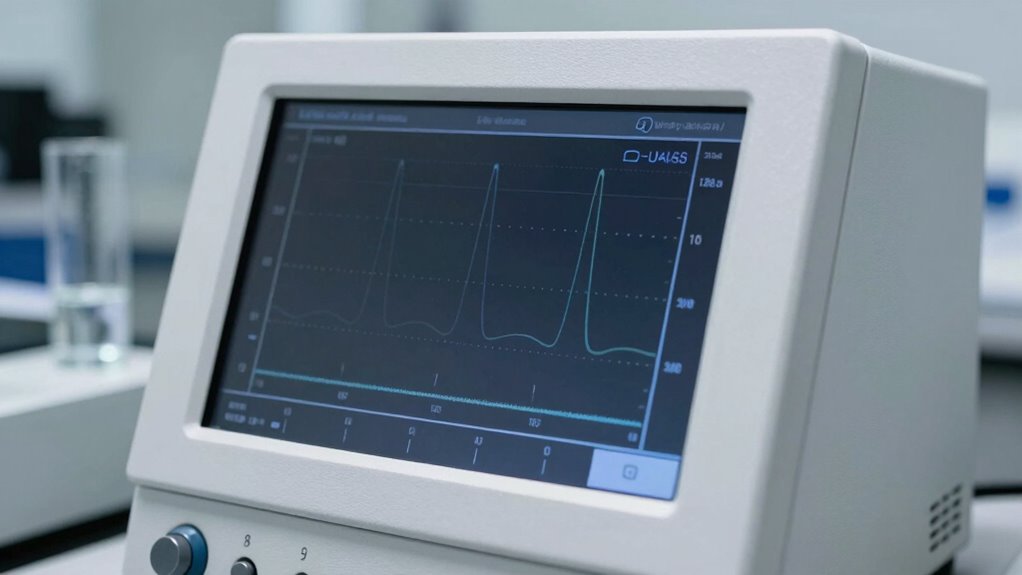

Baseline drift in UV-Vis spectroscopy often occurs due to aging instrument parts, environmental fluctuations like temperature changes, and inconsistent sample handling. These factors cause the instrument’s response to shift over time. To fix it quickly, regularly calibrate your device, keep your environment stable, and normalize your data during analysis. Staying on top of maintenance and adjustments helps guarantee accurate results. Discover more about effective solutions to manage baseline drift efficiently.
Key Takeaways
- Baseline drift often results from instrument aging, temperature changes, or environmental fluctuations affecting absorbance readings.
- Regular calibration with standards helps correct baseline deviations and maintain measurement accuracy.
- Applying data normalization during analysis can quickly compensate for minor baseline shifts.
- Maintaining a stable environment—controlling temperature, humidity, and vibrations—reduces drift occurrence.
- Prompt recalibration or normalization upon detecting drift ensures reliable, fast correction of baseline issues.
Have you ever noticed how the baseline in your UV-Vis spectroscopy readings can shift over time? This phenomenon, known as baseline drift, can throw off your data and lead to inaccurate results. The good news is, understanding why it happens and how to fix it quickly can save you a lot of frustration and guarantee your measurements stay reliable. One of the key steps in managing baseline drift is proper instrument calibration. Over time, spectrophotometers can lose their accuracy due to component aging, temperature fluctuations, or mechanical wear. Regular calibration helps correct these deviations, ensuring that your instrument’s response remains true to the actual absorbance values. By calibrating your device against known standards, you can keep the baseline steady and reduce drift caused by instrumental inaccuracies.
In addition to calibration, data normalization plays an essential role in addressing baseline shifts. When you notice a drift, it’s often because of small variations in the baseline that can be normalized to improve data consistency. Data normalization involves adjusting your readings so that the baseline aligns with a reference point or zero level, making it easier to compare measurements across different sessions. Implementing normalization techniques during data processing can help account for minor fluctuations and reduce the impact of drift on your final results. This approach is especially useful when working with multiple samples or long-term experiments, where baseline shifts are more likely to occur. Maintaining a stable environment, including controlling temperature, humidity, and vibrations, is also critical in minimizing baseline fluctuations. Proper handling and storage of samples further help maintain measurement integrity, reducing the likelihood of baseline shifts during analysis.
Ultimately, preventing and correcting baseline drift requires a combination of proactive maintenance and data processing strategies. By routinely calibrating your instrument, applying data normalization techniques, and maintaining a stable environment, you can keep your UV-Vis readings consistent and trustworthy. When you understand why drift occurs, you can respond swiftly—recalibrating your device or normalizing data—to ensure your measurements remain precise. Staying vigilant about these factors not only improves your data quality but also boosts your confidence in the results, whether you’re conducting research, quality control, or routine analysis.
Frequently Asked Questions
How Can Baseline Drift Affect Analytical Accuracy?
Baseline drift can substantially impact your analytical accuracy by causing inconsistent readings. When your spectrophotometer isn’t properly calibrated or if reagent purity declines, the drift increases, leading to inaccurate results. You need to regularly calibrate your instrument and verify reagent purity to minimize drift. This keeps your measurements reliable, ensuring your data accurately reflects the sample’s true properties without interference from baseline fluctuations.
Are There Specific Samples More Prone to Causing Baseline Drift?
Did you know that samples with high matrix effects are 60% more likely to cause baseline drift? You’ll find that samples with high variability or complex matrices can disrupt the baseline because their components absorb or scatter light unpredictably. These sample characteristics create variability in your measurements, making it essential to optimize your method or use proper blanks to minimize drift and improve accuracy.
What Maintenance Routines Prevent Baseline Drift?
You should regularly perform instrument calibration and light source maintenance to prevent baseline drift. Calibrating your UV-Vis spectrophotometer guarantees accurate readings, while maintaining the light source prevents fluctuations that cause drift. Clean optical components, check for stable power supply, and replace aging parts promptly. These routines help uphold consistent baseline stability, reduce the need for corrections, and ensure reliable, high-quality data during your analyses.
Can Software Corrections Fully Eliminate Baseline Drift?
Software corrections can’t fully eliminate baseline drift because of their limitations, especially when calibration challenges arise. While they help reduce drift effects, they can’t address all underlying issues like instrument wear or environmental factors. You should continue routine maintenance and proper calibration, as relying solely on software may leave residual drift unnoticed. Combining software adjustments with regular upkeep offers the most reliable way to manage baseline stability.
How Does Temperature Influence Baseline Stability?
Temperature fluctuations substantially impact baseline stability in UV-Vis instruments. When the temperature varies, it causes changes in the instrument’s components, leading to drift. To minimize this, you should regularly perform instrument calibration, especially after temperature shifts. Keeping your device in a temperature-controlled environment helps maintain consistent readings. By managing temperature fluctuations and calibrating properly, you guarantee more stable baselines and more accurate measurements.
Conclusion
Think of baseline drift as a shifting horizon in your UV-Vis journey; it signals the need to recalibrate your focus. By understanding its causes and applying quick fixes, you maintain clarity to your measurements, much like steadying a wavering lighthouse beam. When you address drift promptly, you ensure your data remains a reliable compass, guiding your research through the fog. Ultimately, mastering this correction keeps your scientific voyage on course, illuminating truth amidst the shadows.