

Understanding crystal structures involves examining how atoms are arranged within unit cells and how these units pack together to form the entire lattice. The unit cell is the smallest repeating building block that reflects the internal atomic pattern, influencing the crystal’s shape and external features. Efficient packing within the lattice affects the crystal’s density and stability. To learn how microscopic arrangements shape macroscopic properties, keep exploring these fascinating concepts further.
Key Takeaways
- The unit cell is the smallest repeating structure that defines the entire crystal lattice.
- Crystal packing efficiency depends on how atoms are arranged within the unit cell.
- Different unit cell geometries (cubic, tetragonal, orthorhombic, etc.) influence crystal shape and density.
- Atomic arrangement within the unit cell determines the symmetry and overall crystal classification.
- X-ray diffraction patterns reveal the internal packing and atomic positions in the crystal lattice.
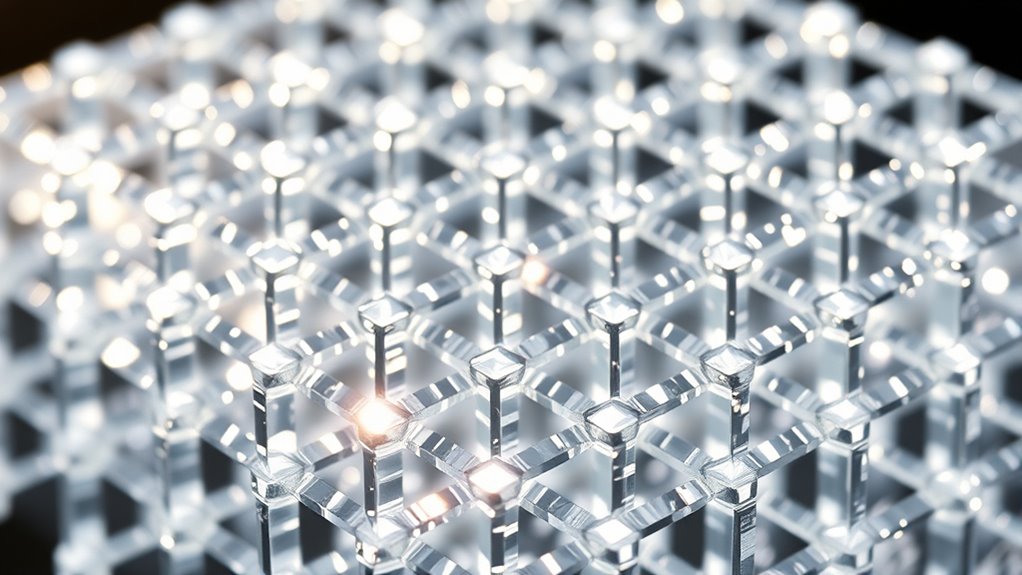
Have you ever wondered what gives crystals their unique shapes and properties? The answer lies in their internal arrangement of atoms, which is governed by the principles of crystal structures. At the core of understanding these arrangements is the technique of X-ray diffraction. When X rays are directed at a crystal, they scatter off the atoms inside, creating a diffraction pattern. By analyzing this pattern, scientists can determine the three-dimensional arrangement of atoms within the crystal. This process reveals the crystal’s symmetry and how atoms are organized, providing insight into the fundamental properties of the material. X-ray diffraction is a powerful tool because it allows you to see beyond the surface, uncovering the internal lattice that defines the crystal’s shape and behavior. The resulting diffraction pattern is directly influenced by the crystal lattice, which reflects the periodic atomic arrangement.
Crystal symmetry plays a *vital* role in defining the overall structure and appearance of a crystal. It describes the repetitive, orderly pattern of atoms that extend throughout the crystal. Symmetry elements such as axes of rotation, mirror planes, and inversion centers help classify crystals into different symmetry groups. These groups determine how atoms are arranged in space and influence the crystal’s external form. When you understand crystal symmetry, you can predict how a crystal might grow, how it interacts with light, or how it conducts electricity. The symmetry elements are directly related to the unit cell—the smallest repeating unit that, when repeated in space, creates the entire crystal lattice. The symmetry within this unit cell influences the crystal’s external facets and internal properties.
The unit cell is fundamental because it encapsulates the entire arrangement of atoms in a minimal volume, and its geometry directly affects the packing efficiency—the way atoms fill space within the crystal. Efficient packing leads to denser, more stable crystals, while less efficient arrangements often result in porous or less stable structures. The symmetry of the unit cell determines how these atoms are arranged and how they repeat throughout the crystal. When you visualize the unit cell, imagine it as the building block of the crystal, with its symmetry dictating how these blocks stack and connect. This stacking pattern influences the crystal’s overall shape, cleavage planes, and physical properties. Ultimately, understanding the interplay between X-ray diffraction, crystal symmetry, and the unit cell allows you to grasp how the microscopic arrangement governs the macroscopic features that make each crystal unique.
Frequently Asked Questions
How Do Defects Affect Crystal Packing?
Defects like vacancy defects and dislocation effects disrupt crystal packing by creating irregularities in the orderly arrangement of atoms. Vacancy defects leave empty spots, weakening structural integrity, while dislocations cause misalignments, making the crystal less rigid. These imperfections can impact the material’s mechanical properties, such as strength and ductility, by allowing easier movement of atoms or slip planes, ultimately altering how the crystal behaves under stress.
What Is the Role of Symmetry in Crystal Structures?
Symmetry is the backbone of crystal structures, acting as the blueprint for their beauty and stability. It guides how atoms are arranged through symmetry operations, ensuring the crystal’s repetitive pattern stays consistent. You can think of crystal symmetry as the secret sauce that keeps everything in harmony, allowing scientists to classify and predict properties. Without symmetry, crystals would be a jumbled mess, losing their organized charm and functionality.
Can Different Materials Share the Same Unit Cell?
Yes, different materials can share the same unit cell, especially if they have similar atomic arrangements or structures. Variations in unit cells, like slight differences in size or symmetry, lead to unit cell variations that distinguish materials. Despite sharing a common unit cell type, material similarities or differences in their atomic packing can influence their properties, making some materials structurally alike even if their chemical compositions differ.
How Is X-Ray Diffraction Used to Determine Crystal Structures?
You use X-ray diffraction to determine crystal structures by analyzing how X-ray beams interact with a crystal’s electron density, producing diffraction patterns. This X-ray analysis reveals the arrangement of atoms within the unit cell. Electron microscopy can complement this by providing detailed images at the atomic level. Together, these techniques allow you to accurately identify the crystal’s structure and packing, helping you understand material properties and behaviors.
What Is the Significance of Polymorphism in Crystals?
A wise saying is “variety is the spice of life,” and polymorphism proves that in crystals. It’s significant because it involves different molecular conformations, leading to distinct physical properties. Polymorphic shifts can alter how a crystal behaves, affecting stability, solubility, and reactivity. Recognizing these differences helps in drug design, material engineering, and understanding crystal behavior, emphasizing that even the smallest change can have a big impact.
Conclusion
Now that you’ve unraveled the secrets of unit cells and packing, you’re like a master architect of crystal worlds. Think of these structures as intricate puzzles where atoms fit together like pieces of a shimmering mosaic. With this knowledge, you hold the key to understanding materials at their core, revealing the hidden artistry behind every sparkle and shimmer. Remember, in crystals, beauty and order dance together, creating a universe you now have the power to explore.