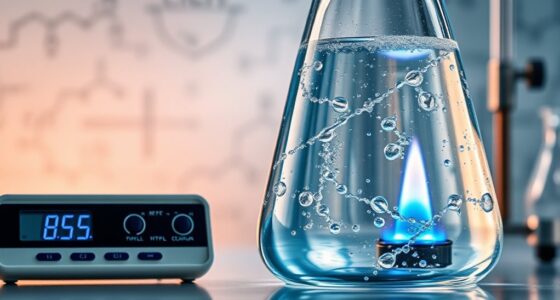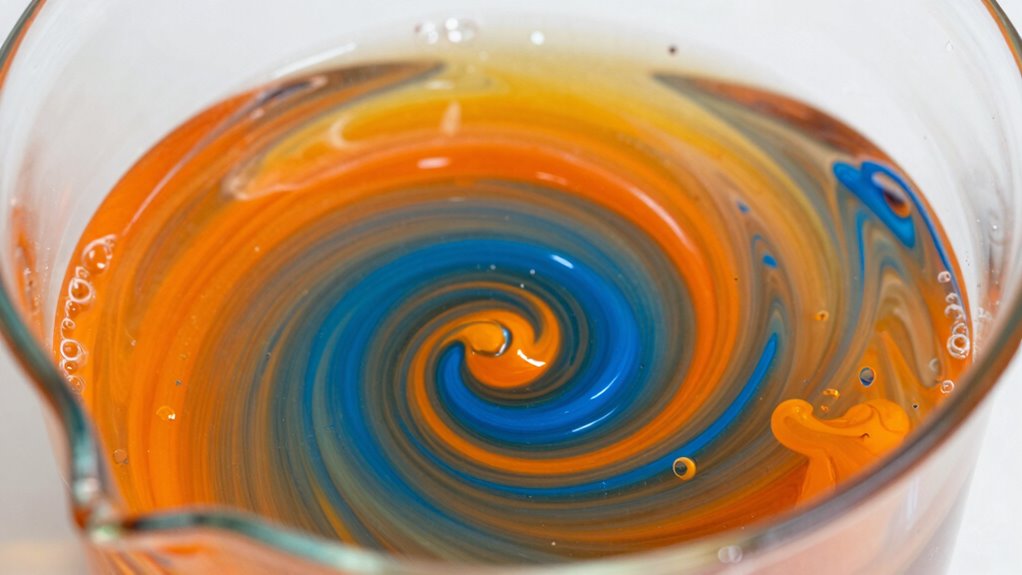

When you mix two liquids, energy is either released or absorbed because of the molecular interactions involved. If strong bonds form, like hydrogen bonds, heat is often released, making the process exothermic. Conversely, breaking weaker interactions requires energy, leading to endothermic effects. The nature of these interactions determines whether mixing produces heat or absorbs it. To understand how these microscopic forces influence the process, there’s more to explore beyond just the reactions.
Listen free for 30 days with Audible
Thousands of audiobooks and originals — cancel anytime.
As an affiliate, we earn on qualifying purchases.
Key Takeaways
- Molecular interactions during mixing can either release or absorb heat, making the process exothermic or endothermic.
- Strong attractions like hydrogen bonds typically release heat; weak or disruptive interactions require energy input.
- The formation of new stable interactions stabilizes the mixture, often resulting in exothermic heat release.
- Breaking existing bonds consumes energy, leading to endothermic heat absorption during mixing.
- The nature and strength of intermolecular forces determine whether the heat of mixing is positive or negative.
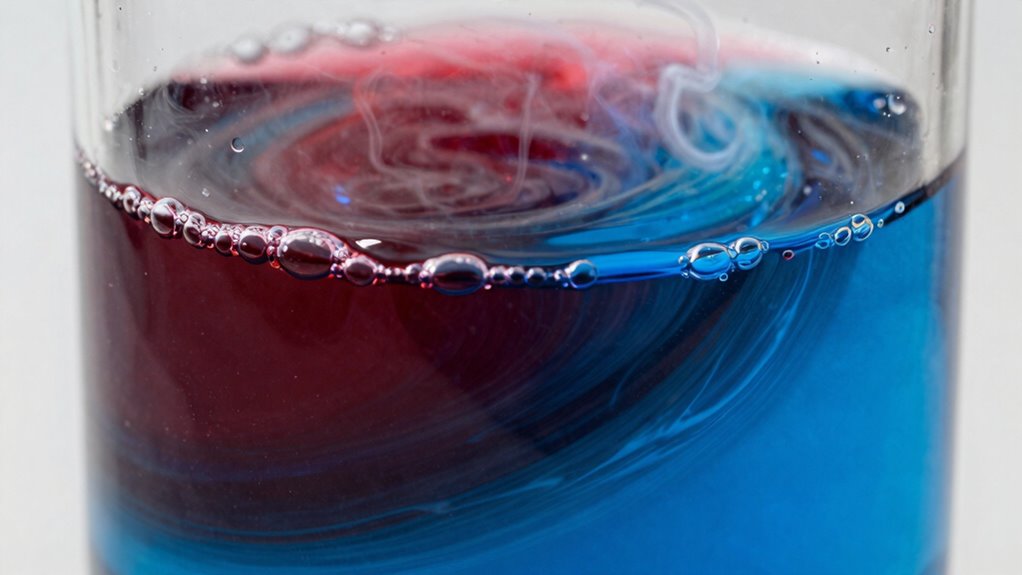
When you mix two liquids, it might seem like a simple, neutral process, but in reality, it often involves changes in energy that can either release or absorb heat. This phenomenon is rooted in the concept of enthalpy change, which measures the heat exchanged during mixing at constant pressure. Fundamentally, you’re not just combining two substances; you’re also altering the molecular interactions between their molecules. These interactions determine whether the process is exothermic (releases heat) or endothermic (absorbs heat).
Think about what happens at the molecular level. When two liquids are mixed, their molecules interact in ways that can stabilize or destabilize each other. If the molecules form new, stronger attractions—say, through hydrogen bonding or dipole interactions—more energy is released. This results in a negative enthalpy change, indicating an exothermic process. On the other hand, if the molecules don’t interact favorably, or if existing interactions are broken during mixing, energy must be absorbed to overcome these forces, leading to a positive enthalpy change, which signifies an endothermic process.
The nature of the molecular interactions largely depends on the liquids involved. For example, mixing water with ethanol often releases heat because of the formation of hydrogen bonds, making the process exothermic. Conversely, mixing certain oils with water might require energy input, as it’s necessary to disrupt existing structures or overcome unfavorable interactions, resulting in heat absorption. This difference is vital in many industrial applications, such as chemical manufacturing, where controlling heat during mixing can impact safety, efficiency, and product quality. Recognizing the energy changes involved is essential for optimizing such processes.
Your understanding of enthalpy change and molecular interactions helps you predict how different liquids will behave when combined. If two liquids are highly miscible and form strong intermolecular bonds, expect a release of heat. If their interactions are weak or require breaking, expect heat absorption. This energy exchange can be subtle or significant, but it always reflects the underlying molecular forces at play. Additionally, the type of intermolecular bonds formed can influence the magnitude and direction of heat transfer, which is crucial in precise industrial applications. Moreover, understanding the molecular structure of each liquid can further refine predictions about their mixing behavior and energy exchange.
In essence, mixing isn’t just a physical process; it’s a dynamic dance of molecules that involves energy shifts. Recognizing how enthalpy change relates to molecular interactions allows you to anticipate the heat effects during the blending of liquids. Whether it’s designing a chemical process or simply understanding everyday phenomena, appreciating these microscopic interactions reveals why the act of mixing can be far from neutral. Understanding molecular interactions is crucial to grasping the energy changes involved in mixing processes.
As an affiliate, we earn on qualifying purchases.
Frequently Asked Questions
How Is Heat of Mixing Measured Experimentally?
You measure heat of mixing experimentally using calorimetry techniques, which involve carefully controlling temperature. You start by mixing the liquids in a calorimeter, ensuring precise temperature control to detect minute temperature changes. The calorimeter captures the heat exchanged during mixing. By analyzing the temperature variation and knowing the system’s heat capacity, you calculate the heat of mixing. This process provides accurate insights into the energetic effects of combining liquids.
What Factors Influence the Heat Released or Absorbed During Mixing?
The heat released or absorbed during mixing depends on molecular interactions and enthalpy changes. When liquids combine, attractive or repulsive forces between molecules influence whether energy is released or absorbed. Factors like polarity, hydrogen bonding, and the compatibility of the liquids’ molecular structures play essential roles. You can expect more heat release if strong interactions form, and more absorption if the process disrupts existing interactions, affecting the overall enthalpy change.
Can Heat of Mixing Predict Chemical Reactions Between Liquids?
Think of heat of mixing as a weather forecast for chemical reactions. It can hint at thermal stability, but it doesn’t predict reactions’ specifics. For example, mixing two liquids might release heat, signaling potential reactivity, but reaction kinetics determine if a reaction proceeds quickly or slowly. So, while heat of mixing offers clues, you can’t solely rely on it to predict whether a chemical reaction will happen.
How Does Temperature Affect the Heat of Mixing?
Temperature effects markedly influence the heat of mixing by altering mixing dynamics. As temperature increases, molecules move faster, often reducing the heat released or absorbed during mixing. Conversely, lower temperatures slow molecular movement, potentially amplifying heat effects. These changes impact how liquids combine, affecting stability and energy transfer. Understanding temperature’s role helps predict whether mixing will be exothermic or endothermic, guiding safer and more efficient industrial and laboratory processes.
Are There Industrial Applications Relying on Heat of Mixing?
Think of the heat of mixing as a secret ingredient that can make or break processes. You’ll find it essential in industrial cooling, where managing heat guarantees equipment runs smoothly. In pharmaceutical formulation, it influences how drugs dissolve and interact. By understanding this energy change, industries optimize reactions and stability, guaranteeing safety and efficiency. It’s a hidden force that shapes many important applications, making your work more precise and effective.
Conclusion
So, next time you mix two liquids, remember it’s not always smooth sailing. The heat of mixing can surprise you, turning a simple blend into a complex event. Even when you think it’s a breeze, hidden reactions might be lurking beneath the surface. It’s a reminder that sometimes, you’ve got to look beyond the obvious. Don’t judge a book by its cover—what’s happening inside can be quite a different story.
Flea & tick season Picks
flea and tick prevention
As an affiliate, we earn on qualifying purchases.