When considering your reaction, kinetics controls how fast it occurs, while thermodynamics determines if it’ll happen at all. If activation energy is high, the reaction may be slow or practically stop, even if it’s thermodynamically favorable. Catalysts can speed things up by lowering activation energy without changing the energy outcome. To fully understand your reaction’s behavior, it’s important to know both the speed and energy factors involved. Keep exploring to see how both aspects interact.
Key Takeaways
- Kinetics determines how fast a reaction proceeds, while thermodynamics predicts whether it is energetically favorable.
- A reaction can be thermodynamically favorable but still occur slowly if kinetics are unfavorable.
- Catalysts speed up reactions by lowering activation energy without changing thermodynamic stability.
- Thermodynamics controls the final equilibrium state, not the reaction rate.
- Both kinetics and thermodynamics are essential to fully understand and control a chemical reaction.
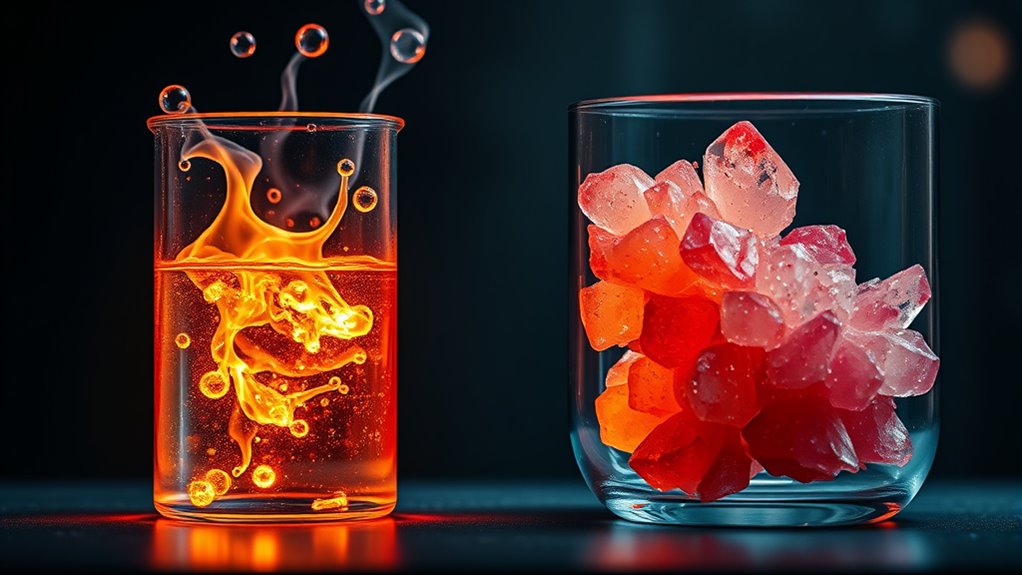
Have you ever wondered why some chemical reactions happen quickly while others take ages to reach completion? The answer lies in understanding the difference between kinetics and thermodynamics. When you think about reaction speed, you’re considering how fast a reaction proceeds from reactants to products. This is all about kinetics—the study of the rate at which reactions occur. On the other hand, thermodynamics helps you determine whether a reaction is energy favorable or not, meaning whether the products are more stable than the reactants. A reaction may be thermodynamically favorable, but it might still take a very long time to happen if the energy barrier, or activation energy, is high. Conversely, a reaction with a low activation energy can proceed rapidly even if it isn’t the most energy-favorable pathway.
Reaction speed depends heavily on kinetic factors. If the reaction pathway has a low activation energy, molecules can collide and react more easily, leading to a faster reaction rate. Catalysts, for example, work by lowering this energy barrier, allowing reactions to speed up without changing their thermodynamic favorability. This means that even if a reaction isn’t energetically the “best” choice, it can still happen swiftly thanks to kinetic influences. Conversely, if the activation energy is high, molecules collide but rarely have enough energy to overcome this hurdle, resulting in slow reaction rates. In some cases, reactions are thermodynamically favorable but proceed at a snail’s pace because their kinetics are unfavorable.
Thermodynamics, however, tells you about the ultimate outcome of the reaction—whether it’s energetically favorable and will tend to proceed spontaneously. If the change in free energy (ΔG) is negative, the reaction is energy favorable and will likely reach completion eventually. But this doesn’t tell you how fast it’ll happen. That’s the domain of kinetics. You could have a reaction that’s thermodynamically favorable but practically impossible to observe because it proceeds at a glacial pace. Think of it like a ball rolling downhill versus a ball hitting a steep hill; both may eventually reach the bottom, but one does it quickly while the other takes ages.
Frequently Asked Questions
How Can You Tell if a Reaction Is Kinetically or Thermodynamically Controlled?
You can tell if a reaction is kinetically or thermodynamically controlled by examining the reaction pathways and energy barriers. If the product forms quickly despite a higher energy barrier, it’s kinetically controlled. Conversely, if the product is more stable with a lower energy state, it’s thermodynamically controlled. Analyzing the energy barriers and final product stability helps you determine which control dominates your reaction.
What Role Does Activation Energy Play in Reaction Control?
Activation energy acts as the energy barrier your reaction must overcome, serving as the key factor in reaction control. If the activation barrier is high, the reaction proceeds slowly, making it kinetically controlled. Conversely, a low energy threshold allows the reaction to occur quickly, often influenced by thermodynamics. Your reaction’s rate depends on this activation energy, determining whether it’s kinetically or thermodynamically driven.
Can a Reaction Switch From Kinetic to Thermodynamic Control?
Yes, your reaction can switch from kinetic to thermodynamic control depending on the energy landscape and reaction pathway. Initially, it may favor a faster, kinetically controlled pathway with a lower activation energy. Over time, as the system reaches equilibrium, the thermodynamically more stable product dominates. Changes in temperature or conditions can shift the energy landscape, allowing your reaction to switch control modes.
How Do Temperature and Pressure Influence Reaction Control?
Did you know that increasing temperature can shift a reaction from kinetic to thermodynamic control? Temperature and pressure considerably impact your reaction conditions, affecting which pathway dominates. Higher temperatures often favor thermodynamic products, while pressure influences phase interactions, like gas or liquid states. These phase influences alter reaction rates and stability, guiding your reaction toward the most energetically favorable outcome. Adjusting these parameters allows you to steer your reaction effectively.
Are There Real-World Examples Where Control Impacts Industrial Processes?
You’ll find control impacts industrial processes, especially when choosing catalysts that direct reaction pathways. For example, in ammonia synthesis, selecting the right catalyst speeds up production without altering thermodynamic limits. Similarly, in refining, catalysts steer reactions toward desired products, ensuring efficiency and safety. By controlling reaction pathways through catalyst selection, industries optimize yields, reduce waste, and improve overall process performance, demonstrating real-world influence on manufacturing outcomes.
Conclusion
Remember, in your reactions, kinetics determines how fast a process occurs, while thermodynamics decides if it’s even possible. Surprisingly, over 80% of industrial processes favor kinetic control because they’re quicker, even if not the most stable. So, next time you think about a reaction, ask yourself: is it about speed or stability? Understanding this can help you harness chemical reactions more effectively and make smarter decisions in your experiments or industry applications.