
In acid-base chemistry, you’ll learn how pKa indicates an acid’s strength, helping you predict how acids and bases behave in different environments. Buffers maintain stable pH by containing weak acids and their conjugate bases, and their capacity peaks near the pKa. Titrations let you determine pKa by watching pH change as you add a titrant. Mastering these ideas allows you to control and predict pH shifts—if you want to explore deeper, you’ll find even more insights ahead.
Key Takeaways
- pKa indicates the pH at which half of an acid is dissociated, guiding acid strength assessment.
- Titration measures pH changes as a base is added to an acid, helping determine pKa.
- Buffer solutions contain weak acids and conjugate bases, resisting pH changes near their pKa.
- Buffer capacity is maximized when pH is close to the pKa, due to optimal weak acid/base ratios.
- Understanding pKa and buffer systems is essential for controlling pH in biological and industrial applications.
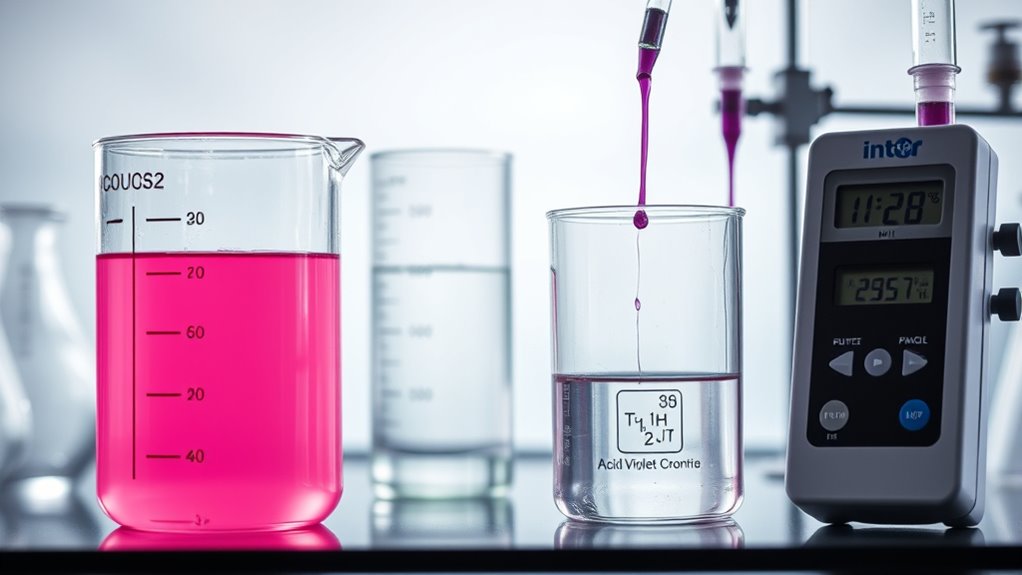
Have you ever wondered how acids and bases interact with each other and affect the world around us? Understanding these interactions starts with grasping some key concepts, like pKa determination and buffer capacity. When acids and bases react, they do so based on their strength, which relates to how easily they donate or accept protons. The pKa value, a fundamental property of a substance, tells you the pH at which half of the acid molecules are dissociated. Determining this pKa is essential because it helps predict how the acid or base will behave in different environments. To find the pKa, you typically perform a titration or use spectroscopic methods. During titration, you gradually add a base to an acid or vice versa, monitoring the pH as you go. The point where half the molecules are dissociated corresponds to the pKa, providing a clear measure of the acid’s strength. Knowing the pKa allows you to understand how the substance will interact in buffers or biological systems, where maintaining specific pH levels is *crucial*.
Buffer capacity is another key concept that stems from understanding acids and bases. It describes a solution’s ability to resist changes in pH when small amounts of acids or bases are added. Think of it as the buffer’s strength or effectiveness. A buffer solution usually contains a weak acid and its conjugate base, which work together to neutralize added H+ or OH- ions. The buffer capacity depends on the concentration of these components and how close the pH is to the pKa of the weak acid. When the pH is near the pKa, the buffer capacity peaks because the weak acid and its conjugate base are in optimalproportions to absorb or release protons. This property is *vital* in many biological and industrial processes, where maintaining a stable pH is necessary for proper function and stability.
Understanding pKa determination and buffer capacity helps you grasp how acids and bases shape our environment and our bodies. Whether you’re designing a pharmaceutical formulation, working in a lab, or just curious about chemistry, knowing how to measure pKa and evaluate buffer capacity gives you powerful tools. These concepts enable you to predict how solutions will behave, control pH levels precisely, and create systems that resist unwanted pH shifts. By mastering these fundamental ideas, you’re better equipped to appreciate the delicate balance that acids and bases maintain in nature and technology, making chemistry not just a subject but a practical guide to understanding and influencing the world around you.

VIVOSUN Digital pH and TDS Meter Kits, 0.01pH High Accuracy Pen Type pH Meter ± 2% Readout Accuracy 3-in-1 TDS EC Temperature Meter for Hydroponics, Pool and Aquarium, Yellow Blue, UL Certified
- Application: Suitable for aquariums, pools, labs
- pH Meter Range: Measures pH 0-14 quickly
- 3-in-1 TDS Meter: Measures TDS, EC, temperature
As an affiliate, we earn on qualifying purchases.
As an affiliate, we earn on qualifying purchases.
Frequently Asked Questions
How Do Temperature Changes Affect Acid-Base Equilibria?
Temperature effects can cause equilibrium shifts in acid-base reactions. When temperature rises, it can either favor the formation of products or reactants, depending on whether the process is exothermic or endothermic. You should remember that increasing temperature generally shifts the equilibrium toward the endothermic side, affecting pKa values and buffer capacity. So, temperature changes influence how acids and bases behave, impacting your calculations and solution stability.
What Are Common Real-World Applications of Buffer Solutions?
Buffer solutions are the unsung heroes in many everyday life scenes. They keep your body’s pH steady like a ship’s rudder in rough waters. In industrial cleaning, buffers prevent damage by maintaining pH levels. Farmers rely on buffers in agricultural fertilizers to ensure nutrients stay available for plants. These solutions act as stabilizers, ensuring processes run smoothly and safely, making them essential in both health and industry.
How Is Pka Related to Drug Absorption in the Body?
You should know that pKa directly impacts drug absorption because it influences drug solubility and absorption efficiency. When a drug’s pKa matches the body’s pH, it tends to be better absorbed because it remains in a more soluble form. If the pKa differs markedly, the drug may not dissolve well or cross cell membranes efficiently, reducing its effectiveness. Understanding pKa helps optimize drug design for better absorption in the body.
Can Titrations Be Performed With Strong Acids and Weak Bases?
Think of titrations as a dance, where acids and bases twirl in perfect step. Yes, you can perform titrations with strong acids and weak bases. Using titration techniques, you’ll compare acid strengths through pH changes, observing how the strong acid reacts more vigorously than the weak base. This method helps you determine concentrations accurately, understanding the difference in acid strength comparison and mastering the delicate balance of acid-base reactions.
How Do Ionic Strength and Activity Coefficients Influence Ph Measurements?
Ionic strength effects can markedly influence pH measurements because they alter activity coefficients. When ionic strength increases, activity coefficients typically decrease, meaning ions don’t behave as ideal entities. This impacts the accuracy of pH readings, as pH depends on ion activity rather than concentration alone. To get precise measurements, you need to account for activity coefficient influence, especially in solutions with high ionic strength, by using correction factors or specific calibration.
Conclusion
Understanding acid–base chemistry helps you grasp how solutions resist pH changes and how to accurately determine their properties. With knowledge of pKa, buffers, and titrations, you can confidently analyze and manipulate chemical reactions. Isn’t it fascinating how these concepts reveal the secrets of everyday substances? Mastering this chemistry empowers you to solve real-world problems, from medicine to environmental science. So, aren’t you ready to explore how acids and bases shape the world around you?