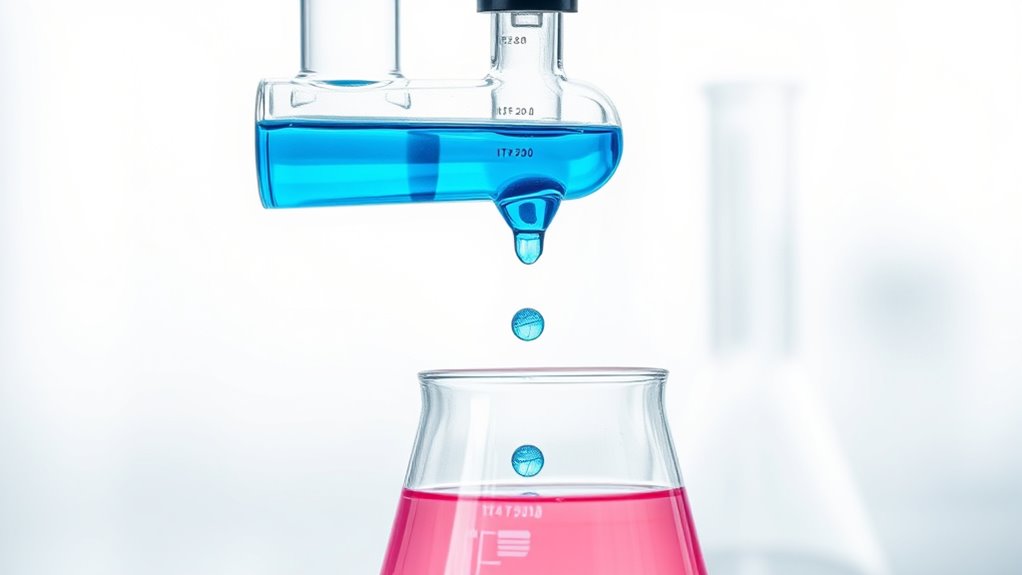
Chemists use colorful indicators in acid–base titrations to accurately determine concentrations, and choosing the right one is essential for precise results.
Browsing Category
Chemistry Fundamentals
128 posts
Orbitals Made Easy: Visualizing Where Electrons Really Live
How electrons truly occupy space in atoms can be perplexing, but understanding their orbitals reveals surprising insights into atomic structure.
Why Electronegativity Shapes the World of Molecules
Understanding why electronegativity shapes molecules unlocks the secrets behind their behavior and interactions, leaving you eager to learn more.
Kinetics Vs Thermodynamics: Which Controls Your Reaction?
Understanding whether kinetics or thermodynamics governs your reaction can transform your approach—discover which factors to manipulate for optimal results.
Beer–Lambert Law: How Chemists Quantify Concentration With Light
For chemists, understanding how light absorption relates to concentration via the Beer–Lambert Law reveals essential insights into quantifying substances accurately.
Intermolecular Forces: Dispersion, Dipole & Hydrogen Bonding Explained
Understanding intermolecular forces—dispersion, dipole, and hydrogen bonds—unveils key insights into molecular behavior that will deepen your scientific knowledge.
Buffer Solutions: How They Work and Why They’re Important
Nurturing stability, buffer solutions resist pH changes, making their mechanisms crucial—discover how they impact everyday life and scientific processes.
Acid–Base Titrations Step‑by‑Step: From Theory to Practice
Next, learn the essential steps and tips to master acid–base titrations for accurate, reliable results.
Gibbs Free Energy in Plain English: Predicting Reaction Spontaneity
Navigating Gibbs Free Energy in plain English reveals how it predicts whether reactions happen spontaneously, helping you understand why some processes occur naturally while others don’t.
Understanding Entropy: Why Disorder Drives the Universe
Entropy explains why disorder naturally increases in the universe. It measures the…