
E‑Factor and PMI are essential metrics to measure how green your chemical processes are. E‑Factor shows how much waste you generate relative to product mass, while PMI indicates the raw materials used per unit of product. Lower values in both suggest more resource-efficient, eco-friendly processes. These tools help you identify opportunities for waste reduction and process improvement, supporting sustainable manufacturing. Keep exploring to see how applying these metrics can boost your process sustainability.
Key Takeaways
- E-Factor and PMI quantify waste and raw material use, indicating the environmental efficiency of chemical processes.
- Lower E-Factor and PMI values reflect greener, more sustainable manufacturing processes.
- These metrics help benchmark performance and identify areas for waste reduction and resource optimization.
- They support green chemistry principles by promoting waste minimization and safer solvent choices.
- Integrating E-Factor and PMI fosters continuous improvement toward environmentally friendly process design.

Are you looking to improve your supply chain efficiency? One effective way is by understanding and applying the concepts behind E-Factor and PMI, which help measure how environmentally friendly your processes are. These metrics focus on process greenness, emphasizing practices like green chemistry and waste minimization. Green chemistry aims to design products and processes that reduce or eliminate hazardous substances, directly impacting waste reduction. Waste minimization is a core principle, ensuring you produce less waste during manufacturing, which not only benefits the environment but also cuts costs and enhances overall efficiency.
Improving supply chain efficiency with green chemistry and waste minimization reduces costs and environmental impact.
E-Factor, or Environmental Factor, gives you a clear picture of how much waste you generate relative to the amount of product produced. It’s calculated by dividing the waste produced by the product’s mass. A lower E-Factor indicates a cleaner, more sustainable process. This metric encourages you to evaluate every step in your process, identifying areas where waste can be minimized and green chemistry principles can be applied. For example, replacing hazardous solvents with greener alternatives or optimizing reaction conditions can notably reduce waste, leading to a lower E-Factor.
Similarly, the Process Mass Intensity (PMI) measures the total mass of raw materials used per unit of product. Lower PMI values mean you’re using resources more efficiently, which is vital for sustainable supply chains. By focusing on PMI, you’re motivated to select processes that maximize yield while minimizing raw material inputs, aligning with waste minimization goals. This approach not only reduces environmental impact but also enhances profitability by cutting material costs.
Both metrics serve as practical tools for benchmarking and continuous improvement. When you regularly monitor your E-Factor and PMI, you can spot inefficiencies early and implement targeted improvements. Integrating green chemistry principles into your processes helps you design more sustainable reactions, reducing hazardous substances and waste from the start. This proactive mindset supports waste minimization and aligns with global efforts to create greener industries.

25ml Hydrothermal Synthesis Autoclave Reactor Stainless Steel Vessel Kettle with PTFE Liner for Rapid Digestion of Insoluble Material, 220℃ 3Mpa 304 Steel High Pressure Digestion Tank
DISSOLUTION PRE-TREATMENT: Our Hydrothermal Autoclave Reactor can be used for sample dissolution pre-treatment in analysis like atomic absorption...
As an affiliate, we earn on qualifying purchases.
Frequently Asked Questions
How Do E-Factor and PMI Compare in Different Industries?
You’ll find that E-factor and PMI vary across industries, reflecting different sustainable practices and industry benchmarks. In chemical manufacturing, E-factor often highlights waste reduction, while PMI emphasizes overall process efficiency. In contrast, electronics might prioritize PMI for energy use, with E-factor focusing on material waste. Comparing these metrics helps you gauge how well industries adopt sustainable practices relative to their benchmarks, guiding improvements in process greenness.
Can E-Factor and PMI Be Used Together for Comprehensive Analysis?
Yes, you can use E-Factor and PMI together for a thorough analysis. Combining these metrics offers synergy potential by providing a more complete view of process greenness—E-Factor highlights waste generation, while PMI assesses material efficiency. This combined assessment helps you identify areas for improvement more effectively, enabling you to optimize processes, reduce environmental impact, and enhance sustainability strategies across different industries.
What Are the Limitations of E-Factor and PMI Metrics?
You might think these metrics tell the whole story, but they have limitations. Data accuracy can be an issue because both depend on precise, consistent data collection. Scalability challenges also arise as they may not adapt well to larger or more complex processes. This means your analysis might miss nuances or oversimplify environmental impacts, so don’t rely solely on E-Factor and PMI for a complete picture of process greenness.
How Do Regulatory Standards Influence E-Factor and PMI Assessments?
Regulatory standards substantially influence your E-factor and PMI assessments by shaping regulatory compliance and policy impacts. When regulations tighten, you must reduce waste and improve efficiency, which lowers E-factor and PMI values. Conversely, lenient policies might allow higher waste levels, skewing sustainability metrics. Staying updated on evolving standards helps you accurately evaluate process greenness, ensuring your assessments reflect true environmental performance and meet regulatory expectations.
Are There Newer Metrics Replacing E-Factor and PMI?
You’ll find that alternative metrics and sustainability benchmarks are increasingly replacing traditional measures like E-Factor and PMI. These newer metrics focus on broader environmental impacts, resource efficiency, and lifecycle assessments, providing a more all-encompassing view of process greenness. By adopting these innovative standards, you can better align your practices with evolving sustainability goals and regulatory expectations, ensuring your processes are both eco-friendly and competitive in today’s eco-conscious market.
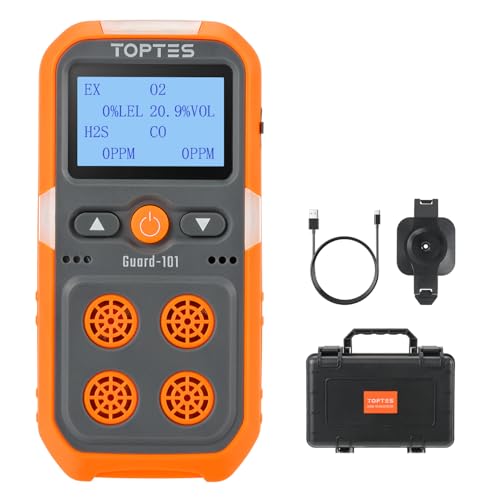
TopTes Guard-101 Gas Detector, 4 Gas Monitor for H2S, CO, LEL and O2, with Vibration, Visual and Audible Alarms, 14h Long Battery Life, Safety Explosion-Proof, for Work, Home - Orange
Quick Detection, Safety First: Guard-101 4 gas monitor multi gas detector is designed for rapid detection of 4...
As an affiliate, we earn on qualifying purchases.
Conclusion
By understanding E-Factor and PMI, you uncover the secrets to truly green processes—it’s like wielding a superpower for sustainability. These metrics reveal the environmental impact of your production, enabling you to make smarter, greener choices. Remember, every decision you make can tip the scales toward a cleaner planet. Embrace these tools, and you won’t just improve processes—you’ll revolutionize the way industries care for the Earth, making a difference that’s nothing short of monumental.

3M Powerflow Powered Air Purifying Respirator Kit 6800PF, Face-Mounted, Medium, Protection Against Dust, Mist, Fumes, Lead, Mold, Asbestos, Radionuclides, Radon Daughters
PROTECTION AGAINST dust, mist, fumes, radionuclides and radon daughter – ideal for lead, asbestos, mold and other hazardous...
As an affiliate, we earn on qualifying purchases.
Amazon Product B07J4WCK6R
As an affiliate, we earn on qualifying purchases.