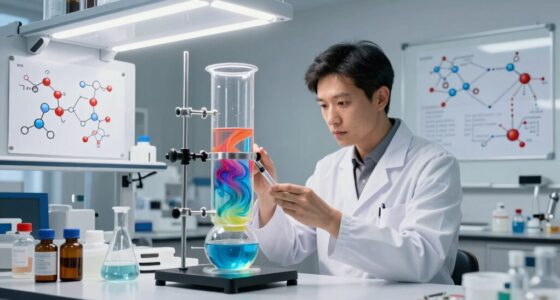

Plastic-eating enzymes show real promise in tackling pollution, but they face major hurdles like environmental stability and slow breakdown rates. Scientists are actively improving enzyme performance through engineering techniques, making them more durable and effective. While not a magic fix yet, ongoing advances hint at a future where these enzymes could help reduce plastic waste appreciably. If you’re curious about how science is shaping this potential, there’s much more to explore.

Prime made for students and young adults
- Fast, free delivery for dorm and study essentials
- Prime Video and Amazon Music included
- Member-only deals
Key Takeaways
- Enzymes like PETase can degrade plastics, but their efficiency is limited by environmental conditions and current engineering constraints.
- Advances in enzyme engineering, such as directed evolution, are improving stability and activity for potential large-scale plastic waste management.
- While promising, enzyme-based plastic degradation faces challenges like slow reaction rates and environmental sensitivity, limiting immediate application.
- Combining engineered enzymes with recycling and biodegradable materials offers a comprehensive approach to plastic pollution solutions.
- Future prospects depend on ongoing research to enhance enzyme durability and integrate biological methods into global waste management strategies.
Have you ever wondered if there’s a way to tackle the global plastic waste crisis more effectively? The idea of using plastic‑eating enzymes might seem promising, but it’s not without significant hurdles. One of the main challenges lies in biodegradation, the natural process where microbes break down materials. Plastics are notoriously resistant to this process because their chemical structure is designed for durability.
Enzymes that can break down plastics, like PETase for polyethylene terephthalate, have been discovered, but they often work slowly and only under specific conditions. This makes large-scale cleanup efforts difficult and inefficient. Overcoming these biodegradation challenges requires innovative solutions to enhance enzyme performance in real-world environments.
Recent enzyme engineering advancements are making strides toward addressing these issues. Scientists are now able to modify enzymes at the molecular level, improving their stability, activity, and efficiency. For example, through techniques like directed evolution, researchers can simulate natural selection in the lab, rapidly generating enzyme variants that perform better at breaking down plastics. These engineered enzymes can withstand higher temperatures, resist deactivation, and act more quickly, making them more practical for industrial applications. Such advancements are critical because they bring us closer to deploying enzyme-based solutions on a large scale, transforming the way we handle plastic waste.
Despite these promising developments, many skeptics question whether enzyme engineering alone can solve the plastic pollution problem. Enzymes are sensitive to environmental conditions and may not always perform ideal outside controlled settings. The environmental stability of enzymes remains a key hurdle to their widespread adoption. Furthermore, the sheer volume of plastic waste generated worldwide surpasses current enzyme capabilities. There’s also concern about the byproducts of enzyme breakdown—whether they’re truly harmless or if they could pose new environmental risks. These challenges highlight that while enzyme engineering progress is exciting, it’s just one part of a broader strategy needed to combat plastic pollution.
Advances in enzyme stability are especially important for making these biological solutions viable in diverse environmental conditions. Looking ahead, the future of plastic‑eating enzymes hinges on continued research and innovation. Combining enzyme technology with other waste management strategies, like recycling and biodegradable materials, could amplify their impact.
Governments and industries are beginning to invest more in these biological solutions, recognizing their potential to complement existing efforts. As enzyme engineering continues to advance, you might see more efficient, environmentally friendly methods to degrade plastics, helping to reduce the staggering amount of waste polluting our planet.
While not a perfect fix yet, these scientific breakthroughs are paving the way toward a cleaner, more sustainable future.
As an affiliate, we earn on qualifying purchases.
Frequently Asked Questions
How Cost-Effective Are Plastic-Eating Enzymes for Large-Scale Waste Management?
You might wonder about the cost-effectiveness of plastic-eating enzymes for large-scale waste management. Currently, a cost analysis shows they’re promising but face scalability challenges due to production costs and enzyme stability.
While they could reduce long-term disposal expenses, widespread use requires overcoming these hurdles. So, although they’re an exciting development, their practical, large-scale application still needs significant advancements to become truly cost-effective.
Can These Enzymes Be Used to Degrade All Types of Plastics?
Imagine enzymes that can break down a million plastic bottles every hour—that’s the potential. However, you should know that these enzymes have polymer specificity, meaning they only target certain plastics.
Their limitations prevent them from degrading all types of plastics, especially ones with complex structures like PVC or polyethylene. So, while promising, these enzymes aren’t a universal solution yet, and ongoing research aims to expand their capabilities.
What Are the Potential Environmental Impacts of Releasing These Enzymes?
You might wonder about the environmental impacts of releasing plastic-eating enzymes. If released, these enzymes could disrupt ecological balance by accelerating plastic degradation, potentially harming wildlife and habitats.
They may also affect biodiversity, as changes in plastic waste levels could alter food chains and ecosystems. While promising for waste reduction, it’s crucial to carefully assess these impacts to avoid unintended consequences on the environment.
Are There Any Health Risks Associated With Consuming Products Processed by These Enzymes?
Imagine you’re in a sci-fi movie—are there health risks with products processed by these enzymes? Rest assured, enzyme safety is a top priority, and current research shows they’re safe for consumer health when properly tested.
These enzymes break down plastics without leaving harmful residues, so you can confidently enjoy products made from or involving enzyme processing.
Continuous monitoring guarantees they stay safe, just like any other food additive.
How Long Might It Take for Enzyme Technology to Become Commercially Viable?
You might wonder how long it’ll take for enzyme technology to become commercially viable. It depends on enzyme optimization efforts to improve efficiency and stability, plus overcoming regulatory hurdles that can slow approval processes.
If research continues to advance and these challenges are addressed, we could see commercial use within the next decade. Stay optimistic, as ongoing innovations are promising, but widespread adoption requires careful testing and regulatory clearance.
Conclusion
While plastic-eating enzymes show promising potential, they aren’t a perfect solution yet. Some studies suggest they can substantially reduce plastic waste, but challenges like enzyme stability and scalability remain. It’s tempting to believe they’ll solve our pollution crisis, but the reality is more complex. You should view them as a valuable tool, not a miracle fix. Continued research is essential to understand their limits and develop practical applications for a cleaner, sustainable future.
Fall Picks
fall essentials
As an affiliate, we earn on qualifying purchases.