
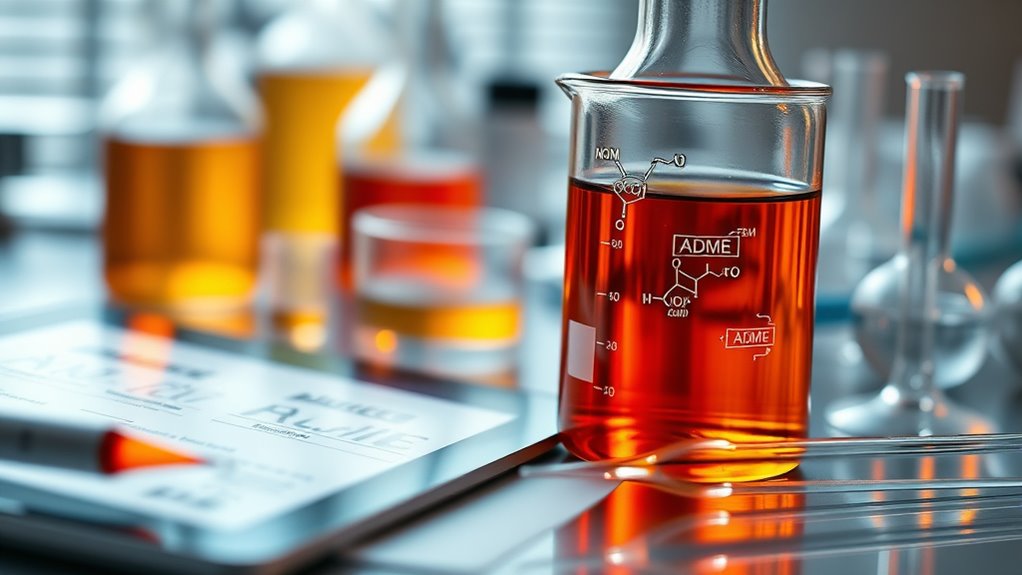
Understanding ADME—absorption, distribution, metabolism, and excretion—is crucial for chemists designing drugs. You need to consider how compounds enter the body, reach target sites, are transformed by enzymes, and are ultimately eliminated. Factors like drug solubility, protein binding, and metabolic pathways impact efficacy and safety. Mastering these fundamentals helps optimize drug properties and anticipate interactions. By exploring further, you’ll discover how to manipulate these processes for better therapeutic outcomes.
Key Takeaways
- ADME describes how drugs are Absorbed, Distributed, Metabolized, and Eliminated, crucial for understanding drug behavior in the body.
- Absorption efficiency depends on administration route, drug solubility, and gastrointestinal conditions.
- Distribution involves bloodstream transport influenced by blood flow, tissue affinity, and plasma protein binding.
- Metabolism mainly occurs in the liver via Phase I and II reactions, affecting drug activity and clearance.
- Water solubility from conjugation facilitates metabolite elimination through urine or bile, impacting drug duration and safety.
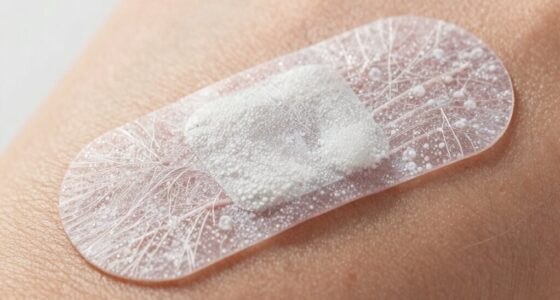
Have you ever wondered how drugs move through your body once you take them? It’s a fascinating process that begins the moment a medication enters your system. The journey starts with drug absorption, where the drug passes from its administration site into your bloodstream. Depending on how you take it—whether orally, intravenously, or through other routes—the efficiency of absorption varies. For oral medications, the drug must survive the acidic environment of your stomach and pass through the intestinal lining to reach your blood. The surface area of your intestines and the drug’s chemical properties, like solubility, influence how quickly and completely it absorbs. Once absorbed, the drug travels via your bloodstream to its target sites, but before it can exert its effects, it often undergoes metabolism.
Metabolism pathways play an essential role in determining a drug’s fate. These pathways mainly occur in your liver, where enzymes transform the drug into metabolites. Some of these metabolites are active and continue to produce therapeutic effects, while others are inactive and facilitate elimination. The process of metabolism can be divided into two phases: Phase I, where enzymes such as cytochrome P450 modify the drug’s structure—often through oxidation, reduction, or hydrolysis—and Phase II, where the drug or its Phase I metabolites conjugate with molecules like glucuronic acid, sulfate, or amino acids. This conjugation increases water solubility, making it easier for your body to eliminate the drug through urine or bile. The efficiency of these metabolism pathways can vary greatly from person to person, influenced by genetics, age, liver function, and even other medications you might be taking. Additionally, understanding the pharmacokinetic parameters helps chemists predict how different individuals will process medications.
Understanding drug absorption and metabolism pathways is vital for chemists because these processes influence dosage, efficacy, and safety. For instance, a drug that’s rapidly metabolized might require a higher or more frequent dose to maintain therapeutic levels. Conversely, if a drug is poorly absorbed, its effectiveness diminishes, and alternative delivery methods might be necessary. By studying these pharmacokinetic principles, chemists can optimize drug design, improve bioavailability, and predict potential interactions or side effects. Ultimately, grasping how drugs are absorbed and metabolized helps guarantee that medications work as intended and are safe for patients. So, when you consider the complex journey of a drug within your body, remember that each step—absorption and metabolism—significantly impacts its overall performance and your health.

Identify Diagnostics 12 Panel Urine Drug Test Cup Kit – 5 Pack
- 12-Panel Urine Drug Test Cup: Includes multiple screening panels
- Broad Screening Coverage: Multiple test panels with clear labels
- Easy and Quick Testing: Results in 5 minutes with simple steps
As an affiliate, we earn on qualifying purchases.
As an affiliate, we earn on qualifying purchases.
Frequently Asked Questions
How Do Chemical Properties Influence Drug Absorption Rates?
Your drug’s chemical properties, like solubility impact and molecular size, directly influence absorption rates. If your drug is highly soluble, it dissolves easily, speeding up absorption. Conversely, larger molecules may cross cell membranes more slowly, reducing absorption. Smaller, lipophilic compounds tend to penetrate tissues faster. So, optimizing solubility and molecular size can markedly enhance how quickly and effectively your drug gets absorbed into the bloodstream.
What Role Does Ph Play in Drug Distribution?
Think of pH as a gatekeeper controlling where your drug travels. It influences drug solubility, making some drugs dissolve better or worse, and affects tissue affinity, guiding where they accumulate. When pH shifts, it’s like opening or closing doors, directing your drug’s journey through the body. By understanding pH’s role, you can predict and optimize where your drug will distribute most effectively.
How Can Metabolic Pathways Be Predicted for New Compounds?
To predict metabolic pathways for new compounds, you should focus on enzyme interaction modeling, which helps identify potential sites of metabolism. Use computational tools and in silico methods to analyze how your compound interacts with metabolic enzymes, such as cytochrome P450s. These approaches allow you to forecast possible metabolites, understand biotransformation patterns, and optimize your compound’s design for better pharmacokinetic properties.
What Are the Latest Methods to Measure in Vivo Drug Levels?
Measuring in vivo drug levels is like capturing a snapshot in a busy marketplace. You can use advanced imaging techniques such as PET and MRI, which provide real-time, non-invasive data. Nanoparticle delivery systems enhance this process by targeting specific tissues, improving accuracy. These methods allow you to monitor drug distribution and concentration dynamically, giving you critical insights into pharmacokinetics and optimizing therapeutic efficacy.
How Do Transporter Proteins Affect Pharmacokinetics?
Transporter proteins considerably influence pharmacokinetics by controlling drug absorption, distribution, and elimination. You should consider transporter specificity, as it determines which drugs are transported and how efficiently. Efflux mechanisms, in particular, can pump drugs out of cells, reducing their bioavailability and altering their therapeutic effects. Recognizing these processes helps you predict drug behavior, optimize dosing, and develop better medications with targeted transporter interactions.
Conclusion
So, now you’re an ADME expert—aren’t you lucky? Next time you see a drug, remember it’s not just magic; it’s a complex dance of absorption, distribution, metabolism, and excretion. But don’t worry, with all this knowledge, you’ll surely impress your friends with your mastery of pharmacokinetics—because understanding how drugs leave your body is obviously everyone’s favorite party trick. Now go forth and make pharmacokinetic science the life of the (lab) party!