PROTACs, or Proteolytic Targeting Chimeras, are designed molecules that help your body eliminate specific disease-causing proteins. They work by linking a target protein to an E3 ligase, which tags the protein for destruction by the cell’s proteasome. This method offers a precise way to remove problematic proteins, even those traditional drugs can’t target. To understand how this innovative technology can transform treatment options, there’s more to explore.
Key Takeaways
- PROTACs are engineered molecules that induce selective degradation of target proteins by linking them to E3 ubiquitin ligases.
- They facilitate proximity between the target protein and ligase, leading to ubiquitination and subsequent proteasomal destruction.
- Unlike traditional inhibitors, PROTACs remove proteins entirely, offering advantages in overcoming drug resistance.
- Advances include improved stability, cell permeability, and computational design to enhance effectiveness and safety.
- PROTACs hold promise for personalized medicine, targeting disease-driving proteins across cancers, neurodegenerative, and infectious diseases.
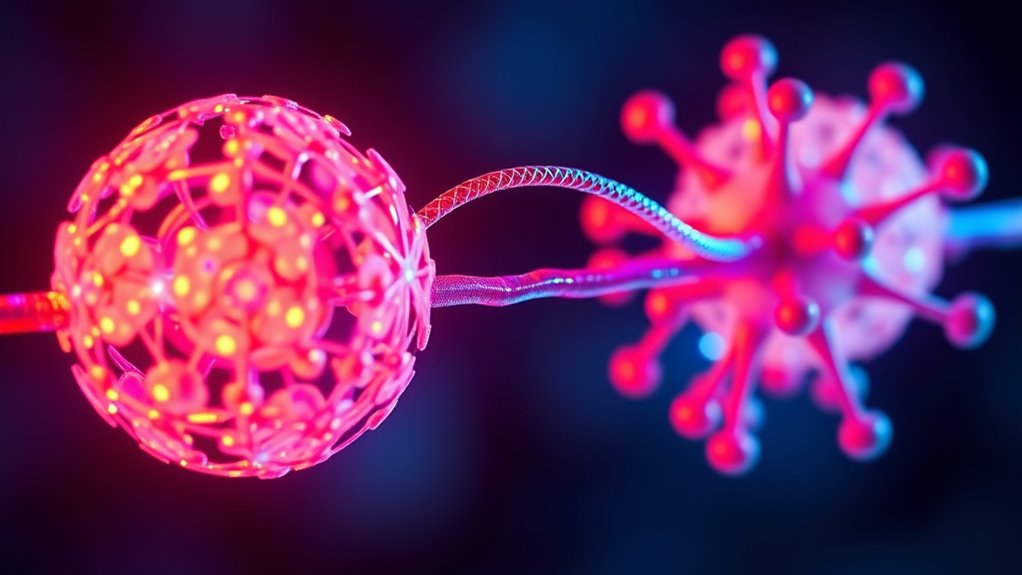
Molecular design is central to creating effective PROTACs. These molecules are composed of two linked parts: one that binds tightly to the target protein and another that recruits an E3 ubiquitin ligase. When the PROTAC binds both, it acts as a bridge, bringing the target protein into close proximity with the ligase. This interaction triggers the ubiquitination process, marking the protein for destruction by the cell’s proteasome. The beauty of this design is its specificity; by carefully selecting binding domains, scientists can craft PROTACs that precisely target disease-associated proteins without affecting others. This precision reduces potential side effects and enhances therapeutic efficiency.
The therapeutic applications of PROTACs are wide-ranging and promising. They hold potential for treating various cancers, neurodegenerative disorders, and infectious diseases by eliminating proteins that drive disease progression. For example, in certain types of cancer, PROTACs can target and degrade mutant or overexpressed oncogenic proteins that traditional therapies struggle to inhibit effectively. Because PROTACs induce degradation rather than mere inhibition, they can overcome resistance mechanisms that develop with conventional drugs. Additionally, their ability to target proteins with shallow binding sites expands the range of druggable targets, transforming the landscape of drug discovery. Advances in machine learning algorithms are accelerating the design of more effective PROTACs by predicting optimal binding interactions and stability.
As research advances, scientists are refining molecular design strategies to improve PROTAC stability, cell permeability, and selectivity. These improvements will likely lead to more potent and safer therapies. The versatility of PROTACs means they could become a cornerstone in personalized medicine, tailored to degrade specific proteins involved in an individual’s disease. Overall, the integration of molecular design into therapeutic applications marks a significant leap forward in how we approach disease treatment—moving from merely blocking harmful proteins to actively removing them from the cell altogether.
Frequently Asked Questions
How Do PROTACS Compare to Traditional Small-Molecule Inhibitors?
You’ll find that PROTACs differ from traditional small-molecule inhibitors because they degrade the entire protein, reducing off-target effects and resistance development. Unlike inhibitors that merely block activity, PROTACs tag proteins for destruction, offering potentially longer-lasting effects. This approach minimizes the chance of resistance, as the protein is eliminated entirely, and helps limit off-target effects by targeting specific proteins for degradation instead of just inhibiting their function.
What Are the Main Challenges in Developing PROTACS?
Imagine steering through a maze—developing PROTACs faces similar twists. You encounter manufacturing hurdles that complicate production, and specificity challenges that make it tough to target only desired proteins. Ensuring the PROTACs are stable, effective, and selective requires overcoming complex chemistry and biological barriers. These challenges demand innovative solutions, guiding you through a landscape where precision and reliable manufacturing are vital for successful therapies.
Are PROTACS Effective Against All Types of Proteins?
You should know that PROTACs aren’t effective against all proteins. Their success depends on protein specificity; if a protein isn’t accessible or doesn’t have suitable binding sites, PROTACs struggle. Additionally, resistance mechanisms, like mutations or upregulation of target proteins, can limit their effectiveness. So, while promising, PROTACs work better with certain proteins, and their broad application still faces significant challenges.
What Are the Potential Side Effects of PROTAC Therapies?
Think of PROTACs as double-edged swords; they can target proteins effectively but may also cause off-target effects that harm healthy cells. You might experience immune responses, such as inflammation or allergic reactions, as your body reacts to the therapy. These side effects highlight the importance of careful design and monitoring. While promising, PROTAC therapies require thorough evaluation to minimize risks and maximize benefits for you.
How Close Are PROTACS to Clinical Approval and Widespread Use?
You’re probably wondering how close PROTACs are to clinical approval and widespread use. Currently, they’re in advanced clinical trials, but regulatory hurdles and manufacturing scalability still pose challenges. You can expect some PROTAC-based therapies to reach the market within the next few years, but widespread adoption depends on overcoming these barriers. As research progresses, you’ll see more of these targeted treatments becoming available, transforming personalized medicine.
Conclusion
Now that you understand how PROTACs work, you’re ready to see them as the Jedi of drug discovery—powerfully targeting proteins for destruction. Just like in the days of knights and dragons, these tiny molecules wield a kind of modern magic, enabling precise intervention. With ongoing research, PROTACs could revolutionize medicine, making old-school treatments seem like a mere stone tablet in comparison. So, keep an eye on this tech; the future’s looking as bright as a Gutenberg press!