Stereochemistry matters in pharmacology because the 3D shape of a drug determines how it fits with biological targets, much like a key matching a lock. The specific arrangement of atoms affects its effectiveness and safety, as one enantiomer can be active while another may be inactive or harmful. Understanding these shape differences helps you grasp why some drugs work better or cause side effects. Keep exploring to discover how scientists harness stereochemistry to develop safer, more effective medications.
Key Takeaways
- The 3D shape of a molecule determines how it interacts with biological targets like enzymes and receptors.
- Enantiomers can have different therapeutic effects due to their distinct stereochemistry.
- Stereochemistry influences pharmacokinetics, affecting drug absorption, metabolism, and excretion.
- Advances in stereoselective synthesis and chiral separation improve drug safety and efficacy.
- Regulatory agencies require enantiomer-specific characterization to ensure proper drug performance and safety.
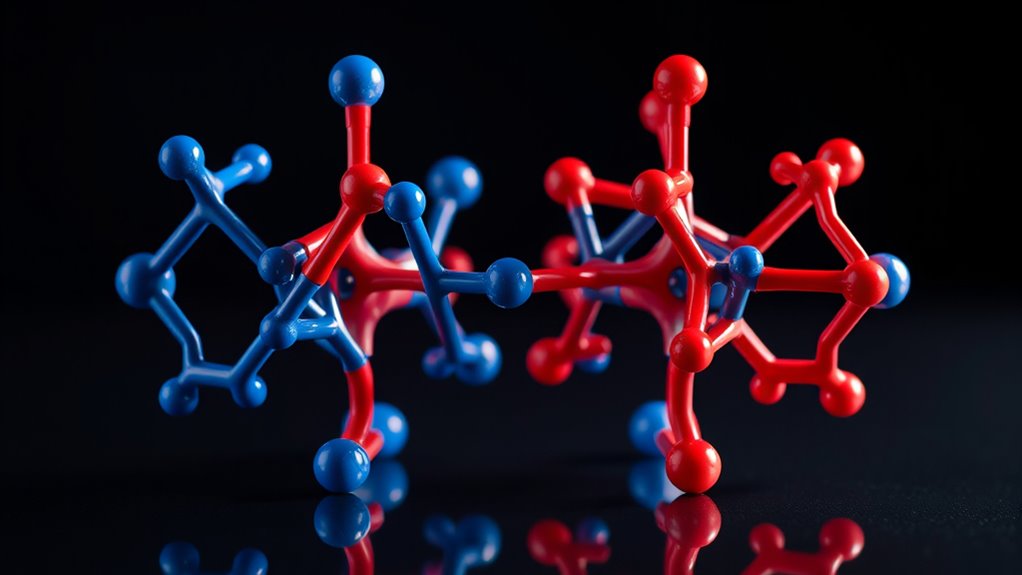
Stereochemistry plays an essential role in pharmacology because the three-dimensional arrangement of molecules determines how drugs interact with their targets. When it comes to chiral molecules, the way they are arranged in space can dramatically influence their biological activity. Chirality effects are especially significant because enantiomers—molecules that are mirror images of each other—often exhibit different pharmacological properties. One enantiomer might be therapeutically active, while its mirror image could be inactive or even harmful. This difference underscores why understanding enantiomer activity is essential in drug development and safety.
As you analyze a chiral drug, you’ll find that the spatial orientation of its functional groups affects how it binds to specific receptors or enzymes. For example, in many cases, only one enantiomer fits perfectly into the binding site, akin to a key fitting into a lock. The other enantiomer, despite having the same molecular formula, may not bind effectively or could cause adverse effects. This highlights the importance of stereoselectivity in pharmacology, where the desired activity hinges on the molecule’s stereochemistry. Ignoring chirality can lead to unexpected outcomes, including reduced efficacy or dangerous side effects, emphasizing the need for stereochemically pure drugs whenever possible.
You’ll also discover that the concept of chirality extends beyond just understanding binding interactions. It impacts pharmacokinetics—how drugs are absorbed, distributed, metabolized, and excreted. Enantiomers don’t always behave identically in these processes; one might be broken down faster, leading to differences in duration of action or toxicity. Recognizing these effects allows you to optimize drug design, ensuring that the most active enantiomer is used, or that the dosage accounts for differences in metabolism. Chiral purity is increasingly important in ensuring drug safety and efficacy.
Moreover, regulations now often require the characterization of each enantiomer in a chiral drug, acknowledging their distinct activities. This means that during drug development, you must carefully evaluate each enantiomer’s pharmacological profile. Advances in stereoselective synthesis and chiral chromatography have made it easier to isolate and produce specific enantiomers, improving the safety and effectiveness of medications. Understanding chirality effects and enantiomer activity helps you make informed decisions, reducing the risk of adverse reactions and maximizing therapeutic benefits. Ultimately, appreciating the significance of molecular shape in pharmacology underscores how fundamental stereochemistry is to developing safe, effective drugs.
Frequently Asked Questions
How Does Stereochemistry Influence Drug Metabolism?
Stereochemistry influences drug metabolism because your body’s enzymatic pathways often recognize specific stereoisomers, affecting how quickly and efficiently a drug is processed. Chiral separation shows that different enantiomers can have distinct metabolic fates, with some being metabolized faster or producing different effects. This means the shape of a drug determines its interaction with enzymes, ultimately impacting its efficacy and safety in your body.
Can Stereoisomers Have Different Side Effects?
Think of stereoisomers as different keys fitting the same lock; one might open smoothly, while the other could cause a jam. Yes, stereoisomers can have different side effects due to chiral selectivity and enantiomeric purity, which influence how they interact with body receptors. You need to contemplate these differences carefully, as one enantiomer might be therapeutic, while its mirror image might cause adverse effects.
How Is Stereochemistry Determined in Drug Development?
You determine stereochemistry in drug development by analyzing the chiral centers within the molecule, which influence its three-dimensional shape. Techniques like optical activity measurements help you identify whether a compound is chiral and how it interacts with polarized light. By understanding the stereochemistry, you can verify the drug’s efficacy and safety, as different stereoisomers may have distinct biological activities and side effects.
Are All Stereoisomers Therapeutically Active?
Not all stereoisomers are therapeutically active. Chirality effects cause some stereoisomer diversity, meaning only specific isomers fit receptor sites properly. You’ll find that one stereoisomer often provides the desired therapeutic effect, while others might be inactive or even cause adverse effects. This is why understanding stereochemistry is essential in drug development, as it helps you identify the most effective and safe stereoisomer for treatment.
What Challenges Exist in Synthesizing Specific Stereoisomers?
You face a tough challenge in synthesizing specific stereoisomers, like finding a needle in a haystack. Achieving chiral purity requires precise stereoselective synthesis, which is often complex and costly. You must control reaction pathways meticulously, avoiding unwanted stereoisomers that can compromise drug efficacy. Despite advances, the process remains a delicate dance, demanding skill, patience, and clever techniques to produce the right shape that your drug needs to work effectively.
Conclusion
Remember, understanding stereochemistry isn’t just academic—it’s key to developing effective drugs. Some might say shape doesn’t matter, but even slight differences can mean the difference between a treatment working or causing side effects. By paying attention to molecular structure, you can better appreciate how drugs interact with your body. So, next time you hear about a new medication, consider how its shape could be the reason it succeeds or fails—because in pharmacology, shape truly matters.