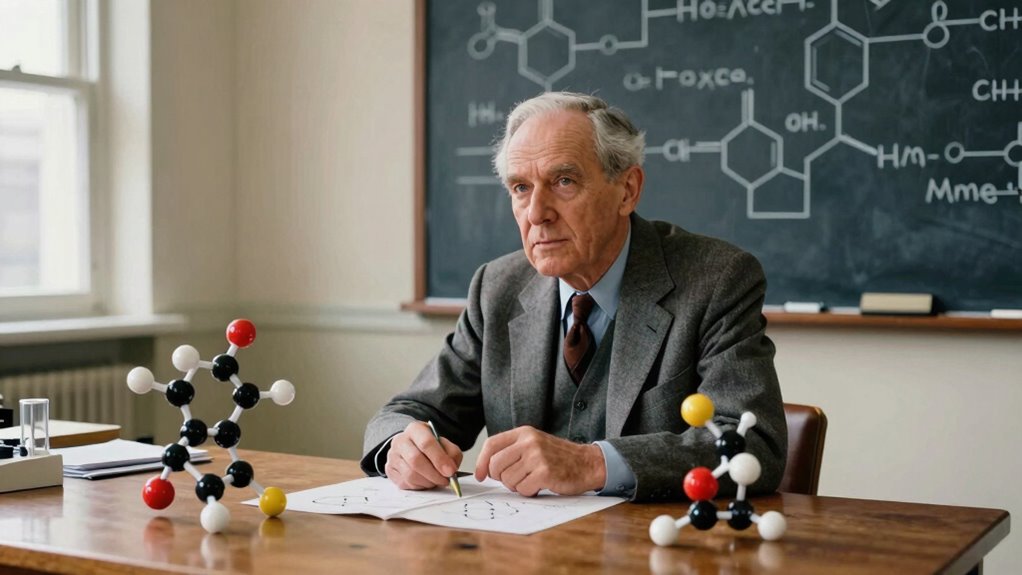

Linus Pauling revolutionized your understanding of chemical bonds by developing theories that explain how atoms connect to form molecules. His work on molecular hybridization and electron pair bonding helps you see how atomic orbitals combine to determine molecular shapes and stability. By bridging quantum mechanics with practical chemistry, Pauling made complex concepts accessible and applicable, influencing modern materials and biological science. If you explore further, you’ll uncover how his ideas continue to shape scientific progress today.

Get school and study supplies delivered free — and shop member deals
- Fast, free delivery on millions of items
- Access to Prime Big Deal Days deals on October 6–7
- Prime Video, Amazon Music and more included
Key Takeaways
- Linus Pauling revolutionized chemistry by developing theories explaining atomic interactions and molecular structures through chemical bonding.
- He introduced molecular hybridization, clarifying how atomic orbitals combine to determine molecular shape.
- Pauling emphasized electron pair sharing, improving understanding of bond strength, length, and molecular stability.
- His work bridged quantum mechanics and practical chemistry, enabling accurate predictions of chemical reactivity.
- Pauling’s contributions laid the foundation for modern molecular modeling and advanced understanding of chemical bonds.

Linus Pauling revolutionized our understanding of chemical bonds by developing theories that explain how atoms combine to form molecules. His work laid the foundation for modern chemistry, especially through his insights into molecular hybridization and electron pair bonding. When you think about how atoms connect, you might picture simple models, but Pauling’s theories delve much deeper, revealing the complex nature of chemical interactions. He showed that atoms don’t just stick together randomly; instead, they form specific shapes and structures based on how their electrons interact.
Molecular hybridization is one of Pauling’s key concepts. It describes how atomic orbitals, which are regions where electrons are likely to be found, combine to form new, hybrid orbitals. These hybrid orbitals allow atoms to bond in specific geometries, giving molecules their shape. When you look at molecules like methane or benzene, you’re seeing the results of hybridization in action. Pauling demonstrated that the shape of a molecule isn’t accidental but results from the way orbitals merge to maximize bonding efficiency. This understanding helps explain not only molecular shapes but also their reactivity and stability. Additionally, he showed how hybridization influences the physical and chemical properties of compounds, providing a more comprehensive view of molecular behavior. Recent advancements in computational chemistry continue to build on Pauling’s foundational ideas, offering even more precise models of molecular shapes. These models often incorporate principles from quantum mechanics, which further refine our understanding of atomic interactions.
Electron pair bonding is another critical part of Pauling’s contributions. He emphasized that bonds form when pairs of electrons are shared between atoms. These pairs can be bonding pairs, which hold atoms together, or lone pairs, which stay on a single atom. By focusing on electron pairs, Pauling clarified why bonds form the way they do and how they influence the properties of molecules. For example, he showed that the strength and length of a bond depend on the number of shared electron pairs, which directly impacts how molecules behave in different environments. Understanding electron pair bonding helps chemists predict molecular stability and reactivity more accurately.
Additionally, Pauling’s work on chemical bonding models helped bridge the gap between quantum mechanics and practical chemistry, making complex theories accessible and applicable. As you explore chemical structures, you’ll find that Pauling’s theories make sense of many phenomena that earlier models couldn’t explain. His ideas about hybridization and electron pairs help you understand why molecules adopt specific shapes and how bonds form and break. They also provide a framework for predicting chemical reactivity and designing new compounds. By applying Pauling’s insights, you gain a clearer picture of the microscopic world, transforming abstract atoms into tangible, predictable molecules. His work remains a cornerstone of chemistry, shaping how you perceive the intricate dance of electrons and atoms that create the materials and life around you.
As an affiliate, we earn on qualifying purchases.
Frequently Asked Questions
How Did Pauling’s Theories Influence Modern Pharmaceutical Development?
Your understanding of molecular modeling and drug design has been transformed by Pauling’s theories. His insights into chemical bonds help you visualize how drugs interact with target molecules, leading to more precise and effective medications. By applying his principles, you can develop new pharmaceuticals faster, designing molecules that fit perfectly into biological systems. Pauling’s work continues to shape modern pharmaceutical development, making treatments safer and more tailored to individual needs.
What Awards Did Pauling Receive for His Work in Chemistry?
Imagine a shining beacon guiding explorers through the fog—Linus Pauling’s awards shimmered brightly for his groundbreaking work. You learn he received the Nobel Prize in Chemistry in 1954, recognizing his insights into chemical stability and bond strength. Additionally, he earned the Nobel Peace Prize in 1962. These honors reflect how his pioneering theories illuminated the path for understanding molecular structures and transforming modern science.
How Did Pauling’s Political Activism Impact His Scientific Career?
Your awareness of Linus Pauling’s political activism shows how his political advocacy influenced his scientific career. His stance on issues like nuclear disarmament heightened public awareness but also drew criticism, affecting his reputation. He believed the ethical implications of scientific work extended beyond labs, which sometimes created tension with colleagues and institutions. Despite this, his activism showcased his dedication to applying science for societal good, shaping his legacy as both a scientist and activist.
What Are Some Common Misconceptions About Chemical Bonding?
You might think chemical bonding is just about atoms sticking together, but misconceptions exist. For example, some believe all bonds involve electron sharing, like covalent bonds, when ionic bonds form through electrical attraction without shared electrons. Others assume bonds are static; in reality, bonds constantly form and break. Recognizing that bonds can be covalent or ionic helps you understand the complexity of chemical interactions better.
How Is Pauling’s Work Relevant to Today’s Material Science?
Your understanding of molecular interactions and bond strength today is shaped by Pauling’s work. His theories help you grasp how atoms bond, influencing the development of new materials with specific properties. By analyzing bond strength, scientists can design stronger, more durable materials or lightweight composites. Pauling’s insights continue to guide innovations in nanotechnology, pharmaceuticals, and electronics, making his contributions essential to advancing modern material science.
Conclusion
You can see how Linus Pauling’s work transformed our understanding of chemical bonds, revealing the true nature of molecules. His theories weren’t just ideas—they were groundbreaking insights that helped us predict and explain chemical behavior. As you explore his contributions, you realize how curiosity and persistence uncover scientific truths. Embracing his approach encourages you to question, investigate, and appreciate the power of scientific discovery—making the complex world of chemistry exciting and accessible.
Halloween Picks
halloween
As an affiliate, we earn on qualifying purchases.