

Many believe that “VOC-free” products are scentless, but that’s a misconception. Not all volatile organic compounds produce noticeable odors, and some odorless chemicals can still be volatile. Your nose detects specific scents based on concentration and sensitivity, so even products labeled “VOC-free” can emit smells from non-VOC substances. To understand why odors and chemical labels often don’t match up, continue exploring how different compounds influence perception.
Key Takeaways
- “VOC-free” labels target specific chemicals but do not account for all volatile substances that can emit odors.
- Some odor-causing compounds are non-VOC volatile substances, meaning products can smell despite being “VOC-free.”
- Odor perception depends on chemical concentration and individual sensitivity, not just chemical presence.
- Not all VOCs produce odors; many are odorless, so “VOC-free” doesn’t guarantee scentless products.
- Variability in classification criteria causes discrepancies, making “VOC-free” labels unreliable indicators of odor absence.
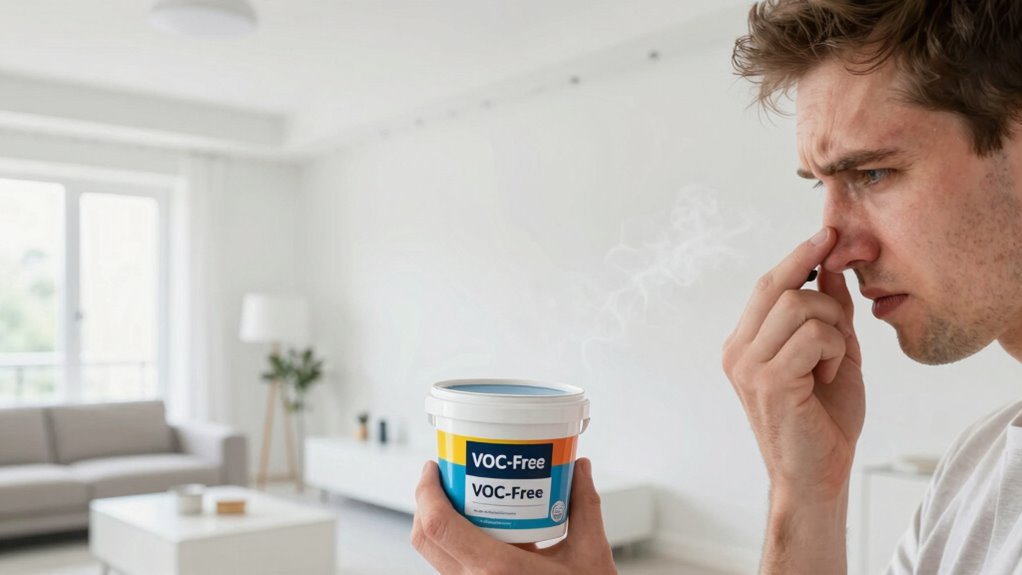
Many people assume that if a product is labeled “VOC-free,” it also has no odor, but that’s a misconception. Volatile compounds, or VOCs, are chemicals that easily evaporate into the air at room temperature. While VOCs are often associated with strong or unpleasant smells, not all volatile compounds contribute to odor perception. In fact, some VOCs are odorless, so a product can be free of the typical scents you might expect despite containing volatile compounds. Conversely, a product labeled as “VOC-free” might still emit odors because it contains other substances that aren’t classified as VOCs but are still volatile or have a scent. This disconnect can lead to confusion, making you think that “VOC-free” guarantees a scentless environment, which isn’t always true.
When you encounter a “VOC-free” label, it’s tempting to assume the product will be odorless. However, odor perception is a complex process influenced by many factors, including your sense of smell, the concentration of chemicals, and the presence of specific volatile compounds. Some VOCs, even in small amounts, can produce noticeable odors, while others might be virtually undetectable. The perception of smell isn’t solely determined by the presence of chemicals but also by their concentration and your individual sensitivity. This means that a product might contain VOCs that produce a mild scent, which your nose perceives clearly, despite being labeled as “VOC-free.”
Furthermore, manufacturers often use different criteria for labeling products as “VOC-free,” focusing mainly on certain chemical groups. As a result, other volatile substances, which aren’t classified as VOCs, might still be present and contribute to odor. For example, natural solvents or plant-based compounds used in some products can be volatile and have a distinct smell, yet not be categorized as VOCs. This discrepancy can lead you to underestimate the potential for odor even when seeing “VOC-free” labels. Understanding chemical classification helps clarify why scent and VOC content don’t always align perfectly.
Frequently Asked Questions
Are Voc-Free Products Completely Safe for Indoor Air Quality?
VOC-free products aren’t necessarily completely safe for indoor air quality because they can still cause chemical exposure through ingredients that aren’t labeled as VOCs. You might also experience fragrance masking, where added scents hide other chemical odors, making it hard to detect harmful emissions. Even VOC-free labels can be misleading, so it’s wise to check ingredient lists and opt for products with minimal, transparent ingredients to protect your indoor air quality.
How Can I Identify True Odor-Free Products?
To identify true odor-free products, look beyond labels and check for scent masking ingredients, which can hide odors but not eliminate them. Trust your nose—if you perceive any smell, it’s not odor-free. Seek products with transparent ingredient lists and third-party testing that confirms minimal odor perception. Remember, scent masking might make odors less noticeable temporarily, but true odor-free products eliminate or markedly reduce odor-causing compounds.
Do All Low-Voc Products Have No Odors at All?
Not all low-VOC products are odor-free; some still carry faint scents. Imagine walking through a garden after rain—subtle, lingering fragrances. Chemical masking and scent masking can hide odors, but you might still notice a slight smell. While low-VOC formulas aim to reduce strong odors, your nose can pick up on residual scents, so don’t assume they’re completely scentless. Always check product labels for scent details.
What Are the Health Risks of Odor-Related Emissions?
Odor-related emissions can pose health risks by exposing you to airborne toxins that may cause sensory irritation, like headaches, sore throats, or eye discomfort. Even if a product claims to be VOC-free, lingering odors can still trigger these symptoms. Continuous exposure to airborne toxins from odors might lead to long-term health issues, especially if you experience ongoing sensory irritation. Always guarantee proper ventilation to reduce these risks.
Can Odor-Free Labels Be Misleading or Inaccurate?
You might think odor-free labels are honest, but they can be misleading. Label accuracy varies, and manufacturers might use vague terms to appeal to consumer skepticism. Often, these labels suggest no smell, but that’s not always true. Don’t trust just the label—your nose knows better. Always check ingredient lists and seek out transparent information to avoid being fooled by false claims about odor-free products.
Conclusion
Remember, just because a product is labeled “VOC-free,” it doesn’t mean it’s odorless. Your nose knows better—those lingering smells can still signal unseen chemicals. The myth that “VOC-free” equals odor-free creates a false sense of safety, but your senses remain your best guide. So, don’t rely solely on labels; trust what you smell. Sometimes, the strongest cues come from your own nose, revealing what words or labels might overlook.