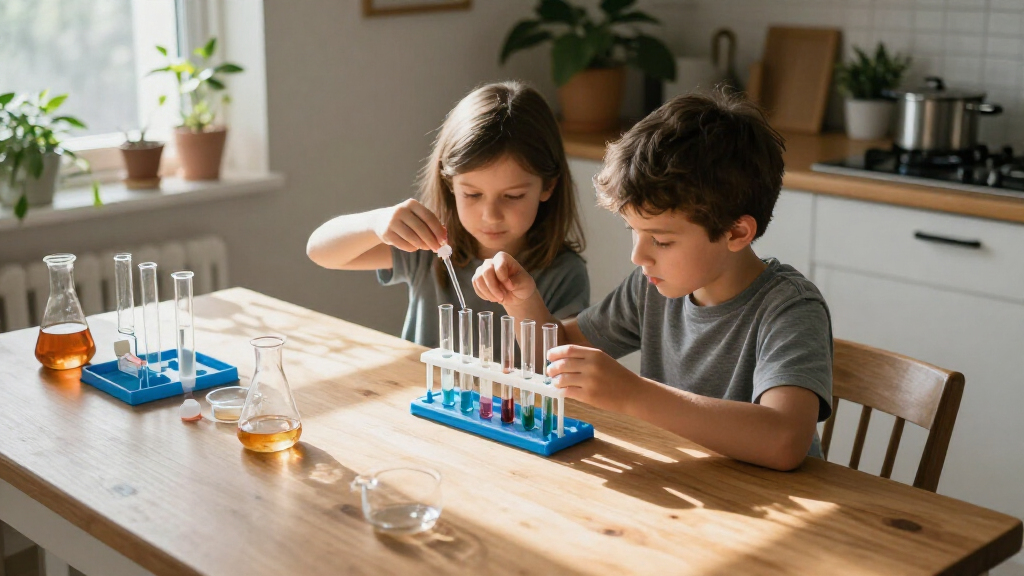

Home chemistry lab kits range from guided experiment sets for children to standalone glassware for more independent work. My best overall pick is the Thames & Kosmos Chem C1000 V2.1, which pairs 125 experiments with a beginner-focused format; the CHEM C3000 offers a larger path for sustained study, while the Apologia Chemistry Lab Glassware Set suits learners who already have a course or experiment plan. The main tradeoff is between structured activities and reusable apparatus, with age, supervision, and included materials shaping how useful a kit will be at home. Read on for the full comparison and recommendations by buyer type.

Prime made for students and young adults
- Fast, free delivery for dorm and study essentials
- Prime Video and Amazon Music included
- Member-only deals
Key Takeaways
- The Chem C1000 V2.1 is the most balanced starter choice in this lineup: its 125 experiments offer more range than the smaller children’s sets without the scale of the C3000.
- The CHEM C3000 is the scale pick, with 333+ experiments for learners who want a longer sequence of activities; its larger scope may be more than a casual family needs.
- Experiment count and lab readiness are different things. Guided kits such as National Geographic’s Amazing Chemistry Set focus on activities, while glassware sets such as the Apologia kit depend on a separate plan and materials.
- Distillation kits are specialized apparatus purchases, not all-purpose chemistry curricula. QWORK’s 12-piece set and Cherish XT’s 15-piece borosilicate setup are better matches for buyers with a specific compatible use in mind.
- Age fit changes the best choice. National Geographic Junior and the 45-experiment Chemistry Set, along with Discovery Super Reactions and Ooze Labs, target approachable activities; advanced study calls for more than a child-oriented experiment count.
| Thames & Kosmos Chem C1000 V2.1 Beginner Chemistry Set, 125 Experiments |  | Best Overall | Brand: Thames & Kosmos | Recommended age: 10 years and up | Experiments: 125 | VIEW LATEST PRICE | See Our Full Breakdown |
| QWORK 12-Piece 100 mL Glass Distillation Apparatus Set |  | Best Compact Distillation Set | Manufacturer: QWORK | Model: QS15522 | Piece count: 12 | VIEW LATEST PRICE | See Our Full Breakdown |
| Cherish XT 15-Piece 500ml 3.3 Borosilicate Glass Distillation Apparatus Kit |  | Best for Advanced Distillation Setups | Manufacturer: Cherish XT | Material: 3.3 borosilicate glass | Capacity: 500 mL | VIEW LATEST PRICE | See Our Full Breakdown |
| National Geographic Amazing Chemistry Set, 100+ Experiments, Ages 8+ |  | Best for Younger Beginners | Brand: Blue Marble | Age range: 8 years and up | Experiments: 15 included experiments and 85 bonus experiments | VIEW LATEST PRICE | See Our Full Breakdown |
| Discovery Super Reactions Science Kit – 66 Experiments STEM Lab for Kids |  | Best for Reaction-Focused Activities | Brand: Discovery | Age range: 8 years and up | Number of experiments: 66 | VIEW LATEST PRICE | See Our Full Breakdown |
| Thames & Kosmos CHEM C3000 Chemistry Set, 333+ Experiments |  | Best for Advanced Home Study | Experiments: More than 333 | Manual: 192-page, full-color illustrated manual | Chapters: 27 | VIEW LATEST PRICE | See Our Full Breakdown |
| National Geographic Junior Chemistry Set with 50 Experiments |  | Best for Preschool Beginners | Age range: 4 years and up | Experiments: 50 | Included tools: 20+ child-safe lab tools | VIEW LATEST PRICE | See Our Full Breakdown |
| National Geographic Chemistry Set with 45 Experiments for Kids |  | Best for Themed Demonstrations | Age range: 8 years and up | Experiments: 45 in title and description; included-components field says 100+ | Educational objective: STEM | VIEW LATEST PRICE | See Our Full Breakdown |
| Apologia Chemistry Lab Glassware Complete Set |  | Best for Curriculum Work | Brand: Nature’s Workshop | Age range: Adult | Theme: Chemistry | VIEW LATEST PRICE | See Our Full Breakdown |
| 32-Piece Chemistry Glassware Set with 24/40 Joint Standard Distillation Apparatus |  | Best for Advanced Glassware Setups | Piece count: 32 | Material: 3.3 borosilicate glass (GG-17) | Joint size: 24/40 standard | VIEW LATEST PRICE | See Our Full Breakdown |
| Ooze Labs Chemistry Station Experiment Set |  | Best for Younger Beginners | Brand: Thames & Kosmos | Age range: 6 years and up | Number of pieces: 57 | VIEW LATEST PRICE | See Our Full Breakdown |
| Chemistry Experiment Kit for Students, School Lab Science Utility Set |  | Best for Supervised School-Style Practice | Brand: Generic | Age range: 14 years and up | Subject: Chemistry and general science | VIEW LATEST PRICE | See Our Full Breakdown |
| home chemistry lab kit | Age range | Brand | Experiments | Model number |
|---|---|---|---|---|
| Thames & Kosmos Chem C1000 V2. | — | Thames & Kosmos | 125 | 640119 |
| QWORK 12-Piece 100 mL Glass Di | — | — | — | — |
| Cherish XT 15-Piece 500ml 3.3 | — | — | — | — |
| National Geographic Amazing Ch | 8 years and up | Blue Marble | 15 included experiments and 85 bonus experiments | NGMEGACHEMAR |
| Discovery Super Reactions Scie | 8 years and up | Discovery | — | 1019069 |
| Thames & Kosmos CHEM C3000 Che | 12+ | — | More than 333 | — |
| National Geographic Junior Che | 4 years and up | — | 50 | NGJRCHEMT |
| National Geographic Chemistry | 8 years and up | — | 45 in title and description; included-components field says 100+ | NGMEGACHEMX |
| Apologia Chemistry Lab Glasswa | Adult | Nature’s Workshop | — | — |
| 32-Piece Chemistry Glassware S | — | — | — | — |
| Ooze Labs Chemistry Station Ex | 6 years and up | Thames & Kosmos | Approximately 20 | 642105 |
| Chemistry Experiment Kit for S | 14 years and up | Generic | — | — |
More Details on Our Top Picks
Thames & Kosmos Chem C1000 V2.1 Beginner Chemistry Set, 125 Experiments
For a home chemistry lab with a broad learning path, the Chem C1000 V2.1 pairs 125 experiments with 30 lab tools, selected chemicals, goggles, and an illustrated manual. Its coverage—from indicators and chromatography to electrochemical reactions—gives curious learners more room to explore than the National Geographic Amazing Chemistry Set, whose included materials support 15 experiments while many more use household items. The 80-page manual and safety guidance also make this a more structured choice for families who want instructions alongside the equipment. The tradeoff is its age recommendation of 10 and up, so younger children may need more direct help or a simpler kit. It also asks for more sustained interest than a kit centered on a few quick, showy activities.
Pros:- 125 experiments cover a broad range of chemistry topics
- Includes 30 lab tools, selected chemicals, and safety goggles
- Illustrated 80-page manual provides step-by-step instructions and safety guidance
Cons:- Age recommendation of 10 and up may exclude younger children without close adult help
- The wider range may be more than a beginner seeking only a few simple activities needs
Best for: Families with a chemistry-curious learner aged 10 or older who wants guided experiments across several topics
Not ideal for: Families shopping for children under 10 or for a small set built around quick activities
- Brand:Thames & Kosmos
- Recommended age:10 years and up
- Experiments:125
- Lab tools:30
- Manual:80-page, full-color
- Included components:Selected chemicals and chemistry lab equipment
- Model number:640119
- Educational focus:STEM
Our verdict“Choose the Chem C1000 V2.1 for an older beginner who wants a guided, varied home chemistry program with equipment and chemicals in the box.”
QWORK 12-Piece 100 mL Glass Distillation Apparatus Set
This is a specialized glassware option for buyers whose home chemistry setup centers on distillation rather than a child-focused sequence of activities. The QWORK set has 12 glass pieces and 100 mL capacity, a smaller format than the 500 mL Cherish XT 15-piece apparatus. That can suit demonstrations or small-scale setups where a larger flask set would take up more room. Its transparent, heat-resistant glass lets a user watch what is happening inside the apparatus, and the product description cites thermal stability and resistance to common chemical corrosion. The tradeoff is limited detail: the listed information does not identify the individual pieces, making it harder to judge fit for a planned experiment. Glass also needs careful handling, and this is less ready-to-use for younger learners than the Thames & Kosmos Chem C1000 V2.1.
Pros:- 12-piece glass set provides a compact apparatus format
- 100 mL capacity suits smaller-scale setups
- Transparent glass makes contents and processes visible
- Described as heat-resistant and resistant to common chemical corrosion
Cons:- Individual pieces in the set are not specified in the supplied product details
- Glass can break if mishandled
- Specialized apparatus offers less guided learning material than the Chem C1000 V2.1
Best for: Adult hobbyists or educators seeking a small-capacity glass distillation apparatus for a defined setup
Not ideal for: Families seeking a guided kit for children or buyers who need a clearly itemized set of glassware
- Manufacturer:QWORK
- Model:QS15522
- Piece count:12
- Capacity:100 mL
- Material:Glass
- Package dimensions:16.34 x 8.94 x 5 inches
- Item weight:2.86 pounds
Our verdict“Pick the QWORK set when you need compact, small-capacity distillation glassware and can confirm that its pieces suit your setup.”
Cherish XT 15-Piece 500ml 3.3 Borosilicate Glass Distillation Apparatus Kit
For buyers who need a larger glass apparatus, the Cherish XT offers 15 pieces, 500 mL capacity, and hand-blown 3.3 borosilicate glass. Compared with the QWORK 100 mL set, its larger capacity is better suited to setups that need more room for material, while the stated temperature tolerance of up to 500°C supports demanding heating applications. The transparent glass also lets a user monitor separation as it happens. Those advantages make it a more specialized choice than the Thames & Kosmos Chem C1000 V2.1, which is organized around guided learning rather than apparatus scale. The main tradeoff is setup complexity: clamps or stands may be needed and are not included, and glass requires careful handling. Its capacity and technical focus may be excessive for small demonstrations.
Pros:- 500 mL capacity offers more room than the QWORK 100 mL set
- 3.3 borosilicate glass is specified for temperatures up to 500°C
- Hand-blown and polished components are described as fitting together precisely
- Transparent glass supports observation during distillation
Cons:- Clamps or stands may be needed and are not included
- Glass construction requires careful handling to reduce breakage risk
- Specialized apparatus is less accessible to beginners than a guided experiment kit
Best for: Experienced adult hobbyists or educators who need 500 mL glassware for distillation or separation work
Not ideal for: Young beginners or buyers who need a complete guided kit with stands and clamps included
- Manufacturer:Cherish XT
- Material:3.3 borosilicate glass
- Capacity:500 mL
- Piece count:15
- Maximum temperature:500°C
- Item weight:6.69 pounds
- Package dimensions:16.57 x 12.2 x 8.23 inches
Our verdict“Choose the Cherish XT if you need larger-capacity borosilicate glassware and already have the support hardware and experience to use it.”
National Geographic Amazing Chemistry Set, 100+ Experiments, Ages 8+
This kit is a lower-barrier starting point for children aged 8 and up who want real lab-style tools without a large dedicated chemistry setup. It supplies materials for 15 experiments and includes test tubes, beakers, and pipettes; the guide adds 85 activities that use common household items. Compared with Discovery Super Reactions, it puts more of its extra activity count into household-based experiments rather than listing 26 guided activities and 40 DIY ideas. That can stretch the kit’s usefulness, though families will need to source materials for the bonus activities themselves. Its main limitation is the included experiment supply: the 15 ready-material activities offer a narrower path than the 125 experiments in the Thames & Kosmos Chem C1000 V2.1. For younger learners, that shorter, more accessible scope may be a better fit.
Pros:- Age range begins at 8 years
- Materials are included for 15 experiments
- Guide adds 85 activities using common household items
- Includes test tubes, beakers, and pipettes
Cons:- The 85 bonus activities require household items that are not included
- Fewer experiments have supplied materials than the Chem C1000 V2.1
- Compact kit dimensions limit the amount of dedicated equipment included
Best for: Families introducing an 8-to-10-year-old to simple chemistry with a few included tools and household-item activities
Not ideal for: Older learners who want a large set of supplied experiments, chemicals, and dedicated lab equipment
- Brand:Blue Marble
- Age range:8 years and up
- Experiments:15 included experiments and 85 bonus experiments
- Educational focus:STEM
- Included tools:Test tubes, beakers, and pipettes
- Item dimensions:8.78 x 3.19 x 11.93 inches
- Item weight:1.8 pounds
- Model number:NGMEGACHEMAR
Our verdict“This is a sensible first chemistry kit for younger children if their family is comfortable gathering household supplies for many of the activities.”
Discovery Super Reactions Science Kit – 66 Experiments STEM Lab for Kids
Discovery Super Reactions centers on visible, playful chemistry: its activity list includes volcanoes, slime, and glowing potions, with concepts such as acid-base reactions and gas expansion woven in. The kit combines 26 guided activities with 40 DIY ideas using household items. That gives it a more reaction-driven focus than the National Geographic Amazing Chemistry Set, whose 15 supplied experiments are paired with 85 household-item activities. Discovery also names several starting materials and tools—including a volcano mold, test tubes, slime mix, citric acid, and red cabbage powder—so the box has a concrete hands-on focus. The tradeoff is adult involvement: the supplied details call for supervision, and some DIY activities require extra household materials. Compared with the broader Chem C1000 V2.1, this is less suited to learners seeking an extended range of chemistry topics.
Pros:- 66 activities combine 26 guided experiments and 40 DIY ideas
- Includes tools and ingredients such as test tubes, citric acid, and red cabbage powder
- Activities explore acid-base reactions and gas expansion through visual projects
- Volcano mold and slime mix give the kit a clear hands-on activity focus
Cons:- Requires adult supervision for safe operation
- Some activities depend on household items not included
- Its reaction-focused themes cover a narrower range than the Chem C1000 V2.1
Best for: Families with children aged 8 or older who enjoy messy, visual reaction activities and can provide adult supervision
Not ideal for: Learners seeking a broad, manual-led chemistry course or families who want every activity’s materials in the box
- Brand:Discovery
- Age range:8 years and up
- Number of experiments:66
- Activity breakdown:26 guided activities and 40 DIY ideas
- Included components:Volcano mold, test tubes, slime mix, citric acid, red cabbage powder, balloons, and instruction manual
- Educational objective:STEM and chemistry
- Model number:1019069
Our verdict“Choose Discovery Super Reactions for a supervised, activity-led introduction to visible chemistry reactions rather than a broad lab curriculum.”
Thames & Kosmos CHEM C3000 Chemistry Set, 333+ Experiments
For a home chemistry lab kit that goes beyond short demonstrations, the CHEM C3000 pairs real lab equipment with 333+ experiments spanning inorganic, organic, and electrochemistry. Its 192-page illustrated manual gives learners a more substantial route through the topics than the National Geographic Chemistry Set with 45 Experiments, which is aimed at simpler, kid-friendly activities. The breadth makes this a stronger fit for a teen ready to follow procedures and connect results to explanations. That depth also brings a bigger commitment: adult supervision is required, and some experiments need household materials beyond the included chemicals and tools. I’d skip it for families seeking quick, mostly self-guided activities, but it stands out for structured study at home.
Pros:- Covers inorganic, organic, and electrochemistry across more than 333 experiments
- Includes glass lab equipment, chemicals, goggles, and other tools
- 192-page illustrated manual provides procedures and scientific explanations
- Includes safety, first-aid, and waste-disposal guidance
Cons:- Requires adult supervision throughout use
- Some experiments call for additional household materials
- Its scope and procedures may be too demanding for younger or casual learners
Best for: Teens aged 12 and up who want a broad, manual-led chemistry course with hands-on lab equipment and an adult available to supervise
Not ideal for: Young children or families seeking independent, low-preparation activities, since adult supervision and occasional household supplies are needed
- Experiments:More than 333
- Manual:192-page, full-color illustrated manual
- Chapters:27
- Chemicals:16+
- Age range:12+
- Safety standard:EN 71-4
- Equipment:Glass test tubes, beakers, Erlenmeyer flask, alcohol burner, tripod stand, safety goggles, and other lab tools
- Supervision:Adult supervision required
Our verdict“Choose the CHEM C3000 if a supervised teen is ready for a broad, structured home chemistry lab kit rather than a simple activity set.”
National Geographic Junior Chemistry Set with 50 Experiments
For the youngest learners in this group, the National Geographic Junior Chemistry Set makes chemistry approachable through 50 illustrated activities and 20+ child-safe tools. Using familiar household items such as baking soda and vinegar lowers the barrier to starting, while the included tools give experiments a lab-like feel. Compared with the National Geographic Chemistry Set with 45 Experiments, this kit targets children from age 4 rather than older kids, so its appeal is ease and early exploration, not more advanced chemistry. The tradeoff is that core materials still need to come from home, and older children may outgrow the activities quickly. I’d pick it for a caregiver-led first introduction, not for a child ready to study lab techniques.
Pros:- Designed for early learners aged 4 and up
- Includes more than 20 child-safe tools
- Illustrated instructions make activities easier for young children to follow
- Uses familiar household ingredients for many experiments
Cons:- Baking soda, vinegar, and other household materials are not included
- Activities may be too simple for older children
- Household ingredients mean preparation is still needed before some experiments
Best for: Caregivers introducing chemistry to children aged 4 and up who benefit from illustrated steps and child-safe tools
Not ideal for: Older children looking for more challenging chemistry concepts, or households wanting a kit that supplies all experiment materials
- Age range:4 years and up
- Experiments:50
- Included tools:20+ child-safe lab tools
- Educational objective:STEM
- Dimensions:11 x 4.22 x 9.64 inches
- Weight:0.72 kg
- Batteries:Not required
- Model number:NGJRCHEMT
Our verdict“Choose this set for a young beginner who needs simple, illustrated activities and an adult to help gather household ingredients.”
National Geographic Chemistry Set with 45 Experiments for Kids
Volcanoes, geysers, and a launched rocket give the National Geographic Chemistry Set a demonstration-first character. Its illustrated instructions introduce basic chemistry and safe experiment practices, making it a more suitable next step for kids aged 8 and up than the National Geographic Junior Chemistry Set, which is intended for children as young as 4. The activities can make a science session feel eventful, though they offer less evidence of a broad lab progression than the Thames & Kosmos CHEM C3000. There is also an unclear scope in the supplied product information: the title and description say 45 experiments, while the included-components field says “100+ easy experiments.” I’d choose it for themed activities, but that inconsistency makes it harder to judge how much chemistry practice the kit provides.
Pros:- Includes themed activities such as volcano, geyser, and rocket experiments
- Illustrated instructions are designed for children
- Introduces basic chemistry, scientific process, and safe practices
- Does not require batteries
Cons:- Product information conflicts on the experiment count: 45 in the title and description versus 100+ in a component field
- The described activities emphasize demonstrations over a clearly sequenced chemistry curriculum
Best for: Families with children aged 8 and up who want illustrated, themed demonstrations such as a volcano, geyser, and rocket
Not ideal for: Buyers seeking a clearly defined experiment count or a structured, broad chemistry curriculum
- Age range:8 years and up
- Experiments:45 in title and description; included-components field says 100+
- Educational objective:STEM
- Included components:Mega Science Kit; component description says 100+ easy experiments
- Material:Rubber
- Dimensions:8.78 x 3.19 x 11.93 inches
- Weight:2.9 pounds
- Batteries:Not required
- Model number:NGMEGACHEMX
Our verdict“Pick this set for eye-catching themed experiments for school-age children if the conflicting experiment-count information is acceptable.”
Apologia Chemistry Lab Glassware Complete Set
The Apologia set is a course-specific equipment kit, rather than an activity box with its own experiment book. Its mass scale, thermometer, test tubes, beakers, and safety gear are intended to cover experiments for Exploring Creation with Chemistry, so it may save a homeschool student from piecing together tools individually. Compared with the CHEM C3000, it supplies fewer reasons to explore chemistry outside a defined curriculum, but it fills a practical role when course instructions already determine what to do. The listed scale capacity and thermometer range add useful detail for measurement-based work. A limitation is that some components are plastic, and the set is not presented as a general-purpose lab. I’d choose it when following that curriculum, not as a standalone discovery kit.
Pros:- Designed to supply equipment for experiments in a specific chemistry curriculum
- Includes a mass scale and thermometer alongside beakers and test tubes
- Safety goggles and filter paper are included
- Provides tools that might otherwise need to be sourced individually
Cons:- Some components are plastic rather than durable glass
- Its usefulness is tied to the requirements of a particular curriculum
- Does not include a described experiment program of its own
Best for: Adult learners or homeschool students following Exploring Creation with Chemistry who need the listed labware and measuring tools
Not ideal for: Families seeking a self-contained experiment program or a versatile kit for chemistry projects outside the named curriculum
- Brand:Nature’s Workshop
- Age range:Adult
- Theme:Chemistry
- Materials:Paper, plastic, and glass
- Weight:500 g
- Scale capacity:0–500 grams
- Thermometer range:−10 to 110 degrees Celsius
- Intended curriculum:Exploring Creation with Chemistry
Our verdict“Choose this set when your chemistry course is Exploring Creation with Chemistry and you need its specified lab equipment.”
32-Piece Chemistry Glassware Set with 24/40 Joint Standard Distillation Apparatus
This 32-piece borosilicate glassware set is the most specialized option here: its 24/40 ground joints and mix of flasks, condensers, and adapters are aimed at setting up distillation and related lab procedures. That makes it a different kind of home chemistry kit from the CHEM C3000, which pairs equipment with chemicals and a guided experiment manual. This set can serve someone who already knows what apparatus a procedure calls for, but the product information does not describe an instructional program or include chemicals. The larger flask capacity and range of jointed pieces support more involved setups; in return, the glass needs careful handling and the package takes up substantial storage space. I’d choose it for experienced users planning specific apparatus-based work, not as a first chemistry kit.
Pros:- 32 pieces provide flasks, condensers, and adapters for varied apparatus setups
- 3.3 borosilicate glass is specified for thermal stability
- Standard 24/40 joints support compatible jointed glassware setups
- Maximum listed flask volume is 1000 ml
Cons:- Fragile glass components need careful handling
- The large, heavy package can be difficult to store
- No experiment manual or chemicals are listed
Best for: Experienced home science learners who already have procedures and need jointed glassware for distillation or related setups
Not ideal for: Beginners seeking guided experiments, included chemicals, or a compact kit that is easy to store
- Piece count:32
- Material:3.3 borosilicate glass (GG-17)
- Joint size:24/40 standard
- Maximum flask volume:1000 ml
- Weight:9.58 pounds
- Package dimensions:23 x 20.12 x 7.62 inches
- Manufacturer:Faazy
Our verdict“Choose this set if you already have a plan for jointed glassware experiments and can handle and store a substantial glass kit safely.”
Ooze Labs Chemistry Station Experiment Set
A ready-to-use station and experiment cards make this a friendly starting point for younger children learning basic chemistry at home. Its roughly 20 activities include slime, fizzing reactions, chromatography, and an underwater volcano, giving kids several kinds of hands-on exploration without requiring a separate collection of lab tools. The non-hazardous chemicals contain no borax, a useful feature for families choosing a kit for ages six and up.
Compared with the National Geographic Junior Chemistry Set, this kit stands out for its dedicated station and clip-on cards, which keep activity instructions close at hand. Its scope is narrower than the Thames & Kosmos Chem C1000 V2.1, which offers many more experiments and suits learners ready for a longer program. The tradeoff is clear: this is an accessible introduction, not a kit for teens seeking advanced procedures or a large experiment library.
Pros:- Plastic station holds equipment and clips experiment cards within easy reach.
- Approximately 20 activities introduce several types of basic chemistry demonstrations.
- Includes varied tools such as a syringe, pipette, funnel, and petri dish.
- Uses non-hazardous chemicals and contains no borax.
Cons:- Activities are aimed at young beginners, limiting its appeal as children advance.
- Its roughly 20 experiments offer less range than the Thames & Kosmos Chem C1000 V2.1.
- The supplied 16-page manual is shorter than a detailed course-style guide.
Best for: Families with children ages six and up who want guided, low-hazard activities and an organized place to work.
Not ideal for: Teen learners or adults looking for a broad, progressively challenging chemistry course or advanced lab techniques.
- Brand:Thames & Kosmos
- Age range:6 years and up
- Number of pieces:57
- Experiments:Approximately 20
- Manual:16-page full-color manual
- Chemicals:Non-hazardous; does not contain borax
- Included equipment:Plastic chemistry station, experiment cards, vessels, syringe, measuring cup, pipette, spatula, tube, petri dish, and funnel
- Warranty:1 year against manufacturer defects
- Model number:642105
Our verdict“Choose this for a young beginner who will benefit from guided activities and a dedicated station, but skip it for advanced study.”
Chemistry Experiment Kit for Students, School Lab Science Utility Set
Glassware and bench equipment give this set a more school-lab feel than the child-focused activity kits in this roundup. Beakers, test tubes, pipettes, a rack, stirring rods, and pH strips support basic measuring, mixing, and observation; the iron stand, wire gauze, and alcohol lamp point toward demonstrations that require direct adult supervision. That mix may suit a teacher or a family following a structured lesson plan.
Compared with the Ooze Labs Chemistry Station, this set is aimed at older students and supplies more conventional lab tools instead of a child-oriented station and packaged activities. It also differs from the Apologia Chemistry Lab Glassware Complete Set by including a lamp and a broad mix of tools, though the product information does not specify a guided experiment count or manual. The glass can break, and the generic brand offers less assurance about consistency. Buyers should plan experiments and supervision separately.
Pros:- Combines glass and plastic beakers with test tubes and pipettes for varied lab tasks.
- Includes a test tube rack, petri dishes, stirring rods, and pH strips for observation and handling practice.
- Iron stand, wire gauze, and alcohol lamp support supervised demonstrations.
- Designed for chemistry and general science learning at home or in school settings.
Cons:- Glass components can break and need careful handling.
- The alcohol lamp requires close adult supervision and a suitable setup.
- Generic branding and the lack of a stated experiment count or manual make quality and learning scope harder to judge.
Best for: Teachers or caregivers of students age 14 and up who already have lesson plans and can supervise glassware and flame-based demonstrations.
Not ideal for: Families seeking a self-guided kit for younger children, or buyers who want a clearly specified curriculum, experiment count, or brand-backed quality assurance.
- Brand:Generic
- Age range:14 years and up
- Subject:Chemistry and general science
- Materials:Glass, plastic, and iron
- Included components:Test tubes, glass and plastic beakers, petri dishes, pipettes, test tube rack, stirring rods, iron stand, wire gauze, alcohol lamp, filter papers, pH strips, spatula, and forceps
- Heat source:Alcohol lamp
- Battery required:No
- Manufacturer:Anshi_Enterprises
Our verdict“Pick this for an older student working under teacher or adult guidance who needs basic lab apparatus, not a ready-made experiment course.”
How We Picked
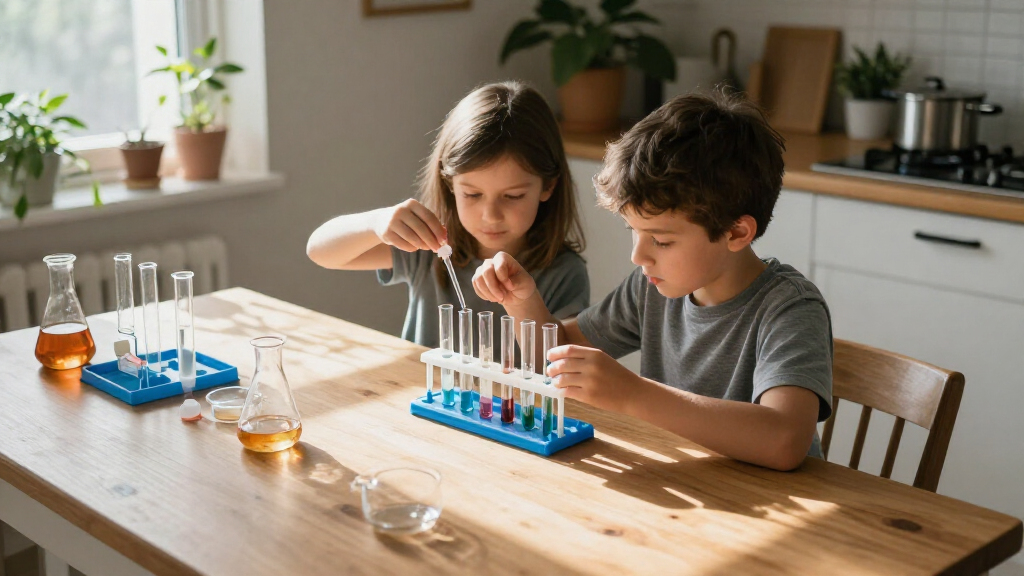
I compared the 12 options by how well each serves a home chemistry goal: guided learning, a child’s first experiments, longer-term study, or adding apparatus to an existing setup. I weighed stated experiment count and age guidance alongside the kind of equipment supplied, the likelihood that a buyer can get started with the kit alone, and whether its focus supports a broad range of activities or a narrow task. A high experiment count matters only when it suits the learner and the kit provides a usable path through the activities.
The ranking favors versatile kits with clear learning paths near the top, then separates focused glassware sets and smaller introductory options by the buyer they serve. The Chem C1000 leads as a balanced structured set; the C3000 ranks as a stronger choice for breadth and continued study. Standalone distillation apparatus and general glassware rank lower for a broad “home chemistry lab” search because they do not, by themselves, supply the same guided learning experience. Product-specific details beyond the supplied names and descriptions are not assumed.
| home chemistry lab kit | Brand |
|---|---|
| Thames & Kosmos Chem C1000 V2. | Thames & Kosmos |
| QWORK 12-Piece 100 mL Glass Di | — |
| Cherish XT 15-Piece 500ml 3.3 | — |
| National Geographic Amazing Ch | Blue Marble |
| Discovery Super Reactions Scie | Discovery |
| Thames & Kosmos CHEM C3000 Che | — |
| National Geographic Junior Che | — |
| National Geographic Chemistry | — |
| Apologia Chemistry Lab Glasswa | Nature’s Workshop |
| 32-Piece Chemistry Glassware S | — |
| Ooze Labs Chemistry Station Ex | Thames & Kosmos |
| Chemistry Experiment Kit for S | Generic |
Factors to Consider When Choosing Home Chemistry Lab Kits
Before choosing a kit, decide what you want the learner to do repeatedly and what equipment or guidance you already have. A big experiment total can look appealing, but age fit, setup requirements, and the difference between a curriculum and a glassware collection often matter more in a home setting.
Choose a learning path before counting experiments
Experiment counts are useful only when the activities suit the learner’s attention span and goals. A child trying chemistry for the first time may benefit more from a smaller set with approachable, guided activities than from a much larger collection. A student following a course may value breadth because repeated practice can support different topics over time. Check whether the kit is meant to teach concepts step by step or simply supply apparatus for experiments chosen elsewhere. A common mistake is treating a high activity count as proof that the kit will sustain interest. Match the scope to how often you expect to use it and whether an adult or teacher will help guide the work.
Match the kit to the learner’s age and supervision
Age guidance is a starting point, not a substitute for checking the actual activities and setup. Younger learners usually need a nearby adult, clear directions, and experiments appropriate to their reading and handling skills. Older students may be ready for more independent work, but still need an adult to review the procedure and safety directions. Think about whether the learner can measure carefully, follow steps in order, and clean up after an activity. Buying a kit aimed at a much older student can lead to frustration, while a very basic set may not hold an experienced learner’s interest. Pick for the learner who will use it most, not the oldest person in the household.
Tell guided kits apart from glassware sets
A chemistry experiment kit and a glassware set solve different problems. Guided sets center on activities and a learning experience; standalone glassware supplies equipment that may support a course or a particular procedure. Before buying apparatus, make a list of the experiments you intend to perform and compare it with the pieces and joint sizes specified by the seller. A mismatch can leave you with glassware that does not connect to the rest of your setup. Also check whether instructions, chemicals, stands, and other required supplies are included, since a glassware collection may not be ready to use on its own. Choose apparatus when you already know what you need it to do.
Treat distillation as a specialized purchase
Distillation apparatus has a narrower role than a general beginner chemistry set, so the right choice depends on a specific compatible procedure and setup. Piece count alone does not tell you whether a kit fits your needs: joint dimensions, vessel capacity, glass type, and included connections can all affect compatibility. Write down the requirements of your planned setup before comparing kits, and check those details against the product listing. A larger collection may provide more components, but it can also add pieces you do not need. Do not assume that a distillation kit includes a curriculum or every item required for a complete experiment. If you have no specific apparatus plan, a guided experiment kit is usually a more direct starting point.
Check what is included and what must be replenished
The usefulness of a kit depends partly on what happens after the first few activities. Look for a clear list of included equipment and materials, along with directions for obtaining anything needed to continue. Some products emphasize reusable glassware, while others are organized around a set of guided experiments; those formats have different replenishment needs. Consider storage, breakage, cleanup, and whether replacement parts or supplies are easy to identify. A frequent buying mistake is comparing bundles by their headline counts without accounting for consumables or equipment supplied separately. If regular use matters, favor a format that fits the supplies and storage space you can maintain.
Frequently Asked Questions
Should I buy the Chem C1000 or the CHEM C3000 for a student?
I would base the choice on how long and how often the student plans to use the kit. The Chem C1000’s 125 experiments make it a more approachable middle ground for a learner starting structured chemistry at home. The CHEM C3000’s 333+ experiments offer a broader set for someone who expects to keep studying and wants more activities over time. A large collection can be wasted if the student only wants occasional experiments or needs close guidance. Choose the C3000 when sustained use is the goal, and the C1000 when balanced scope is a better fit.
Is a glassware set enough to start a home chemistry lab?
Usually, glassware alone is not a complete learning setup. The Apologia set and the distillation kits provide apparatus, while a learner may still need an experiment plan, instructions, compatible supplies, and other equipment. Before buying, list the activities you want to carry out and check every required component against the kit contents. This can prevent a shelf of specialized pieces from replacing a usable learning path. For a first home setup, a guided experiment kit is often easier to put into practice.
Which kit makes sense for a younger child who is new to chemistry?
Start by checking the age guidance and the kind of directions the child can follow with an adult nearby. The National Geographic Junior Chemistry Set, the National Geographic Chemistry Set with 45 Experiments, Discovery Super Reactions, and Ooze Labs are positioned as approachable options for children. Compare the activities and included materials in the listings before choosing, because the product names alone do not establish which one best matches a child’s reading or handling skills. Avoid picking solely by experiment count; a smaller, manageable set may be a better introduction. Plan to supervise and help with setup and cleanup.
When should I choose a distillation apparatus kit instead of an experiment set?
Choose a distillation kit when you already have a specific procedure or course requirement that calls for compatible distillation apparatus. QWORK’s 12-piece set and Cherish XT’s 15-piece borosilicate set are specialized equipment options, rather than broad, guided chemistry programs. Compare joint standards, capacity, and included components with your planned setup before ordering. If you mainly want a learner to explore a variety of chemistry activities, a guided kit is likely to serve that purpose more directly. Apparatus makes more sense when you know how it will be used.
What should I verify before ordering a home chemistry kit for schoolwork?
Start with the course’s experiment list and required apparatus, then compare those requirements with the kit contents. Confirm that any glassware sizes and joint connections match, and check whether instructions and activity materials are included or supplied separately. A high experiment count does not guarantee that a set covers the topics assigned in a particular course. Ask the teacher or consult the course materials if the required equipment is unclear. That check can help you decide whether a complete experiment set, standalone glassware, or a combination is the better fit.
Conclusion
For the broadest balance of guided learning and manageable scope, I recommend the Thames & Kosmos Chem C1000 V2.1 as best overall. The National Geographic Chemistry Set with 45 Experiments is the better value-oriented choice for families seeking a smaller introductory activity set, while the CHEM C3000 is my premium pick for sustained study and a larger experiment library. For beginners, I would start with the National Geographic Junior Chemistry Set or Discovery Super Reactions, depending on the child’s age and interests. If your need is specific apparatus, choose between the Apologia glassware and a distillation kit only after checking course requirements and compatibility; the latter suits a defined setup, not a general first lab.