
Educational chemistry lab kits range from playful starter sets built around slime and color changes to serious lab systems with real glassware, burners, and 250+ experiments — and picking wrong usually means either boring an older kid or overwhelming a younger one. My top overall pick is the Thames & Kosmos Chem C2000 (V 2.0), because it strikes the best balance between genuine lab equipment, guided depth, and long-term replay value. For younger beginners, the Thames & Kosmos Ooze Labs Chemistry Station stands out with non-hazardous experiments and a self-contained workstation, while the National Geographic Amazing Chemistry Set delivers the most experiment count per dollar in the mid-range. The main tradeoffs you will face are safety and supervision requirements versus educational depth, plus how much real lab technique a kit actually teaches. Keep reading for the full breakdown of all 13 kits.

Prime made for students and young adults
- Fast, free delivery for dorm and study essentials
- Prime Video and Amazon Music included
- Member-only deals
Key Takeaways
- Thames & Kosmos is the only brand in this lineup offering a true progression path — Chem C500 to C2000 to C3000 — which makes it the clear choice for kids who will stick with chemistry beyond a few weekends.
- UNGILINGA wins on raw experiment count (up to 272), but many activities are variations of the same reaction, so the effective variety is closer to mid-tier kits like the National Geographic 45-experiment set.
- National Geographic dominates the value segment: its 100+ experiment Amazing Chemistry Set costs less than premium Thames & Kosmos kits while including genuinely different activity types.
- Only the Chem C2000 and Chem C3000 include real lab equipment like alcohol burners and glassware, which means they demand adult supervision and are unsuitable for kids under 11.
- The Discovery Super Reactions kit is the best option for hands-on kids who learn through spectacle (volcanoes, explosions), but it teaches less systematic chemistry than the guided Thames & Kosmos manuals.




| educational chemistry lab kit | Number of Experiments | Brand | Age Range |
|---|---|---|---|
| Thames & Kosmos Ooze Labs Chem | 20 | Thames & Kosmos | 6 years and up (72–300 months) |
| National Geographic Chemistry | 45 | National Geographic | — |
| Discovery Super Reactions Scie | 66 | Discovery | — |
| UNGILINGA 272 Experiments Scie | 272 | — | — |
| UNGlinga 70 Lab Experiments Sc | 70 | UNGlinga | 8 years and up |
| National Geographic Junior Che | 50 | National Geographic | — |
| National Geographic Mega Scien | 75 | — | 8 years and up |
| Thames & Kosmos Chemistry Chem | 28 | Thames & Kosmos | — |
| Thames & Kosmos Chem C2000 | — | Thames & Kosmos | 11+ |
| Thames & Kosmos 640132 Chem C3 | 333 | Thames & Kosmos | 12+ |
| UNGLINGA 150 Experiments Scien | 150 | UNGLINGA | 8 years and up |
| National Geographic Amazing Ch | 100+ | National Geographic | 8–12 years |
| National Geographic Gross Scie | 45 | Blue Marble (National Geographic) | 8 years and up |
More Details on Our Top Picks
Thames & Kosmos Ooze Labs Chemistry Station Science Experiment Kit
This option stands out for its self-contained lab station, which gives kids ages 6 and up a dedicated workspace instead of a loose box of supplies. With only 20 non-hazardous experiments, it trades quantity for accessibility — the slimes, fizzing reactions, and chromatography activities here are genuinely safe for younger children, unlike the Discovery Super Reactions kit, which is rated 8+ and leans on messier reactions. Compared with the UNGILINGA 272-experiment set, this is far less intimidating for a first-time scientist, and the station format keeps vessels and tools organized between sessions. The tradeoff is longevity: an ambitious 10-year-old will exhaust the manual quickly and want something like the National Geographic 45-experiment set next. Cleanup and adult supervision still required, but the low hazard profile makes this the gentlest entry point in the lineup.
Pros:- Non-hazardous experiments make it safe for the youngest age group in this roundup
- All-in-one lab station keeps tools and vessels organized between sessions
- Covers real chemistry basics like acids, bases, and chromatography despite the gentle approach
- Backed by Thames & Kosmos’s strong reputation for educational manuals
Cons:- Only 20 experiments — the smallest count here by a wide margin
- Station setup and cleanup can be time-consuming for parents
- Not enough depth for kids who already know basic chemistry concepts
Best for: Parents buying a first chemistry kit for a 6-8 year old who wants a safe, structured introduction
Not ideal for: Older or advanced kids (10+) who will burn through 20 experiments fast and want bigger reactions
- Number of Experiments:20
- Age Range:6 years and up (72–300 months)
- Brand:Thames & Kosmos
- Sub Brand:Ooze Labs
- Safety Level:Non-hazardous experiments only
- Format:Standalone colorful lab station with vessels
- Educational Focus:Basic chemistry: slime, chromatography, acids and bases
Our verdict“A safe, organized first chemistry station for young kids, provided you accept that 20 experiments won’t last an eager scientist more than a few weekends.”
National Geographic Chemistry Set with 45 Experiments for Kids 8-12
This kit hits the sweet spot between price and payoff with 45 experiments covering crowd-pleasers like volcano eruptions, geysers, and rocket launches. Compared with the Thames & Kosmos Ooze Labs station, you get more than double the activities for a similar investment, though without the dedicated workstation — this is a box of experiments, not a lab setup. The illustrated, kid-friendly instructions are where National Geographic consistently outperforms budget rivals like the UNGlinga 70-experiment kit, whose manuals can feel thinner. The tradeoffs are real: some experiments need additional household items, and the safety documentation is lighter than what Thames & Kosmos provides, so parents should expect to supervise and supplement. It also lacks the authentic lab tools found in the Discovery Super Reactions kit, focusing instead on spectacle. For a mid-budget gift that delivers immediate excitement, this pick makes the most sense.
Pros:- 45 experiments offer strong variety for the price point
- Illustrated instructions kids can follow with minimal help
- High-impact activities (volcanoes, rockets, geysers) that land well as gifts
- Backed by National Geographic’s established STEM brand quality
Cons:- Requires additional household items for some experiments
- Safety guidance is less thorough than premium kits like Thames & Kosmos Chem C2000
- No real lab equipment — focused on showy reactions rather than technique
Best for: Gift-buyers and parents who want maximum experiment-per-dollar excitement for an 8-12 year old
Not ideal for: Parents who want a complete, self-contained kit — some experiments require household items you may not have on hand
- Number of Experiments:45
- Recommended Age:8-12 years
- Brand:National Geographic
- Availability:Amazon exclusive
- Focus:Volcanoes, geysers, rocket launches, STEM reactions
- Instruction Style:Kid-friendly illustrated guide
Our verdict“The best balance of cost, experiment count, and gift appeal here, as long as you’re comfortable supplying household items and supervision.”
Discovery Super Reactions Science Kit – 66 Experiments STEM Lab
Positioned between the National Geographic 45-experiment set and the massive UNGILINGA 272-experiment kit, this option stakes its claim on authenticity: it includes real chemistry tools and a volcano mold rather than just packets and instructions. That makes it better suited to kids who want to feel like actual scientists, not just watch baking soda fizz. The 66 experiments span reactions, slime, and eruptions — more variety than National Geographic’s value pick, though nowhere near the sheer volume of UNGILINGA’s flagship. The included educational manual walks through each activity step by step, which partially offsets the steeper supervision demands of genuine reaction chemistry. Be prepared for mess: several activities are among the messiest in this roundup, and like most kits here, some require household additions. Compared with the Ooze Labs station, the tools are more advanced but the age floor is higher at 8+, reflecting stronger reactions.
Pros:- Includes genuine chemistry tools, not just ingredient packets
- 66 experiments span a wide range of chemistry concepts
- Volcano mold and reaction ingredients included for authentic DIY activities
- Step-by-step educational manual supports independent learning
Cons:- Some of the messiest experiments in this roundup
- Additional household items needed for certain activities
- Higher supervision demand than safer kits like the Ooze Labs station
Best for: Kids 8+ who want real lab tools and hands-on reaction chemistry rather than pre-packaged demonstrations
Not ideal for: Tidy households or hands-off parents — several experiments are messy and all require adult supervision
- Number of Experiments:66
- Recommended Age:8 years and up
- Brand:Discovery
- Includes:Chemistry tools, volcano mold, slime, reaction ingredients
- Features:Hands-on STEM learning, educational manual, DIY experiments
- Category:STEM lab / educational learning toy
Our verdict“The strongest mid-range choice for kids who want to handle real lab equipment, provided the family can tolerate spills and supervision duty.”
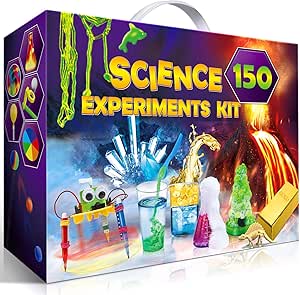
UNGILINGA 272 Experiments Science Kit for Kids, Chemistry Set
With 272 experiments, this kit dwarfs everything else in the roundup — nearly six times the activity count of the National Geographic 45-experiment set. That volume is the entire pitch: this pick makes the most sense for families who want a kit to last months rather than weekends, spanning volcano eruptions, crystal growing, holographic projection, and rainbow walking water. The inclusion of a test tube, beaker, conical flask, and measuring spoon gives it lab credibility comparable to the Discovery Super Reactions kit, though the tested-plastic construction won’t match the durability of premium Thames & Kosmos gear like the Chem C2000. The honest tradeoff is quality control across such a huge catalog — not all 272 experiments are equally meaty, and many lean on household staples rather than included chemicals. Instructions are clear and illustrated, but expect adult supervision and mess throughout. For sheer runway, nothing else here comes close.
Pros:- 272 experiments — by far the largest count in this lineup
- Real lab-style tools including beaker, conical flask, and test tubes
- Diverse activity types from crystal growing to holographic projection
- Clear illustrated instructions support semi-independent use
Cons:- Experiment quality varies widely across such a large catalog
- Many activities rely on household ingredients not included in the kit
- Plastic tools are lighter-duty than premium Thames & Kosmos equipment
Best for: Families who want one kit to sustain a curious child’s interest for months without repeat purchases
Not ideal for: Buyers who prioritize experiment depth over quantity — many of the 272 activities are simple household-ingredient demos
- Number of Experiments:272
- Includes:Test tube, measuring spoon, beaker, conical flask
- Material:Tested plastic
- Activity Types:Volcano eruptions, crystal growing, holographic projection, rainbow walking water
- Instruction Format:Easy-to-follow illustrated manual
- Learning Focus:Critical thinking, problem-solving, hands-on chemistry
Our verdict“The clear choice when experiment count and long-term engagement matter more than per-experiment polish.”
UNGlinga 70 Lab Experiments Science Kits for Kids Chemistry Set
This kit carves out a different niche than its UNGILINGA sibling: instead of sheer volume, it emphasizes the scientific process itself, with 70 experiments framed around teaching kids how to think like scientists. Activities like fruit circuits and crystal growing go beyond the eruption-and-slime formula that dominates the National Geographic 45-experiment set, introducing electricity and observation alongside chemistry. Compared with the 272-experiment UNGILINGA flagship, this version is less overwhelming for a first-time kit owner — 70 curated experiments is a manageable arc — and the child-safe ingredients keep the supervision burden reasonable. The drawback is build quality: component durability is a known question mark, and the included tools feel more basic than what Discovery’s Super Reactions kit provides. It sits at a comfortable middle ground between the gentle Ooze Labs station and the more demanding kits for older kids, making it a sensible structured starting point.
Pros:- 70 experiments framed around the scientific process, not just reactions
- Unusual activities like fruit circuits add variety beyond slime and volcanoes
- Safe, child-friendly ingredients reduce supervision intensity
- Manageable experiment count that won’t overwhelm first-time users
Cons:- Component durability is inconsistent compared with brand-name rivals
- Fewer experiments than similarly priced Discovery and National Geographic options
- Basic tools — no genuine lab glassware or molds included
Best for: Parents of 8-10 year olds who want a process-focused introduction to scientific thinking, not just flashy reactions
Not ideal for: Kids who want maximum spectacle or volume — 70 experiments and modest tools pale next to the UNGILINGA 272 kit
- Number of Experiments:70
- Age Range:8 years and up
- Brand:UNGlinga
- Model Number:HZDZKH030
- Activity Types:Volcanoes, crystal growing, fruit circuits, chemical reactions
- Learning Focus:STEM education, scientific process, critical thinking
- Safety Profile:Safe, child-friendly ingredients with easy instructions
Our verdict“A solid structured starter kit for teaching scientific thinking on a modest budget, if you accept lighter-duty components.”
National Geographic Junior Chemistry Set with 50 Experiments for Kids
Most chemistry sets start at age 8, which leaves the youngest aspiring scientists with nothing but YouTube videos. This option stands out for meeting four-year-olds where they are: 50 experiments built around baking soda, vinegar, and other household staples, with 20+ child-sized tools that make stirring and pouring feel like real lab work rather than a frustrating chore. Compared with the National Geographic Mega Science Lab, this kit trades depth for accessibility — the experiments are simpler, but a five-year-old can genuinely do them rather than watching a parent do the work. The tradeoff is real: by age seven or eight, most kids will have outgrown it, and the absence of listed safety certifications means parents should inspect the tools themselves. The value here is in early exposure and confidence-building, not scientific rigor.
Pros:- Genuinely age-appropriate for preschoolers, a range most chemistry kits ignore
- Uses safe household items, so re-running experiments is cheap and easy
- 20+ kid-sized tools and illustrated instructions support independent play
- 50 experiments give plenty of variety for short attention spans
Cons:- No real chemicals or genuine lab techniques, limiting educational depth
- Kids will outgrow it quickly — likely within a year or two
- No specific safety certifications listed
Best for: Parents of children ages 4-7 who want a safe, low-commitment first introduction to hands-on science
Not ideal for: Kids 8 and older — the household-item experiments will feel babyish next to kits like the Chem C2000 with real chemicals and lab glassware
- Recommended Age:4+
- Number of Experiments:50
- Lab Tools Included:20+
- Materials:Household items, child-safe tools
- Brand:National Geographic
Our verdict“Buy this for the preschooler in your life; skip it if your child is old enough for a real chemistry kit with actual reagents.”
National Geographic Mega Science Lab with 75 Experiments for Kids 8-12
Where most kits in this roundup commit to chemistry alone, this one spreads across three disciplines in a single box: earth science, chemistry, and science magic. That breadth is the whole point. For a child who hasn’t yet discovered what kind of science they love, the real rock, mineral, and crystal specimens offer something no pure chemistry kit can — a collectible, tactile payoff that extends beyond the last experiment. Compared with the Junior Chemistry Set from the same brand, this is a clear step up in sophistication, but it’s still nowhere near the Thames & Kosmos Chem C500’s structured, manual-driven chemistry curriculum. The honest tradeoff: a kid who already knows they love chemistry specifically will get less depth than a dedicated kit provides, and the magic tricks lean more toward performance than science. Think of it as a survey course, not a major.
Pros:- Three-in-one bundle covers earth science, chemistry, and magic for variety
- Includes genuine rock, mineral, and crystal specimens kids can keep
- Wide 75-experiment count keeps boredom at bay
- Strong gift appeal for birthdays and holidays
Cons:- Chemistry content is shallower than dedicated chemistry sets
- Magic tricks dilute the educational focus
- Older or advanced kids may find the experiments too easy
Best for: Parents of 8-12 year olds who want to sample multiple science disciplines before investing in a specialized kit
Not ideal for: Kids already serious about chemistry — the Chem C2000 offers far more genuine lab work for the same age range
- Age Range:8 years and up
- Number of Experiments:75
- Included Kits:Earth Science, Chemistry, Science Magic
- Specimens:Real rock, mineral, and crystal specimens
- Manufacturer:JMW Sales, Inc.
- Model Number:NGMEGASCIKIT
- Educational Focus:STEM, Critical Thinking, Observation Skills
Our verdict“This pick makes the most sense for undecided young scientists testing the waters across disciplines, not for chemistry-focused learners.”
Thames & Kosmos Chemistry Chem C500 Science Kit with 28 Guided Experiments
This is where real chemistry begins. Unlike the household-item experiments in the National Geographic Junior set, the Chem C500 includes actual chemicals, test tubes, pipettes, and stoppers — proper if entry-level lab equipment — paired with a genuinely excellent 48-page manual that explains the science behind each reaction, not just the steps. This model is better suited to families who want an affordable first taste of legitimate chemistry without committing to the price and complexity of the Chem C2000 or C3000. The tradeoffs are straightforward: 28 experiments is the smallest count in the Thames & Kosmos lineup, and there’s no heat source, which excludes entire categories of reactions. Some buyers will burn through the experiments in a few weekends. But as a low-risk entry point that teaches proper technique and safety habits from day one, it holds up remarkably well for the price.
Pros:- Real chemicals and lab equipment at an entry-level price
- 48-page manual explains the science, not just the procedure
- Introduces proper lab technique and safety habits early
- Compact footprint for easy storage
Cons:- Only 28 experiments — the least in the Thames & Kosmos line
- No heat source, so many classic reactions aren’t possible
- Too basic for kids who already have chemistry experience
Best for: Beginners ages 8-10 who are ready for real chemicals and lab tools but not ready for a big investment
Not ideal for: Families wanting long-term value — 28 experiments run out fast compared to the 250 in the Chem C2000
- Number of Experiments:28
- Manual Pages:48
- Included Components:Beakers, test tubes, chemicals, stoppers, pipettes, manual
- Dimensions:13.1″ L x 2.6″ W x 8.9″ H
- Manufacturer Warranty:1 Year
- Brand:Thames & Kosmos
Our verdict“The smart first purchase for a young chemist who’s outgrown toy kits but isn’t ready for burners and 300-experiment manuals.”
Thames & Kosmos Chem C2000 (V 2.0) Intermediate Chemistry Set
The Chem C2000 occupies the sweet spot in the Thames & Kosmos ladder — and that ladder matters, because it makes this kit’s position easy to understand. Compared with the Chem C500, you jump from 28 to 250 experiments, gain a 128-page full-color manual, and unlock the single biggest educational upgrade available at this level: the alcohol burner. Heat-based reactions open up an entirely new branch of chemistry that cooler-running kits simply cannot teach. Compared with the Chem C3000 above it, this set is meaningfully cheaper and less overwhelming, making it the right ceiling for most home users rather than the professional-grade C3000. The Parents’ Choice Silver Award reflects that balance. The honest drawbacks: the burner demands strict adult supervision, chemicals require careful handling and disposal, and younger kids in the 11+ range may hit frustration walls on the more complex protocols.
Pros:- 250 experiments provide months of structured progression
- Alcohol burner unlocks heat-based reactions most kits can’t do
- Professional-quality equipment builds real lab skills
- 128-page full-color manual with genuine scientific explanations
Cons:- Alcohol burner and chemicals require careful adult supervision and safe disposal
- Some experiments will frustrate kids at the younger end of the 11+ range
- Repurchasing chemicals after depletion adds ongoing cost
Best for: Motivated 11-14 year olds who have outgrown beginner kits and want serious, structured lab work at a mid-tier price
Not ideal for: Casual or younger experimenters — the alcohol burner and chemical handling demand maturity and consistent adult supervision
- Experiments:250
- Age Range:11+
- Manual Pages:128
- Includes:Real lab equipment, chemicals, alcohol burner
- Awards:Parents’ Choice Silver Award
- Brand:Thames & Kosmos
Our verdict“The best balance of depth, equipment quality, and price for a serious young chemist — buy it if your child has finished a starter kit and wants more.”
Thames & Kosmos 640132 Chem C3000 Chemistry Set for Ages 12+
The Chem C3000 is the summit of this lineup and priced accordingly. With 333 experiments spanning inorganic, organic, and electrochemistry, a 192-page manual, and 103 pieces of genuine lab equipment, this is less a toy and more a home laboratory in a box. The gap between this and the Chem C2000 is qualitative, not just quantitative: organic chemistry and electrochemistry simply don’t exist at lower tiers, and the equipment list supports genuinely authentic procedure. It meets the EN 71-4 safety standard, which most kits in this roundup can’t claim. But the tradeoffs deserve equal weight — this is for teenagers with real commitment, not a casual weekend interest. Adult supervision isn’t optional given the hazardous chemicals involved, the setup is complex, and paying premium prices for a kit a child abandons after three experiments is an expensive mistake. This pick makes the most sense for a student already planning to pursue science seriously.
Pros:- Only kit in this tier covering organic chemistry and electrochemistry
- Professional-grade 103-piece equipment set for authentic lab work
- 192-page manual reads like a real chemistry textbook
- Certified to the EN 71-4 safety standard
Cons:- Highest price in the roundup by a wide margin
- Hazardous chemicals require strict adult supervision and safe storage
- Complex setup will overwhelm younger or less motivated kids
Best for: Dedicated teens 12+ with genuine chemistry ambitions — science-fair competitors, STEM-track students, homeschool lab curricula
Not ideal for: Casual learners or gift-buyers guessing at interest level — the price, chemical hazards, and complexity demand real commitment
- Number of Experiments:333
- Pieces:103
- Age Range:12+
- Manual Pages:192
- Safety Standard:EN 71-4
- Fields Covered:Inorganic, organic, and electrochemistry
- Brand:Thames & Kosmos
Our verdict“Buy this only for a teenager whose interest in chemistry is proven — it’s a real lab, and it rewards genuine commitment.”
UNGLINGA 150 Experiments Science Kits for Kids – Chemistry and STEM Activities
This UNGLINGA 150-experiment kit stands out for sheer breadth — it spreads across chemistry, physics, earth science, and surface tension, making it the widest-topic option in this price bracket. Where the National Geographic Amazing Chemistry Set goes deeper on pure chemistry, this one trades depth for range, which matters if your child’s attention wanders between subjects. Compared with the UNGLINGA 272-experiment kit, it’s a lighter commitment, though families who want maximum longevity may prefer that bigger sibling. The illustrated manual is genuinely kid-friendly, so less reading help is needed than with Thames & Kosmos sets. The tradeoff: some experiments feel like variations on a theme, and a handful require household items beyond the box, so check the supply list before promising a rainy afternoon of science.
Pros:- Enormous 150-experiment count spans multiple STEM subjects
- Illustrated manual kids can follow with minimal help
- Quality kid-sized tools included, not just powders and packets
- Strong gift value at a lower price per experiment than most rivals
Cons:- Several experiments repeat similar concepts with slight tweaks
- Requires extra household items and adult supervision for some activities
- Chemistry content is shallower than chemistry-focused competitors
Best for: Budget-conscious families with kids 8+ who want months of varied STEM activities without buying multiple single-topic kits
Not ideal for: Parents seeking a rigorous chemistry-only curriculum — the multi-subject spread dilutes the chemistry depth of dedicated sets like the Nat Geo Amazing Chemistry Set
- Brand:UNGLINGA
- Age Range:8 years and up
- Number of Experiments:150
- Subjects Covered:Chemistry, physics, earth science, surface tension
- Included Components:Science experiment tools and materials
- Guide:Easy-to-follow illustrated manual
- Recommended Use:STEM activities, educational gifts
Our verdict“This pick makes the most sense for families who value long-lasting variety over deep chemistry instruction.”
National Geographic Amazing Chemistry Set with 100+ Experiments for Kids 8-12
Among kits aimed at the 8–12 crowd, this is the strongest all-around package. It pairs 100+ chemistry experiments with real lab equipment — test tubes, beakers, and pipettes — plus a bonus guide with 85 more experiments using household items, effectively pushing the total near 185. Compared with the UNGLINGA 150-experiment kit, it stays tightly focused on chemistry, so reactions, color changes, and bubbling solutions build on each other conceptually rather than scattering across subjects. The National Geographic Mega Science Lab offers similar polish but fewer experiments per dollar here. The tradeoffs are real, though: younger children will need supervision, and the brand’s name doesn’t exempt it from occasionally needing pantry items. Still, for structured STEM learning, the instruction quality and equipment set this apart.
Pros:- 100+ core experiments plus 85 bonus household-item experiments
- Includes proper lab equipment: test tubes, beakers, pipettes
- Genuinely chemistry-focused rather than diluted across subjects
- Backed by National Geographic’s educational pedigree and clear instructions
Cons:- Some experiments still require household items not in the box
- Younger kids in the range need close adult supervision
- Higher price than multi-subject competitors with similar counts
Best for: Parents of curious 8–12 year olds who want a chemistry-focused kit with real lab tools and a trusted educational brand
Not ideal for: Families looking for general science entertainment — this is strictly chemistry, unlike the multi-subject UNGLINGA kits
- Brand:National Geographic
- Age Range:8–12 years
- Number of Experiments:100+
- Bonus Experiments:85 additional using household items
- Includes:Test tubes, beakers, pipettes, experiment materials
- Focus:Chemistry and STEM learning
- Notable Activities:Bubbling solutions, color-changing liquids, glowing test tubes
Our verdict“The best single purchase for a kid seriously interested in chemistry who still wants fun, visual reactions.”
National Geographic Gross Science Kit with 45 Experiments for Kids 8-12
Not every child begs for a chemistry set — some need to be lured in by humor. That’s this kit’s entire reason for existing: boiling boogers, glowing worms, and 43 other deliberately disgusting experiments that sneak real STEM concepts past kids who’d otherwise avoid anything labeled ‘educational.’ Compared with the National Geographic Amazing Chemistry Set, it has fewer than half the experiments and leans on household items more heavily, so it works better as a gateway than a curriculum. Against the Nat Geo 45-experiment Chemistry Set, the counts match, but the pitch differs entirely — that one is for kids already curious; this one converts the skeptics. Parents should expect mess and plan for outdoor or well-covered work surfaces. The genuinely funny framing and clear illustrated instructions make it a reliable gift for the hard-to-please 8-year-old.
Pros:- Disgust-themed framing reliably hooks science-averse kids
- Clear illustrated instructions kids can follow independently
- Experiments reuse cheap household items, extending the kit’s life
- Backed by National Geographic quality and customer service
Cons:- Noticeably messy — plan for cleanup and covered surfaces
- Only 45 experiments with lighter educational depth than chemistry-focused rivals
- Gross-out theme actively repels some children
Best for: Kids who resist traditional science toys but love gross-out humor — the gateway-kit buyer
Not ideal for: Squeamish children or parents who dislike messy activities; also a poor fit for kids already doing structured chemistry, since the science is lighter
- Brand:Blue Marble (National Geographic)
- Age Range:8 years and up
- Number of Experiments:45
- Educational Objective:STEM
- Materials:Kit items plus common household items
- Model Number:NGMEGAGRS
- Manufacturer:JMW Sales, Inc.
Our verdict“A brilliant first chemistry kit for kids motivated by laughs rather than lab coats — skip it if yours already loves science.”

How We Picked
I ranked these kits against four criteria that matter most to buyers: educational depth (does the manual explain why reactions happen, or just how to perform them?), safety and age-appropriateness (non-hazardous ingredients for younger kids, real equipment with clear supervision requirements for teens), equipment quality and replay value (durable tools versus single-use packets), and cost per meaningful experiment rather than raw experiment count. Kits that inflated their numbers with repetitive variations scored lower than kits with fewer but genuinely distinct activities.
The ranking also reflects how well each kit fits its intended buyer. A preschooler-friendly slime station and a 12+ alcohol-burner set serve completely different households, so instead of forcing one standard, I ordered kits by how convincingly they deliver on their own promise within their age band. Brand consistency of instruction manuals — a real weakness for the budget UNGILINGA kits and a strength of Thames & Kosmos — broke ties near the top.
| educational chemistry lab kit | Brand |
|---|---|
| Thames & Kosmos Ooze Labs Chem | Thames & Kosmos |
| National Geographic Chemistry | National Geographic |
| Discovery Super Reactions Scie | Discovery |
| UNGILINGA 272 Experiments Scie | — |
| UNGlinga 70 Lab Experiments Sc | UNGlinga |
| National Geographic Junior Che | National Geographic |
| National Geographic Mega Scien | — |
| Thames & Kosmos Chemistry Chem | Thames & Kosmos |
| Thames & Kosmos Chem C2000 | Thames & Kosmos |
| Thames & Kosmos 640132 Chem C3 | Thames & Kosmos |
| UNGLINGA 150 Experiments Scien | UNGLINGA |
| National Geographic Amazing Ch | National Geographic |
| National Geographic Gross Scie | Blue Marble (National Geographic) |
Factors to Consider When Choosing Educational Chemistry Lab Kits
Before settling on a kit, it helps to understand what actually separates a great educational chemistry set from a flashy one that ends up forgotten in a closet. These are the factors I weighed most heavily, plus the mistakes I saw buyers make repeatedly.
Match the Kit to the Child’s Age and Attention Span
The single biggest mistake buyers make is purchasing above a child’s interest level, not their skill level. A 12+ kit with an alcohol burner and titration-style experiments will not challenge a ten-year-old intellectually so much as lose them within the first few sessions, because the manual assumes a baseline of patience and reading stamina. Conversely, giving a capable 11-year-old a slime-focused kit guarantees boredom within a week. Manufacturers’ age ratings are a reasonable guide, but attention span matters more than raw age: a focused eight-year-old may outgrow a junior kit quickly, while a casual tween may never touch a 250-experiment manual. If in doubt, buy one tier below the child’s ceiling — under-challenged kids abandon kits, but kids who succeed ask for the next level up, which is exactly how the Thames & Kosmos C-series progression is designed to work.
Understand What ‘Experiments’ Actually Means
Experiment counts are the most misleading spec in this category. A kit advertising 272 experiments may include dozens of near-identical color-change or bubble reactions, while a 28-experiment kit may teach 28 distinct chemical principles with full explanations. When comparing kits, look at how many experiment types are listed — slime, chromatography, acids and bases, crystals, gas reactions — rather than the headline number. Refill economics matter too: many budget kits rely on consumable packets that run out after one use, while better kits use common household materials (vinegar, baking soda, salt) for most activities. A kit that depletes in two afternoons is poor value even at a low price, so check whether refills are sold separately and what they cost relative to the original kit.
Real Equipment Versus Plastic Novelties
There is a genuine tradeoff between safety and authenticity in kit hardware. Plastic test tubes and droppers are safer, cheaper, and fine for younger kids, but they break the illusion of doing real science and cannot be used with heat. Kits with glassware, an alcohol burner, and a proper stand — the Chem C2000 and C3000 in this roundup — teach actual lab technique: handling hot glass, measuring precisely, and organizing a workspace. That authenticity comes with mandatory adult supervision and a dedicated workspace, so honestly assess whether a parent will be available for those sessions. A middle path exists for ages 8–11: sturdy plastic stations like the Ooze Labs Chemistry Station or National Geographic kits that mimic real lab layouts without the hazards, building good habits before the glass-and-flame stage.
Instruction Manual Quality Determines Educational Value
The manual is where educational chemistry kits earn or lose their purpose. Weak manuals give step-by-step instructions with no explanation, producing a magic show rather than a science lesson; strong manuals explain the chemical principles behind each reaction, suggest variations, and connect activities to real-world chemistry. Thames & Kosmos manuals are consistently the best in this lineup — full-color, well-structured, and written to build knowledge cumulatively across experiments. Before buying any kit, read reviews that specifically mention the instructions, because this is where budget brands cut corners hardest. Also check whether the manual is purely pictorial (fine for ages 6–8, frustrating for older kids) or text-rich (better for tweens who want the ‘why’). A great manual effectively doubles a kit’s value by turning 30 experiments into 30 lessons.
Supervision, Safety, and Household Mess
Buyers routinely underestimate the mess and supervision these kits require. Volcano and slime activities — staples of the National Geographic and Discovery kits — are exciting but demand newspaper-covered surfaces, washable clothes, and a parent willing to supervise actively. Kits labeled non-hazardous still involve food-grade acids and bases that stain fabric and irritate eyes, so safety goggles and a designated work surface are worth adding to any purchase. The premium kits introduce genuinely new hazards: open flames, heated glass, and chemicals that require careful storage away from younger siblings. If your household includes a curious toddler alongside the intended user, factor that into whether an advanced kit is realistic at all. No kit in this roundup uses truly dangerous chemicals, but supervision requirements range from ‘glance over occasionally’ to ‘sit beside them the whole session’ — know which you are signing up for.
When to Pay More — and When Not To
Premium kits justify their price through equipment longevity and curriculum depth, not through more fun. Paying up makes sense when the child has already shown sustained interest — completing a cheaper kit and asking for more — because the C2000 and C3000 hardware lasts for years and supports experiments far beyond the included manual. Paying up for a first chemistry set, however, is a common and expensive mistake: many kids discover they prefer physics or biology, and a $200 advanced kit becomes shelf decoration. For first-timers, spend in the $25–45 range, where National Geographic and UNGLINGA offer enough variety to test genuine interest. Also watch for seasonal pricing — chemistry kits discount heavily around holidays, and last year’s version of a kit (like the C2000 V2.0) is often functionally identical at a lower price than the newest revision.
Frequently Asked Questions
Which chemistry kit is best if my child has never done science experiments before?
For a true beginner between ages 6 and 9, the Thames & Kosmos Ooze Labs Chemistry Station is the safest entry point because every experiment is non-hazardous and the self-contained station keeps mess manageable for a first-time household. If your child is 8 to 11 and already curious about reactions rather than just slime, the National Geographic Junior Chemistry Set with 50 experiments offers more variety while staying fully safe for supervised independent play. Avoid starting with the Chem C2000 or C3000 even for a bright child, because those kits assume basic lab habits — measuring, pouring, patience — that beginners have not built yet. The goal of a first kit is to make chemistry feel achievable and fun; depth can come in the second purchase.
Are the high experiment counts on kits like the UNGILINGA 272 real?
Technically yes, but with a big asterisk. Many of those 272 experiments are variations on the same core reaction — changing a color, a quantity, or one ingredient to produce a similar result — so the effective variety is closer to what you get in a well-designed 45–75 experiment kit. That is not necessarily a bad deal, since repeating a reaction with small changes is genuinely how kids learn experimental thinking, and the kit still costs less per activity than premium options. However, if your child tires of repetition quickly, they may exhaust the kit’s novelty after a dozen sessions. National Geographic kits tend to distribute their experiments across more distinct activity types, which is why they rank higher in my value assessment despite lower headline numbers.
Is an alcohol burner in the Thames & Kosmos C2000 and C3000 safe for home use?
Yes, with conditions. The burners are small, use denatured alcohol, and extinguish easily, but they are a real open flame on your kitchen or garage table, so Thames & Kosmos correctly rates these kits for ages 11+ with adult supervision. You will need a heat-resistant, stable surface, a fire-safe workspace away from younger children and pets, and a parent present for every heated experiment. What you get in return is authentic lab technique that no plastic-only kit can teach — observing reactions at temperature, handling heated vessels with tongs, and understanding flame safety as a genuine lab skill. If your household cannot support that supervision level, the Chem C500 or a National Geographic kit delivers plenty of chemistry without any flame at all.
What happens when the chemicals run out — can I refill these kits?
Refillability varies sharply by brand, and it is worth checking before you buy. Thames & Kosmos sells refill packs for its C-series kits and, more importantly, designs most experiments around common household chemicals like vinegar, baking soda, citric acid, and table salt, so the equipment stays useful indefinitely. National Geographic kits rely more heavily on included packets for their signature reactions, though many activities also use pantry staples. Budget kits like UNGILINGA are the most consumable-heavy — once the packets are gone, the plastic tools have limited standalone value. As a rule, the more a kit’s educational value lives in its equipment and manual rather than its chemicals, the better its long-term value. This is a major reason the Chem C2000 justifies its price for committed young chemists.
My kid loves gross things — is the National Geographic Gross Science Kit actually educational?
It is more educational than its branding suggests, though less systematic than a classic chemistry set. The 45 experiments include genuine microbiology and chemistry concepts — growing cultures, polymer slime, digestion simulations — with explanations that connect the ‘gross’ factor to real science, which is a proven hook for reluctant learners ages 8–12. Compared with the Amazing Chemistry Set from the same brand, it trades breadth for engagement: fewer classic reactions, but far more appeal to kids motivated by the eww factor rather than the wow factor. If your child has shown little interest in conventional science kits, this theming can be the difference between a kit that gets used and one that gathers dust. Just treat it as a gateway — if it lands, graduate to a structured set like the National Geographic Chemistry Set or Chem C500 next.
Conclusion
After comparing all 13 kits, the right choice comes down to who is standing at the lab station. For best overall, the Thames & Kosmos Chem C2000 (V 2.0) earns the top spot with its rare combination of real lab equipment, a genuinely educational 250-experiment manual, and a clear upgrade path toward the C3000. For best value, the National Geographic Amazing Chemistry Set with 100+ experiments delivers the most distinct activities per dollar in the lineup and suits most households with kids aged 8–12.
For beginners and younger kids, the Thames & Kosmos Ooze Labs Chemistry Station is the safest, tidiest first chemistry experience, with the National Geographic Junior Chemistry Set as a strong step up for ages 8–10. For the premium buyer with a committed teen, the Chem C3000 is the closest thing to a home chemistry course and worth every dollar — but only for a child who has already shown sustained interest. For specific needs: the UNGILINGA 272-experiment kit for maximum structured activity on a budget, the Discovery Super Reactions kit for kids who learn through spectacle, the National Geographic Gross Science kit for reluctant scientists, and the Chem C500 as a low-cost way to test whether chemistry sticks before investing in the big kits. Whatever you choose, buy one tier below your child’s ceiling first — you can always level up, and a completed beginner kit is the best predictor that a premium one will get used.
Fall Picks
fall essentials
As an affiliate, we earn on qualifying purchases.