The best electronics instrumentation equipment depends on whether you need dependable measurements, waveform analysis, component checks, or an all-in-one portable tool. I’d make the Rigol DM3058E my overall pick for bench measurements, while the Hantek DSO2D15 stands out for dedicated oscilloscope work and the Fluke 117 for everyday electrical troubleshooting. The main tradeoff is between the capability and controls of dedicated bench instruments and the convenience of compact, combined-function devices. Specialized tools such as an LCR meter or microscope can be a better fit when your work centers on components or inspection. Continue reading for the full breakdown and guidance on matching an instrument to your bench, field kit, or learning setup.

Prime made for students and young adults
- Fast, free delivery for dorm and study essentials
- Prime Video and Amazon Music included
- Member-only deals
Key Takeaways
- Dedicated instruments have a clearer role: the Rigol DM3058E focuses on bench multimeter measurements, while the Hantek DSO2D15 is the dedicated oscilloscope choice in this lineup.
- Portability often means combining functions: the FNIRSI 2C53T, FNIRSI 2D15P, IMARS HO-3S, and EspoTek Labrador combine several capabilities, but buyers should check which functions and interfaces matter most to their work.
- There is no single best oscilloscope for every setting: the Hantek is the dedicated benchtop option, while the FNIRSI DSO152 and Korg NTS-2 emphasize more compact or specialized use.
- Measurement needs can justify a specialist: the FNIRSI LC1020E and LCR-P1 address component testing, while the Woehrsh microscope supports visual inspection rather than electrical measurement.
- Safety and measurement context matter as much as feature count: the Fluke 117, 17B+, and 117/323 kit serve different electrical troubleshooting needs, so buyers should match instrument ratings and functions to the circuits they work on.
| Rigol DM3058E 5.5-Digit Bench Digital Multimeter |  | Best for Bench Measurement and Remote Logging | Resolution: 5.5 digits | Counts: Conflicting listings: 123,000 and 50,000 | Measurement functions: DC/AC voltage and current, resistance, capacitance, frequency, period, continuity, diode testing, and temperature | VIEW LATEST PRICE | See Our Full Breakdown |
| Fluke 117 True-RMS Digital Multimeter with VoltAlert |  | Best for Electricians | Measurement type: True-RMS digital multimeter | Maximum operating voltage: 600 V | DC millivolts range: 600.0 mV | VIEW LATEST PRICE | See Our Full Breakdown |
| Hantek DSO2D15 Digital Storage Oscilloscope, 150MHz Bandwidth, 2 Channels |  | Best Value Oscilloscope for General Lab Work | Bandwidth: 150 MHz | Channels: 2 | Sample rate: 1 GSa/s | VIEW LATEST PRICE | See Our Full Breakdown |
| Woehrsh RM Trinocular Microscope 40X-5000X with HD USB Camera and Dual Mechanical Stage |  | Best for Microscopic Inspection and Digital Documentation | Magnification range: 40X–5000X | Optical system: Infinity optical system with achromatic objective lenses | Eyepieces: 2 WF10x, 2 WF25x, and high-pixel electronic eyepiece | VIEW LATEST PRICE | See Our Full Breakdown |
| Fluke 117/323 Multimeter & Clamp Meter Kit |  | Best Field Kit for Electrical Troubleshooting | Included instruments: Fluke 117 multimeter and Fluke 323 clamp meter | Maximum AC current: 400 A | Maximum voltage: 600 VAC/DC | VIEW LATEST PRICE | See Our Full Breakdown |
| FNIRSI DSO152 Handheld Oscilloscope |  | Best Compact Oscilloscope | Bandwidth: 200 kHz | Real-time sampling rate: 2.5 MS/s | Display: 2.8-inch HD LCD, 320 × 240 resolution | VIEW LATEST PRICE | See Our Full Breakdown |
| Fluke 17B+ Digital Multimeter |  | Best for Electrical Troubleshooting | Maximum voltage: 1000 V | Maximum AC/DC current: 10 A | Temperature measurement: Up to 400 °C with K-type thermocouple | VIEW LATEST PRICE | See Our Full Breakdown |
| FNIRSI LC1020E 100 kHz LCR Meter | 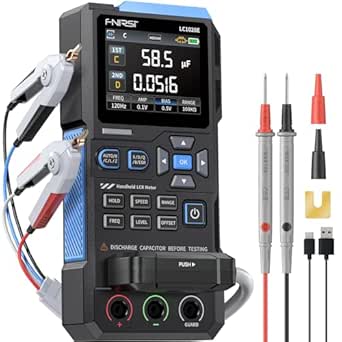 | Best for Component Characterization | Measurement types: Capacitance, resistance, and inductance | Test frequencies: 100 Hz, 120 Hz, 1 kHz, 10 kHz, and 100 kHz | Capacitance range: 1 pF–100 mF | VIEW LATEST PRICE | See Our Full Breakdown |
| FNIRSI 2C53T 3-in-1 Oscilloscope, Multimeter, and DDS Signal Generator |  | Best All-in-One Handheld Instrument | Oscilloscope: 2 channels; 50 MHz bandwidth; 250 MSa/s sampling rate | Record depth: 1 Kpts | Maximum oscilloscope voltage: 400 V | VIEW LATEST PRICE | See Our Full Breakdown |
| EspoTek Labrador USB Oscilloscope, Signal Generator, Power Supply, Logic Analyzer, and Multimeter |  | Best Open-Source PC-Based Lab | Oscilloscope: 2 channels; 750 ksps sample rate | Waveform generator: 2 channels; 1 MSPS per channel | Logic analyzer: 2 channels; 3 MSPS per channel; serial decoding supported | VIEW LATEST PRICE | See Our Full Breakdown |
| IMARS HO-3S Dual-Channel Handheld Oscilloscope, Multimeter, and Signal Generator |  | Best Compact 3-in-1 | Oscilloscope bandwidth: 70 MHz | Sampling rate: 200 MS/s | Channels: 2 | VIEW LATEST PRICE | See Our Full Breakdown |
| FNIRSI 2D15P 100 MHz 3-in-1 Oscilloscope, Multimeter, and DDS Signal Generator |  | Best for Portable Scope Performance | Oscilloscope bandwidth: 100 MHz | Sampling rate: 500 MS/s | Oscilloscope channels: 2 | VIEW LATEST PRICE | See Our Full Breakdown |
| FNIRSI LCR-P1 Transistor Tester and LCR Meter |  | Best for Component Bench Checks | Measurement types: LCR, ESR, transistor, diode, and battery | Display: 1.44-inch full-color screen | Component identification: Automatic identification of component pins and parameters | VIEW LATEST PRICE | See Our Full Breakdown |
| Korg Nu:Tekt NTS-2 DIY Oscilloscope Kit |  | Best for Audio and Synth Work | Type: DIY oscilloscope kit | Channels: 4 | Functions: Oscilloscope, waveform generator, spectrum analyzer, and tuner | VIEW LATEST PRICE | See Our Full Breakdown |
More Details on Our Top Picks
Rigol DM3058E 5.5-Digit Bench Digital Multimeter
The Rigol DM3058E is the strongest fit here for a fixed lab bench where measurement coverage and computer integration matter more than portability. Its 5.5-digit resolution, dual display, and functions spanning voltage, current, resistance, capacitance, frequency, and temperature can reduce instrument swapping during routine work. USB, LAN, RS-232, and SCPI support also make it a better match for automated logging than the handheld Fluke 117, which prioritizes field troubleshooting and non-contact voltage checks. The tradeoff is a corded benchtop format, so it is not suited to moving between job sites. I would also verify the count specification before purchase: the supplied data conflicts between 123,000 and 50,000 counts, and the listed dimensions appear incomplete.
Pros:- 5.5-digit resolution and broad measurement coverage suit bench diagnostics.
- Dual display can show two measurement parameters at once.
- USB, LAN, RS-232, and SCPI support remote control and data collection.
- Corded design is suited to stationary lab or production setups.
Cons:- Requires an outlet, limiting use in field work.
- Provided specifications conflict on whether the meter has 123,000 or 50,000 counts.
- Listed dimensions appear incomplete and are not useful for planning bench space.
Best for: Lab technicians and electronics engineers who need a stationary multimeter with broad measurement functions and remote data collection.
Not ideal for: Electricians who need a portable meter for work away from an outlet, or buyers who require unambiguous count and size specifications.
- Resolution:5.5 digits
- Counts:Conflicting listings: 123,000 and 50,000
- Measurement functions:DC/AC voltage and current, resistance, capacitance, frequency, period, continuity, diode testing, and temperature
- DC voltage accuracy:0.015% basic
- Display:Dual display
- Connectivity:USB, LAN, and RS-232; SCPI support
- Power source:Corded electric
- Weight:2.93 kg
Our verdict“Choose the Rigol for connected, stationary measurement work; choose the Fluke 117 instead when portability and job-site voltage checks matter more.”
Fluke 117 True-RMS Digital Multimeter with VoltAlert
The Fluke 117 is built around the needs of commercial electricians: quick checks, readable results, and fewer misleading voltage readings. VoltAlert adds non-contact voltage detection, while AutoVolt and LoZ help simplify selection and suppress ghost-voltage readings. True-RMS measurement is useful when loads produce nonsinusoidal waveforms, a different priority from the Rigol DM3058E’s bench-oriented connectivity and wider set of measurement functions. The Fluke is also much easier to carry between work areas than a benchtop meter. Its focus has limits: the supplied specifications do not list the broader capacitance, frequency, and temperature coverage offered by some bench instruments. Battery life is listed at 400 hours only with the backlight off, and its operating range excludes more extreme conditions.
Pros:- VoltAlert enables non-contact voltage detection.
- True-RMS measurement is suited to nonlinear electrical loads.
- LoZ mode helps prevent false readings from ghost voltage.
- White LED backlight supports work in dim areas.
Cons:- Listed battery life of 400 hours applies with the backlight disabled.
- Operating temperature range is limited to -10°C to +50°C.
- Does not offer the Rigol DM3058E’s listed LAN, RS-232, and SCPI remote-control options.
Best for: Commercial electricians who want a portable meter with non-contact voltage detection and safeguards against ghost-voltage readings.
Not ideal for: Bench technicians who need remote logging, dual-display readings, or a broad set of documented measurement functions in one stationary instrument.
- Measurement type:True-RMS digital multimeter
- Maximum operating voltage:600 V
- DC millivolts range:600.0 mV
- DC millivolts resolution:0.1 mV
- Operating temperature:-10°C to +50°C
- Typical battery life:400 hours without backlight
- Weight:689 g
- Warranty:3 years
Our verdict“Pick the Fluke 117 for portable commercial electrical troubleshooting, not for automated bench measurement.”
Hantek DSO2D15 Digital Storage Oscilloscope, 150MHz Bandwidth, 2 Channels
The Hantek DSO2D15 puts scope, trigger, and waveform-generation capabilities into a single instrument for buyers who need to inspect changing signals rather than just measure steady electrical values. Its 150 MHz bandwidth, 1 GSa/s sample rate, and 8M memory depth provide a practical starting point for many engineering and education tasks, while the built-in one-channel waveform generator can help create signals without adding another instrument. Compared with the Rigol DM3058E, this is the better choice for waveform analysis, but it cannot replace a multimeter for the Rigol’s listed resistance, capacitance, and temperature measurements. Two channels also limit simultaneous comparisons, and 150 MHz is a poor fit for higher-frequency work. I’d choose it for general-purpose scope tasks, not for a growing multi-channel or high-bandwidth lab.
Pros:- 150 MHz bandwidth and 1 GSa/s sample rate suit a range of general signal checks.
- 8M memory depth supports capturing longer waveform records.
- Built-in one-channel waveform generator adds signal output without a separate generator.
- Includes 14 trigger modes and five serial protocol trigger types.
Cons:- Two channels limit simultaneous signal comparisons.
- 150 MHz bandwidth may fall short for higher-frequency applications.
- An oscilloscope does not replace the broad multimeter measurements listed for the Rigol DM3058E.
Best for: Students, educators, and electronics repairers who need a two-channel scope with a built-in waveform output for general signal analysis.
Not ideal for: Engineers working with high-frequency signals or needing to compare more than two signals at once.
- Bandwidth:150 MHz
- Channels:2
- Sample rate:1 GSa/s
- Memory depth:8M
- Waveform generator:1 channel
- Trigger modes:14
- Serial protocol triggers:5
- Product dimensions:12.44 x 4.33 x 5.91 inches
Our verdict“Choose the Hantek when waveform capture and built-in signal generation matter more than extra channels or high-frequency headroom.”
Woehrsh RM Trinocular Microscope 40X-5000X with HD USB Camera and Dual Mechanical Stage
The Woehrsh RM serves a different instrumentation need from the meters and oscilloscope in this roundup: close inspection of biological samples and other small-scale details. Its trinocular head and USB camera give a user a way to view through the optics and capture images digitally, while the dual mechanical stage supports controlled positioning rather than relying on hand movement alone. That makes it more useful for documentation and classroom demonstrations than the signal-focused Hantek DSO2D15. The microscope’s listed 40X–5000X range and included slides and coverslips also make it a broad kit, though magnification alone does not make it a substitute for electrical test equipment. The tradeoffs are a more involved setup and a listed 240V requirement, which may not suit regions using 110V power.
Pros:- Trinocular design includes a high-pixel electronic eyepiece for digital capture.
- Infinity optical system and achromatic objectives support clear sample viewing.
- Dual mechanical stage allows controlled specimen positioning.
- Included slides, coverslips, and tools provide a broad starting kit.
Cons:- Listed 240V requirement may be incompatible with 110V regions.
- Numerous accessories and setup steps may be challenging for new microscope users.
- It addresses optical inspection, not the electrical measurements covered by the Fluke 117 or Rigol DM3058E.
Best for: Biology educators, lab learners, and inspection users who need a microscope with digital capture and sample-positioning controls.
Not ideal for: Electronics technicians seeking voltage or waveform instruments, or buyers in 110V regions without a compatible power solution.
- Magnification range:40X–5000X
- Optical system:Infinity optical system with achromatic objective lenses
- Eyepieces:2 WF10x, 2 WF25x, and high-pixel electronic eyepiece
- Light source:LED
- Focusing system:Dual coaxial coarse and fine
- Stage:Dual mechanical stage
- Head rotation:306° swivel
- Voltage:240 V
Our verdict“Choose the Woehrsh RM for sample viewing and digital documentation; skip it if your instrumentation work is focused on electrical signals.”
Fluke 117/323 Multimeter & Clamp Meter Kit
The Fluke 117/323 kit is the most job-ready pick for electricians who need both probe-based checks and a way to measure current without opening the circuit. The 117 adds VoltAlert and LoZ for non-contact voltage checks and help with ghost readings; the 323 clamp meter measures up to 400 A AC. That pairing gives field technicians more flexibility than buying the Fluke 117 alone, and the included case helps keep both instruments together between tasks. The tradeoff is that the clamp meter’s current measurement is AC-only, so this kit does not cover DC current with the clamp. Its listed multimeter functions also omit capacitance and frequency, making the connected bench-oriented Rigol DM3058E a better fit for broader measurement work and remote logging.
Pros:- Combines the Fluke 117 multimeter with a Fluke 323 clamp meter.
- Clamp meter measures AC current up to 400 A without requiring an in-line current connection.
- 117 provides True-RMS measurement, VoltAlert, and LoZ mode.
- Includes a C115 soft carrying case for transport and storage.
Cons:- Clamp meter does not measure DC current.
- The multimeter’s listed functions do not include capacitance or frequency.
- Less suited to stationary remote logging than the Rigol DM3058E.
Best for: Electricians and maintenance technicians who need a portable meter-and-clamp combination for AC current and everyday voltage troubleshooting.
Not ideal for: Electronics technicians who need DC current from a clamp meter, capacitance or frequency measurement, or automated bench data collection.
- Included instruments:Fluke 117 multimeter and Fluke 323 clamp meter
- Maximum AC current:400 A
- Maximum voltage:600 VAC/DC
- Multimeter measurements:AC/DC voltage and AC/DC amps
- Clamp meter measurements:AC/DC voltage and AC amps
- Included case:C115 carrying case
- Power source:Alkaline
- Certifications:UL, CSA, ANSI/ISA, CAN/CSA, CE, C-Tick, TUV, and VDE
Our verdict“Choose this kit for field electrical work that calls for AC clamp measurements alongside a full-size handheld multimeter.”
FNIRSI DSO152 Handheld Oscilloscope
The DSO152 is the most portable oscilloscope in this group, weighing just 3.53 ounces and fitting easily into a field kit. Its one-key auto setup helps a technician or student get a basic waveform on screen without much adjustment, while the rechargeable battery supports roughly four hours of use away from an outlet. Compared with the FNIRSI 2C53T, however, it gives up a second channel, far more bandwidth, and integrated multimeter and signal-generator functions. Its 200 kHz bandwidth and 2.5 MS/s sampling rate suit low-frequency checks and introductory work, not fast digital signals or detailed waveform analysis. The small display also limits how much detail is comfortable to inspect. I’d choose it for portability and simple checks, not as a main bench instrument.
Pros:- Pocket-sized, 3.53-ounce design is easy to carry to field jobs.
- One-key auto setup speeds up basic waveform checks.
- Built-in 1000 mAh battery provides approximately four hours of runtime.
- USB-C supports charging and data transmission.
Cons:- 200 kHz bandwidth and 2.5 MS/s sampling rate restrict it to low-frequency work.
- The 2.8-inch screen is cramped for detailed waveform inspection.
- Single-channel capability offers less flexibility than the FNIRSI 2C53T.
Best for: Automotive technicians, students, and field-service workers who need a lightweight oscilloscope for basic, low-frequency signal checks.
Not ideal for: Engineers troubleshooting fast digital circuits or needing multiple channels, deeper analysis, or a larger display.
- Bandwidth:200 kHz
- Real-time sampling rate:2.5 MS/s
- Display:2.8-inch HD LCD, 320 × 240 resolution
- Battery:1000 mAh lithium polymer; approximately 4 hours runtime
- Connectivity:USB Type-C
- Maximum voltage with 10× probe:800 VPP (280 V AC)
- Trigger modes:Auto, Normal, Single
- Dimensions and weight:3.78 × 2.64 × 0.79 inches; 3.53 ounces
Our verdict“Choose the DSO152 for a lightweight, battery-powered instrument for basic low-frequency checks, but pick the FNIRSI 2C53T for broader bench-style capability.”
Fluke 17B+ Digital Multimeter
The Fluke 17B+ is the strongest fit here for routine electrical troubleshooting where a dependable, safety-rated multimeter matters more than waveform viewing. Its CAT III 600 V rating, voltage measurement up to 1000 V, and current measurement up to 10 A cover a wide range of residential, commercial, and industrial checks. The included K-type thermocouple function adds a practical way to check temperatures without carrying a separate thermometer. Compared with the FNIRSI 2C53T, the 17B+ is a focused meter rather than a combined oscilloscope, generator, and multimeter; that simpler role can make sense for electricians who mainly need electrical measurements. The tradeoff is a 10 A current ceiling, which rules out some higher-current tasks, and it offers no waveform display for signal diagnosis.
Pros:- CAT III 600 V safety rating suits demanding electrical work.
- Measures voltage up to 1000 V and current up to 10 A.
- K-type thermocouple support measures temperatures up to 400 °C.
- Designed for one-hand operation, including when wearing gloves.
Cons:- The 10 A current limit excludes higher-current applications.
- It lacks the oscilloscope and signal-generator functions built into the FNIRSI 2C53T.
- At 470 g, it is heavier than the compact DSO152.
Best for: Electricians and maintenance technicians who need a safety-rated handheld meter for voltage, current, resistance, continuity, and temperature checks.
Not ideal for: Electronics engineers who need waveform capture, signal generation, or current measurements above 10 A.
- Maximum voltage:1000 V
- Maximum AC/DC current:10 A
- Temperature measurement:Up to 400 °C with K-type thermocouple
- Measurement functions:Voltage, current, resistance, continuity, diode, capacitance, frequency, and temperature
- Power source:Battery powered
- Weight:470 g
- Dimensions:8.46 × 2.76 × 5.91 inches
Our verdict“Choose the Fluke 17B+ for broad, safety-rated electrical measurements and temperature checks, but look to a combined instrument if waveform analysis is part of the job.”
FNIRSI LC1020E 100 kHz LCR Meter
The FNIRSI LC1020E earns its place by focusing on component measurements that a general-purpose multimeter cannot describe as fully. It measures capacitance, resistance, and inductance at five selectable frequencies, while showing a primary reading alongside a secondary parameter such as ESR, Q, or dissipation factor. That added context helps when comparing capacitors, coils, and other passive components rather than merely checking continuity. Component sorting, adjustable test settings, open/short calibration, and four-terminal Kelvin connections give it more bench utility than the simpler FNIRSI LCR-P1 transistor tester. In exchange, it is a dedicated LCR instrument, not an oscilloscope or broad electrical meter like the Fluke 17B+. Users also need to remove components from powered circuits and fully discharge capacitors before testing.
Pros:- Five test frequencies support component checks across different measurement conditions.
- Displays primary and secondary parameters, including ESR, Q, and dissipation factor.
- Component sorting and adjustable tolerances speed up parts selection.
- Open/short calibration and four-terminal Kelvin connections support more controlled measurements.
Cons:- Components must be fully discharged before measurement.
- On-board components must be tested with circuit power off.
- Its dedicated LCR role does not replace a general multimeter or oscilloscope.
Best for: Repair technicians, electronics students, and makers who regularly measure or sort passive components and need more detail than a standard multimeter provides.
Not ideal for: Buyers seeking one instrument for voltage troubleshooting, waveform capture, or in-circuit measurements without powering down and isolating components.
- Measurement types:Capacitance, resistance, and inductance
- Test frequencies:100 Hz, 120 Hz, 1 kHz, 10 kHz, and 100 kHz
- Capacitance range:1 pF–100 mF
- Resistance range:10 mΩ–10 MΩ
- Inductance range:1 µH–100 H
- Secondary parameters:X, D, Q, θ, and ESR
- Connections:3-pin sockets and 5-slot jacks for four-terminal Kelvin measurements
- Display and battery:2.8-inch color TFT; 3000 mAh battery with USB-C charging
- Weight and dimensions:250 g; 3.35 × 1.38 × 7.28 inches
Our verdict“Choose the LC1020E for detailed passive-component measurement and sorting, but keep a multimeter or oscilloscope for broader troubleshooting.”
FNIRSI 2C53T 3-in-1 Oscilloscope, Multimeter, and DDS Signal Generator
The FNIRSI 2C53T ranks as the most versatile standalone handheld in this batch: it combines a two-channel oscilloscope, a 4.5-digit multimeter, and a DDS signal generator. Its 50 MHz bandwidth and 250 MSa/s sampling rate give it far more waveform capability than the compact DSO152, while the integrated meter reduces the need to carry a separate instrument such as the Fluke 17B+. The generator adds a useful source for basic circuit checks, though its 50 kHz ceiling is modest beside the oscilloscope’s bandwidth. A 1 Kpts record depth and 2.8-inch screen also limit detailed waveform analysis, and the stated 400 V oscilloscope input ceiling is not suited to every high-voltage task. I’d favor it when carrying fewer tools matters more than specialized depth.
Pros:- Combines a two-channel oscilloscope, 4.5-digit multimeter, and DDS signal generator.
- 250 MSa/s sampling rate and 50 MHz bandwidth exceed the DSO152’s basic signal range.
- Multimeter covers broad voltage, current, resistance, and capacitance ranges.
- 3000 mAh battery and USB-C support portable work and image export.
Cons:- The 1 Kpts record depth limits waveform capture detail.
- The 2.8-inch display can feel cramped during close waveform analysis.
- Signal generation tops out at 50 kHz, and the oscilloscope input is limited to 400 V.
Best for: Field technicians, electronics students, and repairers who want oscilloscope, multimeter, and basic signal-generation functions in one battery-powered unit.
Not ideal for: Users who need long waveform records, a large display, a signal generator above 50 kHz, or higher-voltage oscilloscope measurements.
- Oscilloscope:2 channels; 50 MHz bandwidth; 250 MSa/s sampling rate
- Record depth:1 Kpts
- Maximum oscilloscope voltage:400 V
- Multimeter ranges:AC voltage 0–750 V; DC voltage 0–999.9 V; current 0–9.999 A; resistance 0–19.99 MΩ; capacitance 0–99.99 mF
- Signal generator:13 waveforms; maximum frequency 50 kHz; 1 Hz step
- Display:2.8-inch LCD
- Battery and standby:3000 mAh; up to 6 hours standby
- Weight and dimensions:400 g; 6.57 × 3.5 × 1.38 inches
Our verdict“Choose the 2C53T when one portable tool must cover several electronics tasks, but select dedicated bench instruments for deeper analysis or specialized limits.”
EspoTek Labrador USB Oscilloscope, Signal Generator, Power Supply, Logic Analyzer, and Multimeter
The EspoTek Labrador takes a different approach from the handheld instruments: it connects to a PC, Raspberry Pi, or Android device and uses that screen as the interface for five basic lab tools. Its open-source hardware and software make it especially appealing to students and makers who want to inspect or adapt the design rather than use a sealed instrument. Two oscilloscope channels sit alongside a waveform generator, logic analyzer with serial decoding, low-power supply, and basic multimeter functions. Compared with the standalone FNIRSI 2C53T, it is far lighter and more adaptable to a software-based setup, but it depends on a compatible host and its oscilloscope sample rate is only 750 ksps. The 0.75 W supply also limits what it can power, so this is a learning and prototyping aid, not a replacement for a full bench lab.
Pros:- Combines oscilloscope, waveform generator, power supply, logic analyzer, and multimeter functions.
- Open-source hardware and software support inspection and modification.
- Works with Windows, macOS, Linux, Android, and Raspberry Pi platforms.
- Weighs just 20 g, making the device easy to carry.
Cons:- The 750 ksps oscilloscope sample rate is unsuitable for many fast signals.
- The power supply output is limited to 0.75 W.
- Requires a compatible host device, unlike the standalone FNIRSI 2C53T.
Best for: Students, makers, and engineers who already have a compatible computer or Raspberry Pi and value open-source tools for low-speed electronics work.
Not ideal for: Technicians needing a standalone field instrument, faster waveform capture, or a power supply capable of running demanding circuits.
- Oscilloscope:2 channels; 750 ksps sample rate
- Waveform generator:2 channels; 1 MSPS per channel
- Logic analyzer:2 channels; 3 MSPS per channel; serial decoding supported
- Power supply:4.5–15 V; maximum output power 0.75 W
- Multimeter functions:Voltage, current, resistance, and capacitance
- Compatible devices:PC, Raspberry Pi, and Android device
- Open-source status:Hardware and software are open source
- Power source and weight:Corded electric; 20 g
Our verdict“Choose the Labrador for open-source, host-based learning and low-speed prototyping, but pick a standalone instrument for field work or faster signal analysis.”
IMARS HO-3S Dual-Channel Handheld Oscilloscope, Multimeter, and Signal Generator
The IMARS HO-3S brings a 70 MHz, two-channel oscilloscope, a 20,000-count True RMS multimeter, and a basic waveform generator into a 7.8-ounce handheld tool. That mix suits technicians who want several core checks in one bag rather than a bench full of separate instruments. Compared with the larger FNIRSI 2D15P, the HO-3S is far lighter, but gives up bandwidth, sampling speed, screen space, and generator capability. Its 2.4-inch display keeps the unit compact, though crowded waveforms and readings may take more effort to interpret. Stored readings and waveform captures help with follow-up work, while the replaceable 18650 battery is convenient to swap; the listed runtime is only up to four hours. I’d choose it for portability, not sustained bench sessions or the clearest waveform view.
Pros:- Combines a dual-channel oscilloscope, True RMS multimeter, and waveform generator in one handheld instrument.
- At 7.8 ounces, it is much easier to carry than the 907 g FNIRSI 2D15P.
- Stores up to 1,000 multimeter readings and 200 waveform records for later review.
- Replaceable 18650 battery, overload protection, and audible and visual overvoltage alerts support portable troubleshooting.
Cons:- The 2.4-inch display provides limited room for viewing waveforms and readings.
- Listed battery runtime is up to four hours, which may constrain longer field sessions.
- Its 70 MHz bandwidth and 200 MS/s sampling rate are below the FNIRSI 2D15P’s stated 100 MHz and 500 MS/s.
Best for: Field technicians and electronics hobbyists who want an oscilloscope, multimeter, and simple signal source in a lightweight handheld unit.
Not ideal for: Buyers who need a large, easy-to-read display, long untethered sessions, or higher bandwidth and sampling performance than the FNIRSI 2D15P offers.
- Oscilloscope bandwidth:70 MHz
- Sampling rate:200 MS/s
- Channels:2
- Multimeter:20,000-count True RMS
- Signal generator waveforms:Sine, triangle, and square
- Display:2.4-inch color TFT
- Battery:Replaceable 18650 lithium battery; up to 4 hours
- Dimensions and weight:3.3 × 6.3 × 1.3 inches; 7.8 oz
Our verdict“Choose the HO-3S when light carry and three functions in one instrument matter more than screen size or higher-end scope performance.”
FNIRSI 2D15P 100 MHz 3-in-1 Oscilloscope, Multimeter, and DDS Signal Generator
The FNIRSI 2D15P is the performance-focused pick among these handheld all-in-ones: its 100 MHz, two-channel scope and 500 MS/s sampling rate exceed the IMARS HO-3S’s 70 MHz and 200 MS/s. That extra capacity can help when inspecting faster signals, while the 4.3-inch IPS touchscreen gives waveforms more room than the IMARS’s 2.4-inch display. The package also combines a 19,999-count TRMS multimeter with a 10 MHz DDS generator offering nine waveform types, plus analysis functions and waveform export. The tradeoff is portability: at 907 g, it is substantially heavier than the HO-3S, and its scope bandwidth can be limited to 20 MHz when the bandwidth-limit feature is enabled. I’d pick it for a portable bench-style setup, not for a pocketable field tool.
Pros:- 100 MHz bandwidth and 500 MS/s sampling rate outpace the IMARS HO-3S.
- The 4.3-inch IPS touchscreen offers more viewing area than the HO-3S’s 2.4-inch screen.
- Combines a TRMS multimeter and 10 MHz DDS generator with nine waveform types.
- Supports waveform analysis, export, and USB-C charging from a 5,000 mAh battery.
Cons:- At 907 g, it is much heavier than the compact IMARS HO-3S.
- The bandwidth-limit feature can restrict oscilloscope bandwidth to 20 MHz.
- Its larger body is less suited to pocket carry than lighter handheld instruments.
Best for: Electronics technicians and serious hobbyists who need stronger scope specifications, waveform analysis, and a larger display in a rechargeable all-in-one instrument.
Not ideal for: People who prioritize low carry weight or need a small handheld tool for frequent travel; the IMARS HO-3S is far lighter.
- Oscilloscope bandwidth:100 MHz
- Sampling rate:500 MS/s
- Oscilloscope channels:2
- Multimeter:19,999-count TRMS
- Signal generator:10 MHz DDS; 9 waveform types
- Display:4.3-inch IPS touchscreen
- Battery and charging:5,000 mAh; USB-C
- Dimensions and weight:5.08 × 2.24 × 7.72 inches; 907 g
Our verdict“Choose the 2D15P if you want the strongest scope specifications and a larger screen in this portable 3-in-1 group, and can accept its weight.”
FNIRSI LCR-P1 Transistor Tester and LCR Meter
The FNIRSI LCR-P1 fills a different role from the oscilloscope-led tools in this roundup: it is for identifying and checking individual components, not observing changing signals. Automatic identification of transistors, diodes, capacitors, resistors, and inductors can speed up repair work when parts are unmarked or pulled from a board. Its replaceable patch seat accommodates tiny SMD parts as well as larger components, giving it more component-focused flexibility than the IMARS HO-3S or FNIRSI 2D15P. The NEC infrared decoding function also adds a niche tool for remote-control troubleshooting. That focus comes with limits: the 1.44-inch screen is small, and this tester does not replace the multimeter and oscilloscope functions of the 3-in-1 models. I’d keep it as a complementary bench instrument rather than a general-purpose tester.
Pros:- Automatically identifies component types, pins, and parameters across several common electronic parts.
- Replaceable patch seat supports testing both small SMD and higher-power components.
- NEC infrared waveform analysis can assist with remote-control debugging.
- Anti-burn protection automatically discharges undischarged capacitors.
Cons:- The 1.44-inch screen may be difficult to read, particularly for users who need larger text.
- It is a component tester rather than a substitute for the scope, multimeter, and generator functions of the 3-in-1 instruments.
- Its stated maximum operating temperature is 40 °C.
Best for: Repair technicians and electronics hobbyists who regularly identify loose or salvaged components, test SMD parts, or debug NEC infrared remote controls.
Not ideal for: Buyers seeking an oscilloscope, general-purpose multimeter, or signal generator; the IMARS HO-3S and FNIRSI 2D15P cover those broader measurement tasks.
- Measurement types:LCR, ESR, transistor, diode, and battery
- Display:1.44-inch full-color screen
- Component identification:Automatic identification of component pins and parameters
- Infrared function:NEC infrared protocol decoding
- Protection:Anti-burn protection for undischarged capacitors
- Battery:300 mAh
- Charging interface:USB Type-C
- Dimensions and weight:3.19 × 2.56 × 0.98 inches; 2.72 oz
Our verdict“Choose the LCR-P1 as a compact component-identification tool for repair benches, not as your primary instrument for circuit-level signal measurements.”
Korg Nu:Tekt NTS-2 DIY Oscilloscope Kit
The Korg Nu:Tekt NTS-2 is the most specialized instrument here: it pairs a four-channel oscilloscope with a waveform generator, spectrum analyzer, and tuner for audio and control-voltage work. Stereo inputs and through connections let it sit in a studio or live signal path, a use case that the general-purpose IMARS HO-3S and FNIRSI 2D15P do not target as directly. Its tiny 130 g body is easy to place alongside compact music gear, and the kit requires no soldering. Buyers still need to assemble it before use, and its compact size limits how much information can be viewed at once. It also is not a replacement for a general bench oscilloscope and multimeter combination. I’d choose the NTS-2 for musicians and synth builders who value its audio-oriented tools and connections over broader electrical testing.
Pros:- Combines a four-channel oscilloscope with a waveform generator, spectrum analyzer, and tuner.
- Stereo inputs and through connections suit studio and live signal routing.
- Compact 130 g design takes little space alongside music equipment.
- No-soldering assembly makes the DIY kit accessible to builders without soldering equipment.
Cons:- Requires assembly before it can be used.
- Compact dimensions limit viewing area and may make controls and displayed information less comfortable to handle.
- Its audio-oriented feature set does not provide the general-purpose multimeter functions found in the FNIRSI 2D15P.
Best for: Synth builders, electronic musicians, and audio technicians who need compact signal visualization, spectrum analysis, and tuning tools in a studio or live setup.
Not ideal for: General electronics technicians who need a conventional multimeter or a larger oscilloscope display; the FNIRSI 2D15P combines scope and meter functions in a more general-purpose instrument.
- Type:DIY oscilloscope kit
- Channels:4
- Functions:Oscilloscope, waveform generator, spectrum analyzer, and tuner
- Assembly:DIY; no soldering required
- Connectivity:Dual stereo IN, dual stereo THRU/OUT, and two separate OUTPUTs
- Dimensions:3.07 × 5.08 × 1.54 inches
- Weight:130 g
- Warranty:1 year
Our verdict“Choose the NTS-2 for portable synth and audio analysis, but select a general-purpose scope-and-meter unit for broader electronics troubleshooting.”
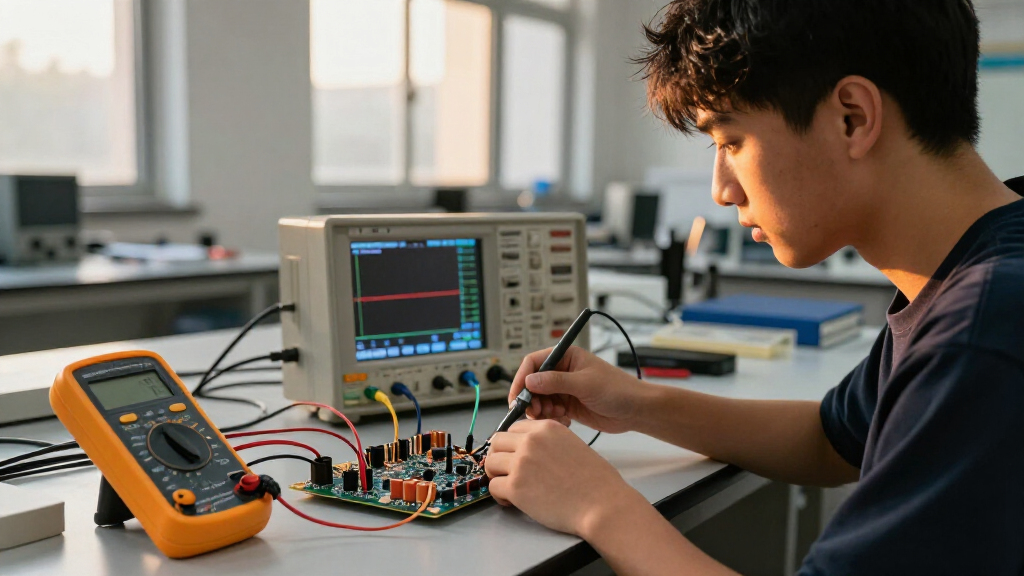
How We Picked
I compared these instruments by the job they are designed to do: voltage and current measurement, waveform analysis, component testing, circuit inspection, or multi-function bench and field work. I gave more weight to a clear match between the instrument’s capabilities and a buyer’s likely task than to a long feature list. Dedicated equipment ranked ahead when a focused measurement role called for a more direct choice; combination instruments earned a place for portability and breadth, with the tradeoff that buyers need to check their specific functions and workflow.
I also considered usability, portability, included capabilities, and how much an instrument can contribute to a working setup. The ranking distinguishes general-purpose picks from tools for narrower needs rather than treating a microscope, LCR meter, and oscilloscope as interchangeable. Since the lineup spans different categories and use cases, the order reflects usefulness for common electronics work, not a claim that one type of instrument replaces another.
Factors to Consider When Choosing Best Electronics Instrumentation Equipment
Before choosing a model, I’d start with the measurement or inspection task that currently slows down your work. A broader instrument can reduce kit clutter, but a specialized tool may give you a more direct workflow for a recurring job. These choices help narrow the field without relying on feature count alone.
Match the Instrument to the Measurement
List the measurements you actually need before comparing specifications: voltage, current, resistance, capacitance, frequency, inductance, or waveform behavior. A multimeter is suited to common electrical checks, while an oscilloscope helps reveal how a signal changes over time. LCR meters and component testers address parts-level questions that a general meter may not answer conveniently. Microscopes support inspection and assembly, not electrical measurement, so they belong in the same toolkit only when visual work is part of the job. A common mistake is buying the broadest instrument and assuming it will handle every task equally well. Choose around your most frequent measurement, then check whether occasional tasks justify a second instrument.
Choose Bench Precision or Field Convenience
A bench instrument can be a better fit when measurements happen at a fixed work area and you value a dedicated interface. A handheld or USB-based option can reduce setup friction for field calls, classrooms, or compact workspaces. Portability is not automatically a benefit if the screen, controls, or connection method makes repeated measurements cumbersome. USB instruments also depend on a host device and compatible software, so factor that into the working setup. Before choosing a portable model, think about where probes, leads, power, and data will be managed. Pay for portability when it changes how often or where you can use the tool.
Read Oscilloscope Specifications in Context
Bandwidth is only one part of choosing an oscilloscope; the signals you need to observe and the way you capture them matter too. Compare channel count, probe needs, controls, and display workflow against the circuits you work on. A compact scope may be easier to carry, while a dedicated bench model can make more sense for regular waveform analysis. Buyers sometimes focus on the largest bandwidth number without checking whether the instrument’s interface suits their debugging habits. Consider what signal types you expect to inspect and whether you need a separate signal generator. A scope with a useful workflow for your actual tasks can be more valuable than a higher headline specification.
Check Safety Ratings and Circuit Limits
For electrical troubleshooting, verify that the meter’s safety category and voltage limits match the circuits where you intend to use it. A maximum voltage figure alone does not describe suitability for every environment or measurement. Also check current limits, lead condition, and whether the measurement type you need is supported. Do not assume that a feature-rich handheld instrument is appropriate for mains work just because it measures voltage. When your work spans low-voltage electronics and building wiring, keep the different risk levels in mind and select equipment rated for each setting. A more conservative match between tool and circuit is preferable to stretching an instrument beyond its stated use.
Decide Whether an All-in-One Tool Fits Your Workflow
Combined instruments can put an oscilloscope, meter, or signal generator in one compact unit, which is useful when space or travel matters. The tradeoff is that shared controls and a small display may make frequent switching between functions less convenient than separate devices. Think about whether you need several functions at the same time or just occasionally. If you are learning, a multi-function instrument can make different measurement methods accessible in one setup, but it may also add menus and operating steps. Check which functions are included and how each is accessed rather than assuming every combined model offers the same capability. For a task you perform daily, a dedicated tool may be the simpler choice.
Plan for Components, Inspection, and Learning
Electronics work can involve more than voltage and waveforms: component identification, solder-joint inspection, and experimenting with circuits all call for different tools. An LCR meter or transistor tester can answer component questions faster than a general-purpose meter, while a microscope can help reveal small physical defects. A DIY instrument kit may appeal to learners who value assembly and exploration, but it is not the same purchase as a ready-to-use bench tool. Decide whether the goal is measurement, inspection, or education before choosing among these categories. Buyers often overlook accessories and setup needs, so check what probes, leads, software, or assembly work the tool requires. Prioritize the extra capability you will use repeatedly rather than collecting functions without a defined task.
Frequently Asked Questions
Should I buy a bench multimeter or a handheld multimeter for electronics work?
I’d choose a bench meter when most measurements happen at a fixed workstation and the instrument will be used regularly for circuit development or bench testing. A handheld meter is easier to carry between locations and more convenient for troubleshooting that involves moving around. Think about whether you need a dedicated bench display or the freedom to measure at different points in a building or on equipment. For mains or field work, confirm that the meter’s safety ratings and limits suit the circuits involved. If your work includes both settings, a single meter may not be the best compromise.
Can a handheld or multi-function oscilloscope replace a dedicated oscilloscope?
It can cover some waveform checks, but whether it replaces a dedicated scope depends on how often you use it and what signals you need to examine. A compact instrument may be easier to carry and may add meter or generator functions, while a dedicated unit can offer a more focused scope workflow. Compare the required bandwidth, channel count, controls, and display before deciding. Also think about whether you need to observe signals while using other instrument functions. For frequent bench debugging, convenience in the scope interface can matter more than having extra modes in one device.
When do I need an LCR meter instead of a multimeter?
An LCR meter is useful when you need to measure inductance or characterize capacitance and resistance in components beyond routine circuit checks. A multimeter remains the more direct tool for common voltage, current, continuity, and resistance measurements. If component selection, troubleshooting, or sorting is a regular part of your work, a dedicated LCR tool can make those checks more practical. For occasional component identification, a transistor tester may be a better fit than a more specialized meter. Choose based on the component questions you need to answer, not on the assumption that one instrument covers every test equally well.
What should I check before using an instrument on mains voltage?
Check the instrument’s safety category, maximum voltage, current limits, and supplied measurement leads against the specific circuit and environment. Do not treat a stated voltage limit as proof that the tool is suitable for every mains measurement. Confirm that the measurement function you plan to use is rated for the task, and inspect leads and probes for damage. If your work includes both low-voltage electronics and mains circuits, choose equipment with ratings appropriate to the higher-risk setting rather than relying on a general-purpose feature list. Follow the instrument maker’s instructions and applicable electrical safety practices.
Is a USB instrument a good first choice for a student or hobbyist?
A USB instrument can suit a student or hobbyist who already works at a computer and wants several measurement functions in a compact setup. Its usefulness depends on software compatibility, the host device, and comfort with a screen-based workflow. A standalone instrument may be easier when you want to make quick checks without opening software or connecting a computer. Also compare how probes, power, and signal connections fit the projects you plan to build. If the instrument is meant for learning, choose the workflow that makes measurements understandable rather than simply selecting the most functions.
Conclusion
For a broadly useful bench setup, I’d choose the Rigol DM3058E as the best overall pick, while the Fluke 117 is a more natural choice for everyday electrical troubleshooting and the Hantek DSO2D15 for dedicated waveform analysis. The lineup does not identify a universal best value or premium choice across unlike instrument categories; I’d judge those by the task, included functions, and fit with your existing setup rather than by label alone. Beginners who want to explore several measurement types may prefer a combined instrument such as the EspoTek Labrador, provided a computer-based workflow suits them. For specific needs, look to the FNIRSI LC1020E or LCR-P1 for component checks, the Woehrsh microscope for visual inspection, and the Korg NTS-2 for a DIY learning project. Choose the tool that serves your most frequent task, then add specialist equipment only when a real gap appears.