
Chemistry glassware sets range from simple beaker assortments to jointed kits built for organic chemistry and distillation. My best overall pick is the Deschem 32-Piece 24/40 Organic Chemistry Laboratory Glassware Kit, which stands out for its broad assortment and standardized joints. The EISCO 9-Piece Borosilicate Glass Laboratory Set is a more approachable choice for basic lab tasks, while the QWORK 12-Piece 100 mL Home Distillation Apparatus Set suits buyers focused on a smaller distillation setup. The main tradeoff is breadth versus fit: a high piece count can mean more specialized parts, while a compact set may leave gaps as your work expands. Read on for the full comparison and guidance on choosing a set that matches your intended experiments and equipment.

Prime made for students and young adults
- Fast, free delivery for dorm and study essentials
- Prime Video and Amazon Music included
- Member-only deals
Key Takeaways
- Deschem’s 32-piece 24/40 kit leads for buyers who need a broad range of connected organic chemistry glassware; its specialized joints are less useful if you only need general-purpose vessels.
- EISCO’s nine-piece set offers a simpler route into basic labware, while larger assortments make more sense when you already know which procedures and vessel types you need.
- QWORK’s 100 mL distillation set prioritizes a defined small-scale apparatus rather than the broad utility of a mixed beaker-and-flask kit.
- The larger Frienda kits and other high-piece-count assortments can expand the range of included items, but buyers should check the exact contents rather than treating piece count as a measure of useful capacity.
- Karter Scientific’s six-size Griffin beaker set stands apart for routine measuring, mixing, and heating tasks where a useful range of beaker sizes matters more than specialty joints.
| Deschem 32-Piece 24/40 Organic Chemistry Laboratory Glassware Kit |  | Best for Organic Chemistry Setups | Piece count: 32 | Material: G3.3 borosilicate glass | Joint size: 24/40 | VIEW LATEST PRICE | See Our Full Breakdown |
| FOUR E’S SCIENTIFIC 19-Piece Glass Beaker and Labware Set |  | Best for Temperature-Rated Everyday Labware | Piece count: 19 | Material: Borosilicate glass | Maximum temperature: 500°C | VIEW LATEST PRICE | See Our Full Breakdown |
| EISCO 9-Piece Borosilicate Glass Laboratory Set |  | Best for Organized Storage and Transport | Piece count: 9 | Material: Borosilicate 3.3 glass | Beaker capacities: 50 mL, 100 mL, and 250 mL | VIEW LATEST PRICE | See Our Full Breakdown |
| Feekoon Borosilicate Glass Beaker and Graduated Cylinder Set with Stirring Rod, 10 Pieces |  | Best for Mixing Larger Volumes | Piece count: 10 | Material: 3.3 borosilicate glass | Beaker capacities: 50 mL, 100 mL, 250 mL, 500 mL, and 1,000 mL | VIEW LATEST PRICE | See Our Full Breakdown |
| 32-Piece Chemistry Glassware Distillation Kit with 24/40 Joints |  | Best for a Packaged Distillation Set | Piece count: 32 | Material: 3.3 borosilicate glass (GG-17) | Joint size: 24/40 | VIEW LATEST PRICE | See Our Full Breakdown |
| QWORK 12-Piece 100 mL Home Distillation Apparatus Set |  | Best for Small-Scale Distillation | Pieces: 12 | Capacity: 100 mL | Material: Glass | VIEW LATEST PRICE | See Our Full Breakdown |
| Periodic Tableware Laboratory Shot Glass Set |  | Best Novelty Gift | Included components: 2 Erlenmeyer flask shot glasses and 2 beaker shot glasses | Material: Borosilicate glass | Listed capacity: 50 mL | VIEW LATEST PRICE | See Our Full Breakdown |
| Frienda 20-Piece Borosilicate Glass Labware Set | 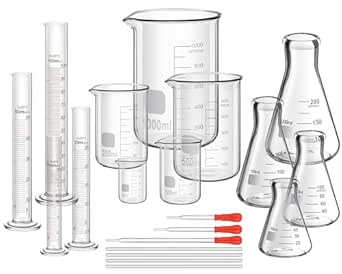 | Best for Measurement Variety | Number of pieces: 20 | Material: Borosilicate glass | Measuring cups: 50, 100, 250, 500, and 1,000 mL | VIEW LATEST PRICE | See Our Full Breakdown |
| JOLABEAR 15-Piece Lab Glassware Set |  | Best Balanced Starter Set | Set contents: 3 beakers, 3 Erlenmeyer flasks, 3 graduated cylinders, 5 transfer pipettes, and 1 glass stirring rod | Beaker capacities: 50, 100, and 250 mL | Erlenmeyer flask capacities: 50, 100, and 250 mL | VIEW LATEST PRICE | See Our Full Breakdown |
| Frienda 37-Piece Borosilicate Glass Chemistry Lab Kit |  | Best for Classrooms and Group Projects | Number of pieces: 37 | Main labware material: Borosilicate glass | Other materials: Plastic rack; glass and rubber droppers | VIEW LATEST PRICE | See Our Full Breakdown |
| Karter Scientific 9-Piece 3.3 Borosilicate Glass Beaker, Flask, and Graduated Cylinder Set |  | Best for Core Lab Essentials | Piece count: 9 | Material: 3.3 borosilicate glass | Included items: Beakers, flasks, and graduated cylinders | VIEW LATEST PRICE | See Our Full Breakdown |
| Frienda 30-Piece Borosilicate Glass Labware Set |  | Best for Beginners | Piece count: 30 | Material: Borosilicate glass | Included items: 6 measuring cups, 6 stirring rods, 6 graduated cylinders, 6 droppers, 6 beakers | VIEW LATEST PRICE | See Our Full Breakdown |
| QWORK 18-Piece Borosilicate Glass Labware Set |  | Best for Controlled Heating | Piece count: 18 | Material: 3.3 borosilicate glass | Temperature resistance: Up to 180°C | VIEW LATEST PRICE | See Our Full Breakdown |
| 31-Piece Borosilicate Glass Labware Set |  | Best for Broadest Task Coverage | Set size: 31 pieces | Material: Borosilicate glass | Included items: 5 beakers, 4 graduated cylinders, 4 Erlenmeyer flasks, 3 dropper bottles, 4 storage bottles, 4 stirring rods, 3 droppers, 4 funnels | VIEW LATEST PRICE | See Our Full Breakdown |
| Karter Scientific Griffin Low-Form Borosilicate Glass Beaker Set, 6 Sizes |  | Best for Beaker-Only Work | Set contents: 6 low-form beakers | Capacities: 10, 50, 100, 250, 500, 1000 ml | Material: Type 1 Class A 3.3 borosilicate glass | VIEW LATEST PRICE | See Our Full Breakdown |
| chemistry glassware set | Material | Item weight | Piece count |
|---|---|---|---|
| Deschem 32-Piece 24/40 Organic | G3.3 borosilicate glass | — | 32 |
| FOUR E’S SCIENTIFIC 19-Piece G | Borosilicate glass | — | 19 |
| EISCO 9-Piece Borosilicate Gla | Borosilicate 3.3 glass | — | 9 |
| Feekoon Borosilicate Glass Bea | 3.3 borosilicate glass | — | 10 |
| 32-Piece Chemistry Glassware D | 3.3 borosilicate glass (GG-17) | 9.58 pounds | 32 |
| QWORK 12-Piece 100 mL Home Dis | Glass | 2.86 pounds | — |
| Periodic Tableware Laboratory | Borosilicate glass | 10.24 ounces | — |
| Frienda 20-Piece Borosilicate | Borosilicate glass | 3.9 pounds | — |
| JOLABEAR 15-Piece Lab Glasswar | 3.3 borosilicate glass | — | — |
| Frienda 37-Piece Borosilicate | — | 5.5 pounds | — |
| Karter Scientific 9-Piece 3.3 | 3.3 borosilicate glass | 2.88 lb | 9 |
| Frienda 30-Piece Borosilicate | Borosilicate glass | — | 30 |
| QWORK 18-Piece Borosilicate Gl | 3.3 borosilicate glass | 2.36 lb | 18 |
| 31-Piece Borosilicate Glass La | Borosilicate glass | 8.43 lb | — |
| Karter Scientific Griffin Low- | Type 1 Class A 3.3 borosilicate glass | 12.8 oz | — |
More Details on Our Top Picks
Deschem 32-Piece 24/40 Organic Chemistry Laboratory Glassware Kit
For buyers who need connected apparatus rather than just containers, the Deschem 32-piece kit offers the broadest range of setup pieces in this group. Its 24/40 joints, round-bottom flasks, separatory funnel, Vigreux column, adapters, and three condenser styles support more varied organic chemistry arrangements than the FOUR E’S SCIENTIFIC set, which focuses on beakers, cylinders, and basic handling. The three flask capacities—250, 500, and 1,000 mL—also give you room to match vessels to different batch sizes.
The tradeoff is that this is a more involved kit to store and assemble: the listing does not specify a case, and its numerous glass components call for careful handling. I’d choose it for a planned lab setup, not casual measuring or a beginner who only needs basic glassware.
Pros:- Includes round-bottom and separatory flasks, a Vigreux column, and multiple adapters
- Three condenser types offer more setup flexibility than basic beaker-and-cylinder sets
- G3.3 borosilicate glass and standard 24/40 joints
- Three flask capacities, from 250 mL to 1,000 mL
Cons:- No carrying or storage case is specified
- The many separate glass components require careful handling and assembly
- The specialized jointed apparatus is excessive for buyers who only need routine measuring and mixing
Best for: Chemistry students or experienced hobbyists assembling 24/40-joint apparatus for distillation, reflux, or related organic chemistry work.
Not ideal for: Beginners seeking simple measuring and mixing equipment, or buyers who need a supplied case for organized storage and transport.
- Piece count:32
- Material:G3.3 borosilicate glass
- Joint size:24/40
- Flask capacities:250 mL, 500 mL, and 1,000 mL
- Condenser types:Liebig, Graham, and Allihn
- Condenser length:300 mm
- Thermometer:Celsius, rated to 200°C; 300 mm
- Other included components:Round-bottom flasks, separatory funnel, Vigreux column, adapters, stoppers, clips, rubber hose, and pH paper
Our verdict“Choose the Deschem if you need a broad 24/40-joint organic chemistry setup; skip it if basic labware or a storage case matters more.”
FOUR E’S SCIENTIFIC 19-Piece Glass Beaker and Labware Set
The FOUR E’S SCIENTIFIC set is a practical choice for buyers who want a ready mix of vessels and measuring tools without moving into specialized jointed apparatus. It pairs four beakers, four conical flasks, and four graduated cylinders with droppers, rods, and a cleaning brush, giving it broader routine-lab coverage than the Feekoon set’s beakers-and-cylinders focus. Its stated 500°C maximum temperature rating is another useful distinction, though it does not mean every piece is suited to every heating method or sudden temperature change.
Its variety makes it easier to mix, measure, and transfer liquids from one set, but the assortment is less suited to distillation than the Deschem 32-piece kit, which has condensers and 24/40 joints. Glass still needs careful stirring, and buyers should check the item dimensions against their workspace before ordering.
Pros:- Combines beakers, conical flasks, graduated cylinders, droppers, and stirring rods
- Four cylinder capacities support a range of measuring tasks
- Borosilicate glass is rated to 500°C
- Includes a cleaning brush for routine care
Cons:- Does not include jointed condensers or other specialized distillation components
- Glass requires care during stirring to avoid damage
- Dimensions should be checked to confirm the set suits the intended workspace
Best for: Students and home lab users who need an all-purpose assortment of beakers, conical flasks, cylinders, and transfer accessories for routine experiments.
Not ideal for: Buyers assembling distillation or reflux apparatus, or anyone who needs a clearly specified compact footprint before choosing.
- Piece count:19
- Material:Borosilicate glass
- Maximum temperature:500°C
- Beakers:50 mL, 100 mL, 250 mL, and 500 mL
- Conical flasks:50 mL, 100 mL, 150 mL, and 250 mL
- Graduated cylinders:10 mL, 25 mL, 50 mL, and 100 mL
- Other accessories:Two graduated droppers, four stirring rods in 15 cm and 20 cm lengths, and one cleaning brush
- Bottom shapes:Round and conical
Our verdict“Pick this set for varied everyday measuring and mixing, but choose the Deschem kit if your work needs jointed distillation glassware.”
EISCO 9-Piece Borosilicate Glass Laboratory Set
The EISCO set earns its place through measurement credentials and protective storage, not piece count. It includes three beakers, three Erlenmeyer flasks, and three ASTM Class A graduated cylinders, with a fitted foam case to keep the assortment together between sessions. That makes it easier to store or transport than the FOUR E’S SCIENTIFIC set, which includes more types of accessories but has no case specified. The cylinders’ Class A standard is a useful distinction for buyers who care about stated measuring tolerances.
At nine pieces, this is a focused collection rather than a full chemistry apparatus kit: it has no condensers, jointed adapters, or stirring accessories. The Feekoon set supplies more beaker and cylinder sizes, including a 1,000 mL beaker, while EISCO’s case and specified cylinder standard favor organized, measured work. Glass can still break if mishandled, and the listed capacities limit the range of tasks.
Pros:- Includes three beakers, three Erlenmeyer flasks, and three graduated cylinders
- Graduated cylinders meet ASTM Class A specifications
- Custom-fit foam case supports storage and transport
- Borosilicate 3.3 glass is specified as microwavable and autoclavable
Cons:- Nine-piece assortment has fewer tools and vessel capacities than larger sets
- Glass can break despite its stated durability
- No condensers or jointed apparatus for distillation setups
Best for: Students, educators, and mobile lab users who want a compact set of core vessels with ASTM Class A cylinders and a fitted storage case.
Not ideal for: Buyers who need large-volume beakers, a wide accessory assortment, or jointed glassware for distillation.
- Piece count:9
- Material:Borosilicate 3.3 glass
- Beaker capacities:50 mL, 100 mL, and 250 mL
- Erlenmeyer flask capacities:50 mL, 100 mL, and 250 mL
- Graduated cylinder capacities:10 mL, 50 mL, and 100 mL
- Cylinder standard:ASTM Class A
- Cylinder collars:Removable protective collars
- Storage:Custom-fit foam case
Our verdict“Choose EISCO when measured core glassware and a fitted case matter more than a large assortment or specialized apparatus.”
Feekoon Borosilicate Glass Beaker and Graduated Cylinder Set with Stirring Rod, 10 Pieces
Feekoon is the most direct pick here for buyers who want beakers across a wide volume range without adding a long list of specialized pieces. Its five beakers run from 50 mL to 1,000 mL, a useful spread for small measurements and larger mixing tasks. Compared with EISCO’s nine-piece set, Feekoon gives you a larger beaker and more cylinder sizes, while EISCO counters with a fitted case and ASTM Class A cylinders.
The four graduated cylinders add finer measuring options, and the included 20 cm rod covers basic stirring. The key limitation is that the cylinders are not suitable for heating; the set is not an all-purpose heating kit, despite the beakers being described as heat resistant. It also lacks the condensers and 24/40 joints found in the Deschem kit, so it is a poor match for distillation or synthesis apparatus.
Pros:- Five beaker capacities span 50 mL to 1,000 mL
- Four graduated cylinders cover small and moderate measuring volumes
- Includes a 20 cm stirring rod
- 3.3 borosilicate glass is specified for the beakers
Cons:- Graduated cylinders are not suitable for heating
- Glass can break if dropped or mishandled
- No case or specialized jointed apparatus is specified
Best for: Home lab users and students who need a 1,000 mL beaker alongside smaller vessels for mixing and measuring.
Not ideal for: Buyers seeking ASTM Class A measuring cylinders, a storage case, or equipment for heating measured samples in cylinders or building distillation apparatus.
- Piece count:10
- Material:3.3 borosilicate glass
- Beaker capacities:50 mL, 100 mL, 250 mL, 500 mL, and 1,000 mL
- Graduated cylinder capacities:5 mL, 10 mL, 50 mL, and 100 mL
- Stirring rod:20 cm
- Heating guidance:Beakers are described as heat resistant; graduated cylinders are not suitable for heating
- Cylinder features:Clear graduations and pour spouts
Our verdict“Choose Feekoon for a broad beaker range and basic measuring, but opt for EISCO if cylinder standards and protected storage are priorities.”
32-Piece Chemistry Glassware Distillation Kit with 24/40 Joints
This Faazy kit targets buyers who want a 32-piece 24/40-joint assortment for distillation, purification, and synthesis. Its listed glass material is 3.3 borosilicate GG-17, and the standard joint size gives the set a defined connection format for assembling compatible apparatus. Like the Deschem kit, it includes flasks, condensers, a separator funnel, and adapters; the available details, however, do not spell out specific condenser types or accessories as fully as Deschem’s listing does. That makes Deschem easier to evaluate if the exact configuration matters before purchase.
The Faazy set’s stated package dimensions and weight help buyers plan storage for a sizable collection, but also signal that this is not a compact starter assortment. Its broad use claims are appealing, yet the supplied specifications give fewer component details than Deschem. I’d favor it when the 24/40 format and overall kit scope fit the plan, and choose the more explicitly itemized set when component selection is the deciding factor.
Pros:- 32-piece assortment includes flasks, condensers, a separator funnel, and adapters
- 3.3 borosilicate glass is specified for thermal changes
- 24/40 joints provide a standard connection size
- Package dimensions and item weight are listed for storage planning
Cons:- Available specifications do not identify the exact condenser types or full component breakdown
- Large package dimensions make it less suited to compact storage
- Glass components require careful handling
Best for: Buyers planning distillation or synthesis setups who want a 32-piece set built around 24/40 joints and can confirm the included component mix meets their needs.
Not ideal for: Beginners who need a simple beaker-and-cylinder set, or buyers who require a fully itemized list of condenser and adapter types before ordering.
- Piece count:32
- Material:3.3 borosilicate glass (GG-17)
- Joint size:24/40
- Flask capacities:250 mL, 500 mL, and 1,000 mL
- Included equipment:Flasks, condensers, separator funnel, adapters, and other apparatus
- Intended applications:Distillation, purification, and synthesis
- Package dimensions:23 × 20.12 × 7.62 inches
- Item weight:9.58 pounds
Our verdict“Choose the Faazy kit if you want a broad 24/40-joint distillation set and its component mix checks out; choose Deschem when a more explicit parts list matters.”
QWORK 12-Piece 100 mL Home Distillation Apparatus Set
I’d choose this set when the main goal is distillation, not building a general-purpose glassware collection. Its 100 mL capacity suits small demonstrations and limited-volume projects, while clear glass lets users watch the contents during a process. The product is described as resisting heat, temperature changes, and chemical corrosion, which fits its intended lab and education uses. Compared with the Deschem 32-Piece 24/40 Organic Chemistry Laboratory Glassware Kit, this QWORK set is a narrower, smaller-scale choice rather than a broad collection built around more pieces. That focus is also its main limitation: the supplied information does not name the 12 individual components, so I can’t judge how complete the apparatus is or whether it fits a buyer’s planned setup. Choose it for its stated distillation purpose; skip it if you need clearly itemized, versatile labware.
Pros:- Designed for distillation, essential-oil making, and chemistry education
- 100 mL capacity is suited to small-volume demonstrations
- Clear glass allows the contents to be monitored
- Described as resistant to heat, temperature changes, and chemical corrosion
Cons:- The included 12 pieces are not individually specified in the supplied product data
- Small 100 mL capacity limits the volume of work
- The description does not provide detailed component dimensions or joint information
Best for: Science educators and hobbyists seeking a compact, 100 mL glass set specifically for small-scale distillation demonstrations.
Not ideal for: Buyers who need a general-purpose labware assortment or must confirm specific apparatus pieces before ordering.
- Pieces:12
- Capacity:100 mL
- Material:Glass
- Stated uses:Essential-oil making, laboratory distillation, and chemistry education
- Package dimensions:16.34 × 8.94 × 5 inches
- Item weight:2.86 pounds
- Manufacturer:QWORK
- Model number:QS15522
Our verdict“Pick this QWORK set for small-scale distillation, but choose a broader and more explicitly itemized kit for varied lab tasks.”
Periodic Tableware Laboratory Shot Glass Set
This is the lineup’s display-and-gift pick, not a substitute for working lab glassware. Two beaker-shaped and two Erlenmeyer-shaped shot glasses bring recognizable chemistry forms to serving, and the kiln-fired enamel markings give them a more finished look than plain utility glass. They are marked to 40 mL and dishwasher-safe, a practical combination for reusable novelty drinkware. By comparison, the JOLABEAR 15-Piece Lab Glassware Set is built around measuring, mixing, and handling liquids for experiments; this four-piece set is meant for casual use and visual appeal. One detail calls for care: listed capacity is 50 mL, while the markings go only to 40 mL, so the printed scale does not represent the full stated capacity. I’d skip it for accurate lab measurements or anyone shopping for a genuine chemistry apparatus set.
Pros:- Includes two Erlenmeyer flask shapes and two beaker shapes
- Borosilicate glass construction
- Kiln-fired enamel markings add durable decoration
- Dishwasher-safe for convenient cleanup
Cons:- Listed 50 mL capacity differs from the 40 mL marking range
- Four drinkware pieces do not provide the variety needed for lab tasks
- Designed as shot glasses rather than laboratory measuring equipment
Best for: Chemistry enthusiasts shopping for reusable, science-themed drinkware or a small novelty gift.
Not ideal for: Students and experimenters who need calibrated working glassware, a wide range of tools, or clearly matched capacity markings.
- Included components:2 Erlenmeyer flask shot glasses and 2 beaker shot glasses
- Material:Borosilicate glass
- Listed capacity:50 mL
- Markings:Marked to 40 mL
- Decoration:Kiln-fired enamel markings
- Dishwasher-safe:Yes
- Dimensions:8.82 × 3.5 × 2.48 inches
- Item weight:10.24 ounces
Our verdict“Choose this set for chemistry-themed drinkware, not for measurement or experiments.”
Frienda 20-Piece Borosilicate Glass Labware Set
I’d rank this Frienda set for buyers who want many sizes and tool types without moving up to the larger 37-piece kit. It combines measuring cups from 50 mL to 1,000 mL with graduated cylinders, beakers, rods, and droppers, giving science projects more flexibility than the small, distillation-focused QWORK 12-Piece 100 mL Home Distillation Apparatus Set. The listed borosilicate construction and clear markings support routine measuring and handling, while the varied capacities make it easier to pick a vessel suited to a task. The tradeoff is that a 20-piece count does not mean a complete apparatus for every experiment: the supplied contents focus on basic measuring and transfers, not distillation equipment. Glass can also break if dropped, so I’d favor this for careful classroom or home use rather than settings where pieces are likely to be handled roughly.
Pros:- Combines measuring cups, beakers, graduated cylinders, droppers, and stirring rods
- Measuring cups range from 50 mL to 1,000 mL
- Clear measurement markings aid routine measuring
- Borosilicate glass is described as acid- and alkali-resistant
Cons:- Glass pieces can break if dropped
- The assortment does not include distillation apparatus
- Several tool types have limited piece counts, which may restrict simultaneous activities
Best for: Teachers, students, and home experimenters who need a mix of measuring vessels, cylinders, droppers, and stirring rods in varied sizes.
Not ideal for: Buyers seeking distillation apparatus, specialized reaction setups, or labware suited to rough handling.
- Number of pieces:20
- Material:Borosilicate glass
- Measuring cups:50, 100, 250, 500, and 1,000 mL
- Glass stirring rods:4; 7.87 inches (20 cm)
- Graduated cylinders:4; 10, 25, 50, and 100 mL
- Glass droppers:3; 90, 120, and 200 mm
- Beakers:4; 50, 100, 150, and 200 mL
- Item weight:3.9 pounds
Our verdict“Choose this Frienda set for varied everyday measuring and handling tools, but look elsewhere for distillation or specialized apparatus.”
JOLABEAR 15-Piece Lab Glassware Set
The JOLABEAR set earns its place as a balanced starter assortment: it pairs beakers and Erlenmeyer flasks in three capacities with cylinders, transfer pipettes, and a stirring rod. That mix supports routine measuring, mixing, and liquid transfer without pushing into the much larger assortment of the Frienda 37-Piece Borosilicate Glass Chemistry Lab Kit. Its 3.3 borosilicate glass construction and custom-fit foam packaging are useful points for buyers handling a multi-piece glass set, and the cylinders’ hexagonal bases and removable anti-tip rings add stability. The limits are practical rather than cosmetic: the graduated markings are only approximate references, and the set arrives without chemicals or project materials. I’d pick it for foundational exercises and basic lab tasks, but not when precise volume measurement or a large classroom inventory is the priority.
Pros:- Combines beakers, Erlenmeyer flasks, graduated cylinders, pipettes, and a stirring rod
- 3.3 borosilicate glass construction
- Hexagonal cylinder bases and removable anti-tip rings add stability
- Custom-fit EPE foam cushions the glass during transit
Cons:- Graduations are approximate rather than precision references
- Chemicals and project materials are not included
- The 15-piece assortment is less expansive than the Frienda 37-piece kit
Best for: Students and home science learners who want a compact mix of vessels and transfer tools for basic measuring and mixing exercises.
Not ideal for: Buyers who require precise volume measurement, chemicals included, or enough duplicate glassware for a large group.
- Set contents:3 beakers, 3 Erlenmeyer flasks, 3 graduated cylinders, 5 transfer pipettes, and 1 glass stirring rod
- Beaker capacities:50, 100, and 250 mL
- Erlenmeyer flask capacities:50, 100, and 250 mL
- Graduated cylinder capacities:10, 50, and 100 mL
- Transfer pipettes:5; 3 mL each
- Material:3.3 borosilicate glass
- Cylinder features:Hexagonal bases and removable anti-tip rings
- Packaging:Custom-fit EPE foam
Our verdict“Choose JOLABEAR for a compact, balanced foundation in common lab tasks, but not for precision work or larger group activities.”
Frienda 37-Piece Borosilicate Glass Chemistry Lab Kit
For a classroom station or shared science project, I’d favor this Frienda kit for its wide assortment and included rack. Beakers, cylinders, flasks, test tubes, droppers, and stirring rods give a group more types of basic equipment than the JOLABEAR 15-Piece Lab Glassware Set, while the three-tier rack helps keep test tubes organized between demonstrations. The beaker range extends from 50 mL to 1,000 mL, and cylinders span 10 to 100 mL, so the set can support activities at different scales. The tradeoff is a larger, heavier collection with more fragile pieces to store and supervise; the listing specifically advises keeping the glass away from small children. Some sizes and colors may vary slightly from the listing, so I’d choose it for breadth rather than exact uniformity. It is a poor fit for buyers who need a compact kit or tightly specified components.
Pros:- Broad mix of beakers, graduated cylinders, flasks, test tubes, droppers, and stirring rods
- Borosilicate glass is used for the main lab pieces
- Three-tier plastic rack helps organize test tubes
- Beaker capacities range from 50 mL to 1,000 mL
Cons:- The larger assortment weighs 5.5 pounds and requires more storage space
- Glass pieces can break and need careful supervision around children
- Listed sizes and colors may vary slightly
Best for: Teachers and supervised science-fair groups that need a broad assortment of glassware and a rack for organizing test tubes.
Not ideal for: Buyers seeking a compact, precisely uniform set or households where fragile glassware cannot be kept away from small children.
- Number of pieces:37
- Main labware material:Borosilicate glass
- Other materials:Plastic rack; glass and rubber droppers
- Graduated cylinder capacities:10, 25, 50, and 100 mL
- Beaker capacity range:50 to 1,000 mL
- Test tube sizes:Includes 10 × 100 mm and 13 × 75 mm sizes, plus other listed sizes
- Rack:Blue, three-tier plastic
- Item weight:5.5 pounds
- Intended use:Classroom, home projects, and science fairs
Our verdict“Pick this kit for supervised classrooms and group projects that benefit from a broad assortment, not for compact storage or unsupervised use around young children.”
Karter Scientific 9-Piece 3.3 Borosilicate Glass Beaker, Flask, and Graduated Cylinder Set
I’d choose this set for a buyer who wants the main vessel types without adding lots of accessories. Its nine pieces cover beakers, flasks, and graduated cylinders, giving it a more focused mix than the 30-piece Frienda set, which adds rods and droppers for broader task coverage. The 3.3 borosilicate glass and ASTM E960 Type I compliance make material specification a clearer point of reference than in sets described only as borosilicate. Reusability also suits repeated classroom or hobby-lab work. The tradeoff is limited sizing information: the listed data does not identify individual capacities, so I can’t judge whether the set fits a particular measurement range. Buyers wanting accessories or known vessel sizes should compare it with the 31-Piece Borosilicate Glass Labware Set.
Pros:- Includes three foundational vessel types
- Made from inert 3.3 borosilicate glass
- Meets ASTM Specification E960, Type I requirements
- Reusable for repeated lab tasks
Cons:- Individual piece capacities are not specified
- Nine pieces provide fewer accessories than the Frienda 30-piece set
Best for: Students or home experimenters seeking a compact core assortment of beakers, flasks, and graduated cylinders with a stated glass standard.
Not ideal for: Buyers who need confirmed vessel capacities, stirring tools, droppers, or a broad range of accessories.
- Piece count:9
- Material:3.3 borosilicate glass
- Included items:Beakers, flasks, and graduated cylinders
- Reusable:Yes
- Standard:ASTM Specification E960, Type I
- Item weight:2.88 lb
- Package dimensions:12.28 × 12.28 × 6.57 in
Our verdict“Choose this set for specified glass quality and core vessels, but skip it if you need listed capacities or a fuller accessory assortment.”
Frienda 30-Piece Borosilicate Glass Labware Set
I’d put this set near the top of a beginner’s shortlist because its five distinct tool types let a new user practice measuring, transferring, and stirring without assembling separate purchases. The six measuring cups include capacities up to 1000 ml, while the beakers and graduated cylinders add smaller-volume options. Compared with the Karter Scientific 9-Piece Set, Frienda gives up the stated ASTM E960 Type I specification but supplies many more pieces and accessories. That breadth is useful for school projects and basic experiments, though the product notes that manual measurements may vary slightly. Buyers needing tighter dimensional confidence or a more formal glass standard may prefer Karter; those seeking an all-in-one starter assortment get more task variety here.
Pros:- Combines measuring cups, rods, cylinders, droppers, and beakers
- Includes capacities from 10 ml cylinder sizes to a 1000 ml measuring cup
- Clear measurement markings support routine measuring
- Borosilicate glass is described as acid- and alkali-resistant
Cons:- Manual measurements may produce slight size deviations
- No ASTM standard is listed, unlike the Karter Scientific 9-Piece Set
Best for: Students and first-time home-lab users who want measuring vessels, droppers, rods, and beakers in one introductory assortment.
Not ideal for: Buyers who need a stated ASTM glassware standard or close control over exact piece dimensions.
- Piece count:30
- Material:Borosilicate glass
- Included items:6 measuring cups, 6 stirring rods, 6 graduated cylinders, 6 droppers, 6 beakers
- Measuring cup capacities:2 × 50 ml, 100 ml, 250 ml, 500 ml, 1000 ml
- Graduated cylinder capacities:100 ml, 50 ml, 2 × 25 ml, 2 × 10 ml
- Beaker capacities:2 × 50 ml, 2 × 100 ml, 150 ml, 200 ml
- Stirring rod length:7.87 in (20 cm)
- Dropper lengths:2 × 90 mm, 2 × 120 mm, 2 × 200 mm
Our verdict“Pick Frienda for a broad beginner assortment, but choose a standards-specified set if documented glassware requirements matter more than accessory variety.”
QWORK 18-Piece Borosilicate Glass Labware Set
The QWORK set earns a distinct place for buyers who need glassware with a stated temperature limit and a clear description of appropriate heating methods. Its 3.3 borosilicate vessels resist temperature changes up to 180°C and are specified for lab plates or hot-water baths, not open flames. That limitation is useful guidance, but it rules out flame-based procedures. Compared with the Karter Scientific 9-Piece Set, QWORK adds droppers, stirring rods, and cleaning brushes, while the Karter listing gives an ASTM standard and includes graduated cylinders, beakers, and flasks without a stated heating limit. I’d favor QWORK for controlled, indirect heating and routine cleanup; buyers who need open-flame use or documented ASTM compliance should look elsewhere.
Pros:- 3.3 borosilicate glass with a stated resistance up to 180°C
- Specifies suitable use on lab plates and in hot-water baths
- Includes beakers, flasks, cylinders, droppers, and stir rods
- Two cleaning brushes support routine care
Cons:- Not suitable for heating over an open flame
- Individual vessel capacities are not supplied in the listed set details
Best for: School or home-lab users who heat mixtures on a lab plate or in a hot-water bath and want basic cleaning tools included.
Not ideal for: Users who need open-flame heating, or buyers requiring a listed ASTM compliance standard.
- Piece count:18
- Material:3.3 borosilicate glass
- Temperature resistance:Up to 180°C
- Set contents:3 beakers, 3 flasks, 3 cylinders, 5 droppers, 2 stir rods, 2 cleaning brushes
- Heating use:Lab plates or hot-water baths; not for open flame
- Item weight:2.36 lb
- Package dimensions:13.62 × 9.29 × 4.09 in
- Manufacturer model:QWORK WD15079
Our verdict“Choose QWORK for controlled indirect heating and included cleaning brushes, but not for open-flame procedures.”
31-Piece Borosilicate Glass Labware Set
Among these five options, this set has the broadest stated mix for buyers who want to measure, store, transfer, and pour with one collection. The 31 pieces include beakers, cylinders, Erlenmeyer flasks, bottles, droppers, rods, and funnels, with capacities listed across several vessel types. That makes it more versatile than the Frienda 30-Piece Set, which has measuring cups and more droppers but no listed storage bottles or funnels. The breadth comes with a practical cost: at 8.43 lb, it is substantially heavier than QWORK’s 18-piece set, and the large assortment needs more storage space. The listing describes the glass as heat- and chemical-resistant, but does not give a temperature limit or a formal glassware standard.
Pros:- Includes seven kinds of glassware and accessories
- Lists capacities for beakers, cylinders, flasks, and bottles
- Graduations on select items support measuring and pouring
- Borosilicate glass is described as heat, corrosion, acid, and alkali resistant
Cons:- At 8.43 lb, it is heavier than the QWORK 18-piece set
- No specific temperature limit or formal glassware standard is listed
- Large assortment requires more storage space than compact sets
Best for: Home-lab organizers, educators, and project teams who need varied vessel shapes, storage bottles, and funnels in one set.
Not ideal for: Buyers with limited storage space, those seeking a lightweight starter kit, or users who require a specific heating limit or stated ASTM standard.
- Set size:31 pieces
- Material:Borosilicate glass
- Included items:5 beakers, 4 graduated cylinders, 4 Erlenmeyer flasks, 3 dropper bottles, 4 storage bottles, 4 stirring rods, 3 droppers, 4 funnels
- Beaker capacities:50, 100, 250, 500, 1000 ml
- Graduated cylinder capacities:10, 25, 50, 100 ml
- Erlenmeyer flask capacities:50, 100, 150, 200 ml
- Bottle capacities:Dropper bottles: 30, 60, 125 ml; storage bottles: 100, 250, 500, 1000 ml
- Item weight:8.43 lb
Our verdict“Choose this set when breadth and storage vessels matter most, but skip it if you want a compact kit or a specified thermal limit.”
Karter Scientific Griffin Low-Form Borosilicate Glass Beaker Set, 6 Sizes
I’d choose this Karter set when the job calls for beakers across a wide capacity range rather than a mixed glassware kit. The six sizes run from 10 ml to 1000 ml, so one set can handle small samples and larger mixing tasks without adding flasks or cylinders that may go unused. Its Type 1 Class A 3.3 borosilicate glass and ASTM E960 Type I requirements make the material details more specific than those supplied for the 31-Piece Borosilicate Glass Labware Set. The tradeoff is focus: this is only six beakers, so it lacks the measuring cylinders, flasks, funnels, and transfer tools in broader collections. Also, the 5% graduation tolerance makes the markings less suitable when tighter measurement precision is required.
Pros:- Six capacities span 10 ml to 1000 ml
- Made from Type 1 Class A 3.3 borosilicate glass
- Meets ASTM E960, Type I requirements
- Described as resistant to heat, corrosion, acids, alkalis, and thermal shock
Cons:- Contains beakers only, unlike the 31-Piece Borosilicate Glass Labware Set
- Graduation tolerance is 5%
- Does not include separate graduated cylinders for measurement
Best for: Users who already own other labware and need a focused range of low-form beakers for mixing, holding, or approximate volume checks.
Not ideal for: New lab setups needing flasks, graduated cylinders, funnels, or measurement markings with tighter tolerance.
- Set contents:6 low-form beakers
- Capacities:10, 50, 100, 250, 500, 1000 ml
- Material:Type 1 Class A 3.3 borosilicate glass
- Graduations:Double-metric scale
- Graduation tolerance:5%
- Standard:ASTM E960, Type I requirements
- Shape:Cylindrical, round bottom
- Item weight:12.8 oz
Our verdict“Pick this set to fill a beaker-size gap in an existing lab, but choose a mixed kit for a complete glassware starter collection.”

How We Picked
I ranked these chemistry glassware sets by how well their stated contents match recognizable buyer needs: general lab work, beginner practice, organic chemistry, or distillation. I gave weight to the practical value of the assortment, material information such as borosilicate glass, vessel size range, joint standard where specified, and whether a set’s design supports a coherent task instead of simply offering many pieces. I also considered how clearly a buyer can tell what the set is for and what additional compatible equipment may be needed.
The ranking favors sets with a clear role and useful scope over assortments whose piece count alone suggests value. That puts the Deschem jointed kit first for broad organic-chemistry capability, while simpler sets rank better for buyers who need everyday lab vessels without specialized fittings. Dedicated distillation kits are judged on their fit for that narrower job, not on how many unrelated pieces they include. The 15 entries are distinct options, but buyers should verify exact contents, dimensions, and compatibility before purchase.
Factors to Consider When Choosing Chemistry Glassware Sets
Before choosing among these chemistry glassware sets, decide what you expect to do with the pieces and what equipment you already own. A large assortment is only useful when its vessels and connections match your workbench, procedures, and storage space.
Match the set to the work, not the piece count
Start by listing the procedures you expect to perform, such as measuring, mixing, heating, or distillation. A beaker-and-cylinder assortment serves routine handling better than a jointed kit, while a distillation set may devote much of its contents to one apparatus. Piece counts can include small accessories or multiple related components, so they do not tell you how many independent experiments the set supports. A common mistake is buying the largest set before identifying which vessel types you will actually use. If your needs are still basic, a smaller coherent assortment can be easier to store and understand. Choose extra pieces only when they add a specific capability you can name.
Check joint standards and connection needs
Jointed glassware is useful only when its connections fit the other parts in your apparatus. A stated joint size such as 24/40 gives you a compatibility reference, but you still need to check that the rest of your components use the same standard. Sets without joint specifications may be better suited to standalone vessels than assembled systems. Do not assume that two kits labeled for chemistry or distillation will connect to each other. Adapters can sometimes bridge different components, but they add complexity and another point to verify. If you already own glassware, compare its joint markings before choosing a new set.
Treat glass type and heat use as separate questions
Borosilicate glass is a useful material cue, but it does not answer every question about safe heating. Buyers should check the product’s stated use, construction, and any handling instructions rather than assuming every vessel is suitable for every heat source. Thin walls, narrow necks, and joined components may call for more careful handling than a sturdy beaker used for simple mixing. Avoid rapid temperature changes unless the manufacturer’s guidance permits them. For work involving heat, plan for appropriate supports and protective equipment as well as the glassware itself. Material labels are a starting point, not a substitute for checking intended use.
Read capacities and dimensions before buying
Capacity determines whether a vessel is practical for the quantities you plan to handle, and a set with many pieces can still have a narrow size range. Check the listed volumes and dimensions against your workspace, storage, and procedures. A small-scale apparatus may suit demonstration or limited-volume work but prove restrictive if you need larger batches. Graduated markings can help with approximate measurement, though buyers should not assume every included vessel is designed for precise volumetric work. Compare the actual size list rather than relying on product photos, which can make differently sized pieces look similar. This step can prevent buying a set that is either too small for the task or unnecessarily bulky.
Budget for supports, cleaning, and storage
A glassware kit may not include every clamp, stand, stopper, adapter, or cleaning tool needed for a complete setup. Check the contents against the equipment you already have and account for safe support of taller or connected pieces. Narrow-necked and jointed items can take more care to clean and dry than open beakers. Storage also matters: mixed assortments need protected space so pieces do not knock together or become difficult to identify. Buyers sometimes focus on acquisition cost and overlook the time and accessories needed to make a kit usable. A smaller set that fits your existing setup may be more practical than a larger one that requires substantial add-ons.
Choose beginner-friendly scope before specialty breadth
New users often benefit more from a small group of familiar vessels than from a large collection of specialized glassware. Beakers, flasks, and graduated cylinders can support basic learning tasks without requiring a full assembly plan. Jointed organic chemistry kits offer broader apparatus options, but they also ask the buyer to understand fitting compatibility and support needs. If your learning goals are not yet settled, prioritize clear contents and common vessel types. If you know you need a specific method, a purpose-built set can reduce the need to source individual components. Match the complexity of the kit to the skills and procedures you are ready to use.
Frequently Asked Questions
Is a 24/40 jointed set compatible with ordinary beakers and flasks?
Not automatically: a 24/40 designation refers to a specific joint connection, while many ordinary beakers have no joint at all. A jointed kit can connect only to compatible jointed parts or suitable adapters. Check the markings on any glassware you already own and compare them with the set’s stated joint size. Also confirm which pieces in the kit have joints, since not every item in a large assortment will necessarily connect to the others. If your work mainly uses open vessels, a general labware set may be a better fit.
Should I buy a large mixed set or a smaller set of beakers and cylinders?
Choose based on the tasks you can identify, not the number of pieces in the listing. A larger mixed kit can be useful when you need several vessel types or specialty components, but it can leave you storing pieces you rarely use. A smaller set focused on beakers and cylinders is often easier to learn with and can cover routine measuring and mixing. Check the capacity range and exact contents before deciding, since two sets with similar piece counts may serve very different purposes. If your needs are likely to grow, prioritize compatibility with future equipment.
Can borosilicate glassware be used over a flame or on a hot plate?
Do not infer heat-source suitability from the word “borosilicate” alone. Check the manufacturer’s instructions for the specific vessel and follow the limits for heating, support, and temperature changes. A vessel intended for general lab use may not be appropriate for every direct-heating setup, and joined assemblies need stable support. Avoid sudden heating or cooling unless the product guidance allows it. When instructions are unclear, contact the seller or manufacturer before using the glassware with heat.
Does a home distillation set include everything needed to operate an apparatus?
Not necessarily. A set may supply several glass components while leaving out stands, clamps, heat sources, tubing, adapters, or other items needed for a complete arrangement. Read the included-parts list and compare it with the equipment required for your intended setup. Check joint sizes as well, especially if you plan to combine the kit with glassware you already own. Distillation also involves procedural and safety requirements that a glassware set does not provide. Do not assume a product labeled as an apparatus is a complete ready-to-run system.
Are graduated cylinders in these sets suitable for precise measurements?
A graduated cylinder can be useful for measuring liquid volume, but suitability for precise work depends on its markings, capacity, stated tolerance, and intended use. Product listings do not always provide enough detail to compare measurement accuracy. If accuracy matters for a procedure, look for explicit tolerance information rather than relying on the presence of graduations alone. Beakers are generally better treated as mixing or rough-volume vessels unless the manufacturer states otherwise. Match the measuring tool to the precision your task requires.
Conclusion
For the broadest organic chemistry assortment, I recommend the Deschem 32-Piece 24/40 kit as best overall, provided you need those standardized connections. The FOUR E’S SCIENTIFIC 19-piece set is my best value direction for buyers seeking a mixed glassware assortment without centering their choice on a specialized jointed apparatus; check its listed contents against your needs. For a more considered upgrade focused on routine vessels, the Karter Scientific Griffin Low-Form Beaker Set is my best premium-style pick for buyers who want six beaker sizes rather than a broad mix of equipment. Beginners should start with the EISCO 9-piece set for a simpler assortment, while buyers focused on small-scale distillation should look at the QWORK 100 mL apparatus set. If none of those roles fits, compare the Frienda, JOLABEAR, and other mixed kits by exact contents and capacities instead of headline piece count.
Columbus Day / Indigenous Peoples' Day Picks
long weekend sales
As an affiliate, we earn on qualifying purchases.