Digital microscopes for students span a wide range, from $30 handheld toys to lab-grade HDMI setups, and the biggest tradeoff is usually portability versus optical quality. My top pick is the TOMLOV DM301 Pro, because its 7-inch screen, adjustable stand, and included science accessories hit the sweet spot of usability and image quality for student work at a fair price. Students who need serious magnification for advanced coursework should look at the Andonstar AD266S with its 2160P video and five-lens system, while younger learners are better served by the BMDSAE 1000X, a self-contained handheld scope that survives rough handling. Budget buyers can get respectable results from the Skybasic wireless model, though they give up the built-in screen entirely. Keep reading for the full breakdown of strengths, weaknesses, and who each model actually suits.

Prime made for students and young adults
- Fast, free delivery for dorm and study essentials
- Prime Video and Amazon Music included
- Member-only deals
Key Takeaways
- Built-in screen size was the single biggest usability divider: the 10.1-inch Andonstar AD249S-M Plus and 7-inch TOMLOV DM301 Pro made group work and long study sessions far easier than the 2-inch BMDSAE or phone-dependent Skybasic.
- Magnification claims are wildly inconsistent across this category — a ‘1000X’ handheld like the BMDSAE delivers far less useful detail than the Andonstar AD266S at similar rated power, because sensor quality and lens selection matter more than the number on the box.
- Two models are niche tools disguised as student scopes: the TOMLOV DM4W with its precision scale suits coin and specimen measuring, and the Andonstar AD249S-M Plus with its soldering station targets electronics students rather than general biology work.
- The Celestron LCD II and Thames & Kosmos models occupy the traditional middle ground — proper compound-style design with modest screens — making them safer bets for curriculum-aligned schoolwork than handheld units.
- Accessories made a real difference for students: the TOMLOV DM301 Pro and BMDSAE ship with slides, tools, and experiment guides that turn the hardware into a ready-to-use science kit, while the Skybasic and Andonstar models assume you already own supporting materials.


| digital microscopes for student | Magnification | Connectivity | Screen | Illumination |
|---|---|---|---|---|
| BMDSAE 1000X Handheld Digital | 1000X | USB-C (Windows XP-11, Mac 11.0+) | 2.0" IPS | 8 adjustable LEDs |
| Celestron LCD Digital Microsco | — | — | 3.5" rotating LCD touchscreen | Top and bottom LED |
| Andonstar AD266S 20X-5000X HDM | — | HDMI, USB | 7-inch IPS LCD | — |
| TOMLOV DM301 Pro Microscope fo | Up to 1200X | WiFi app, USB, HD output to TV/PC/projector | 7" IPS with adjustable angle | Dual adjustable LED (top and bottom) |
| Skybasic Wireless Digital Micr | 50X-1000X | WiFi (iOS/Android), USB (Windows/Mac) | — | 8 adjustable LEDs |
| Thames & Kosmos Digital Micros | 10x – 150x | — | — | LED with adjustable brightness |
| TOMLOV DM4W Digital Microscope | 10X – 200X | USB (Windows/Mac compatible) | — | — |
| Andonstar AD249S-M Plus 3 Lens | 15x – 2040x across three lenses | HDMI, USB | 10.1 inch | — |
More Details on Our Top Picks
BMDSAE 1000X Handheld Digital Microscope for Kids with 2.0″ IPS Screen
Most digital microscopes assume the user is at least eight years old, but this handheld option is built for the 3-12 range, and that changes everything about its design. The oversized focus dials, shock-absorbent ABS casing, and built-in 2-inch IPS screen mean a first-grader can explore a leaf or a beetle without a smartphone, a computer, or a fragile glass stage in sight. Compared with the Skybasic wireless model, which leans on a phone app and adjustable stand, this one keeps the whole experience self-contained — a real advantage when the user can’t yet be trusted with a paired device. The tradeoff is capability: 32MB of storage fills quickly and needs frequent exporting, and the manual focus demands patience that younger kids may not have yet. Compared with the Celestron LCD II, it lacks interchangeable objectives and a mechanical stage, so serious slide work is out of reach.
Pros:- True handheld portability with a built-in screen, no phone or computer required
- Kid-proof design with shock-absorbent casing and oversized focus controls
- 8 adjustable LEDs and anti-shake help young users get usable images
- CE, FCC, and CPC safety certifications for young children
Cons:- 32MB internal storage fills after roughly 200 photos and requires frequent USB exporting
- Manual focus is frustrating for children at the young end of the age range
Best for: Parents of children roughly 3-12 who want a self-contained, screen-built-in first microscope that works anywhere without extra devices
Not ideal for: Middle and high school students doing cell biology — the fixed magnification, tiny storage, and plastic build won’t support structured lab work
- Magnification:1000X
- Camera:2MP
- Screen:2.0″ IPS
- Battery:600mAh, up to 2 hours
- Storage:32M internal (200+ photos)
- Connectivity:USB-C (Windows XP-11, Mac 11.0+)
- Illumination:8 adjustable LEDs
- Warranty:1 year
Our verdict“A durable, screen-included first microscope for elementary-age explorers — not a tool for older students with serious coursework.”
Celestron LCD Digital Microscope II with 3.5″ Rotating Touchscreen
This is the closest thing in the lineup to a traditional compound microscope with a screen bolted on — and that’s exactly its appeal for biology coursework. With a revolving nosepiece of 4x, 10x, and 40x objective lenses plus digital zoom, it reaches 1600x the way school microscopes do, and the mechanical stage with dual LED illumination makes proper slide technique possible. That puts it a step above screen-only tools like the TOMLOV DM301 Pro for students who need to learn actual lab skills rather than just view images. The rotating 3.5-inch display is genuinely useful for shared viewing between a student and teacher or two lab partners. Tradeoffs are real, though: the screen is small compared with the 7-inch panels on the TOMLOV and Andonstar models, batteries aren’t included, and storage depends entirely on the SD card slot.
Pros:- Genuine compound design with 4x/10x/40x objectives and a mechanical stage teaches real lab skills
- Rotating touchscreen allows eye-free viewing and easy sharing between two people
- Dual top and bottom LED illumination handles both slides and solid specimens
- Runs on AA batteries or AC adapter for flexible placement
Cons:- 3.5-inch screen is small next to 7-inch competitors, limiting group viewing
- No internal storage — media capture depends on an SD card, and batteries are not included
Best for: Middle and high school students, and homeschool families, who want to learn genuine compound microscope technique on real slides
Not ideal for: Anyone wanting a big shared display or a field-portable device — the 3.5-inch screen is cramped and the body is desk-bound
- Screen:3.5″ rotating LCD touchscreen
- Camera:5MP, 30 fps video
- Max Magnification:1600x (with 4x digital zoom)
- Objective Lenses:4x, 10x, 40x
- Illumination:Top and bottom LED
- Storage:SD card (2GB included)
- Power:4 AA batteries or AC adapter
- Warranty:2 years (US)
Our verdict“The pick for students who need authentic compound-microscope practice with a screen, provided a small display and card-based storage don’t bother you.”
Andonstar AD266S 20X-5000X HDMI Digital Microscope with 5 Lenses and 2160P UHD Video
The AD266S sits at the top of this lineup because it refuses to pick a single identity: it works as a stereo scope, a compound scope, and a handheld unit, with five screw-mounted lenses spanning 20x to 5000x. For a student heading toward serious biology — or one who also wants to inspect coins or circuit boards — that range dwarfs everything else here. The 7-inch IPS screen and 2160P output outclass the Celestron LCD II’s 5MP/3.5-inch setup for detail and group viewing, and the metal stand with an X-Y moveable stage eliminates the wobble that plagues handheld units like the BMDSAE. But this capability comes at a cost beyond price: swapping lenses means loosening screws, and the multi-part setup has a learning curve that would overwhelm a young beginner. It’s a tool a motivated student grows into, not one they outgrow.
Pros:- Enormous 20x-5000x range across five lenses covers dissection through cell-level study
- 2160P UHD output and 7-inch IPS screen deliver the clearest viewing in the group
- Sturdy metal stand and X-Y moveable stage enable precise, shake-free specimen positioning
- Complete kit includes slides, remote control, measurement software, and 32GB micro SD
Cons:- Lens changes require unscrewing and remounting hardware rather than a quick-swap mechanism
- Complex assembly and multiple components create a steeper learning curve than all-in-one rivals
Best for: Advanced students, college-bound biology learners, and families who want one microscope to serve science coursework, coin inspection, and electronics work for years
Not ideal for: Young children or casual first-time users — the screw-based lens changes and multi-component setup demand patience and supervision
- Magnification Range:20X – 5000X
- Lenses:5 interchangeable
- Screen:7-inch IPS LCD
- Video Resolution:2160P UHD
- Stage:X-Y moveable, metal stand
- Connectivity:HDMI, USB
- Storage:32GB micro SD card
- Warranty:2 years
Our verdict“A long-term investment for serious students who need lab-grade versatility — overkill for a child’s first microscope.”
TOMLOV DM301 Pro Microscope for Kids Adults Students, 7″ Screen Science Kit
This model earns the top spot because it nails the balance point most student buyers actually need: a big 7-inch IPS screen, 1200X magnification with three achromatic lenses — enough for cell study without paying for the Andonstar AD266S’s rarely-needed 5000x ceiling — and a classroom-friendly feature set right out of the box. Unlike the Celestron LCD II, it displays on TVs and projectors over USB/HD for group lessons, and the WiFi app support lets a student mirror a live view to a phone. The built-in measurement scale overlay is a small touch that matters for kids learning to record observations properly, and the roughly 3-hour battery outlasts the BMDSAE’s 2. The compromise is size: this is a desk instrument, not something that travels in a backpack, and its digital-zoom-reliant magnification won’t match a true optical compound scope for the most demanding biology work.
Pros:- 7-inch adjustable-angle IPS screen suits extended solo or paired viewing
- USB/HD output to TVs and projectors plus WiFi app sharing enable classroom-scale demos
- 8MP photos and 1080P video with three achromatic lenses resolve cells and microorganisms
- Built-in measurement scale and included slides make it STEM-ready from day one
Cons:- Bulky tabletop footprint makes storage and transport awkward
- Heavy reliance on digital zoom limits true optical resolution at the top of the range
Best for: Homeschool families and students 8+ who want one desk microscope that handles lessons, demos, and shared viewing for years
Not ideal for: Anyone needing field portability — the 12.5-inch-tall body and stand make this strictly a tabletop tool
- Magnification:Up to 1200X
- Lenses:3 achromatic
- Screen:7″ IPS with adjustable angle
- Imaging:8MP photos, 1080P video
- Connectivity:WiFi app, USB, HD output to TV/PC/projector
- Illumination:Dual adjustable LED (top and bottom)
- Battery Life:Up to 3 hours
- Dimensions:7.3″ L x 5.3″ W x 12.5″ H
Our verdict“The most complete all-around student microscope here — big-screen clarity and classroom connectivity without premium-model complexity.”
Skybasic Wireless Digital Microscope, 50X-1000X Magnification, WiFi & USB Portable Handheld Camera with Adjustable Stand
For a first dip into microscopy without a big spend, the Skybasic turns the phone or tablet a student already owns into the display, which is why it costs less than self-screened rivals like the BMDSAE. The WiFi connection to iOS and Android, backed by a USB mode for computers, gives it more display flexibility than any single-screen option here, and the included stand plus one-button capture make basic documenting simple. The 8 adjustable LEDs keep images usable across the 50x-1000x range. But the fixed-focus design is the honest limitation: the manufacturer itself flags this as unsuitable for serious biological work, so it belongs in the curiosity category rather than the coursework one. Compared with the TOMLOV DM301 Pro, it gives up the big screen, measurement scale, and slide kit — yet it wins on portability and price of entry.
Pros:- Uses existing phones and tablets as the display, keeping the entry cost low
- Dual WiFi and USB connectivity covers iOS, Android, Windows, and Mac
- Lightweight body with included adjustable stand for steadier viewing
- One-button photo and video capture at up to 1080P
Cons:- Fixed-focus optics can’t deliver sharp results at the upper magnification range
- App and connectivity quirks — function keys only work in WiFi mode, and older app versions can drop the connection
Best for: Budget-minded families and casual hobbyists who want smartphone-based exploration of plants, insects, and minerals on a spending plan
Not ideal for: Students with biology assignments — the fixed focus and app quirks make it unreliable for graded or serious specimen work
- Magnification:50X-1000X
- Sensor:2MP HD CMOS
- Resolution:1080P on smartphone, 720P on computer
- Illumination:8 adjustable LEDs
- Connectivity:WiFi (iOS/Android), USB (Windows/Mac)
- Focal Range:3-60 mm
- Includes:Microscope, USB cable, bracket, base, manual
- Warranty:1-year replacement
Our verdict“A cheap, phone-powered gateway to microscopy for casual exploration — just don’t expect it to carry a student through actual lab assignments.”
Thames & Kosmos Digital Microscope with HD Imaging and LCD Display
Where most digital microscopes arrive as bare hardware, the Thames & Kosmos kit shows up as a complete first-science curriculum. The 2.8-inch LCD means younger students can view specimens without squinting through an eyepiece, and the 16-page illustrated manual plus 16 prepared specimens turn unboxing into a lesson rather than a setup chore. Compared with the simpler BMDSAE handheld, this model trades portability for a proper lab feel: slides, tweezers, a dropper, and labels teach actual technique. Its 10x-150x range won’t reach the magnification of the TOMLOV DM301 Pro, but for biology basics that’s rarely a limitation. The real tradeoff is storage — you’ll need to supply your own microSD card to save the 5MP photos and 1080p video, and the small screen pushes serious analysis toward a computer.
Pros:- Built-in 2.8-inch LCD lets kids view specimens directly without an eyepiece or attached device
- Complete starter bundle with prepared slides, slide-making tools, and a 16-page educational manual
- Adjustable LED illumination with 5MP photo and 1080p video capture
- USB-C connection to a computer for a larger shared viewing screen
Cons:- MicroSD card for saving photos and videos is not included
- The small 2.8-inch screen limits group viewing and detailed inspection without a separate computer
Best for: Elementary and middle school students getting their first microscope, especially parents who want a guided learning kit rather than just a gadget
Not ideal for: High school or college students who need higher magnification for cell-level biology work — the 150x ceiling falls short
- Brand:Thames & Kosmos
- Magnification:10x – 150x
- Photo Resolution:Up to 5MP
- Video Resolution:Up to 1080p
- Display:2.8-inch LCD
- Illumination:LED with adjustable brightness
- Ports:USB Type-C, microSD card slot
- Included Accessories:4 prepared slides, 4 blank slides, 8 coverslips, specimen vials, tweezers, dropper, 16-page manual
Our verdict“This kit makes the most sense for younger students whose first microscope should come with guidance, tools, and specimens included rather than purchased separately.”
TOMLOV DM4W Digital Microscope with Built-In Precision Scale
The built-in 0.1g-resolution scale is what separates the TOMLOV DM4W from every other model in this lineup — it’s a microscope and a balance in one cord-free device, which is genuinely useful for student experiments involving density, crystal growth, or mineral identification. Its 4.3-inch IPS screen is noticeably brighter and wider-angled than the LCD on the Thames & Kosmos kit, and USB output mirrors to a computer for classroom demonstrations. Magnification tops out at 200x with a generous 8-inch stand height, giving more working room than typical handheld options like the Skybasic wireless model. The honest catch: ±0.5g accuracy means this is a classroom tool, not a lab-grade analytical balance, and there’s no prepared-slide bundle or manual here — it assumes the student already has supplies.
Pros:- Unique combination of 10X-200X microscopy and a built-in 0.1g-resolution scale in a single device
- Bright 4.3-inch IPS display with wide viewing angles for shared observation
- Cord-free built-in battery allows field use and portable inspection
- USB connectivity to Windows and Mac for recording and larger-screen viewing
Cons:- Scale accuracy of ±0.5g is inadequate for serious quantitative lab work
- Fixed 4.3-inch screen feels limiting for detailed analysis without connecting an external monitor
Best for: Middle and high school students running experiments that combine visual inspection with weight measurement, plus hobbyists like coin collectors and rock enthusiasts
Not ideal for: Students who need precise laboratory weighing, since ±0.5g accuracy is too loose for chemistry-class quantitative work
- Model:DM4W
- Magnification:10X – 200X
- Display:4.3-inch IPS HD screen
- Built-in Scale:0.1g resolution, ±0.5g accuracy
- Weighing Units:g, oz, ct
- Connectivity:USB (Windows/Mac compatible)
- Stand Height:8 inches
- Power:Built-in rechargeable battery
Our verdict“This model is best suited to students whose projects pair observation with measurement, and who value portability over bundled learning materials.”
Andonstar AD249S-M Plus 3 Lens 2160P 10.1” HDMI Digital Microscope with Soldering Station
This is the most capable — and most demanding — option in the roundup. The three-lens system spanning 15x to 2040x covers everything from soldering inspection to biological slides, something no single-lens model here can match, and the 10.1-inch screen with 2160P HDMI output dwarfs the 7-inch TOMLOV DM301 Pro for classroom visibility. The bundle is unusually generous: helping hands, an anti-static mat, a 32GB SD card, and Windows measurement software make it a legitimate electronics-workstation starter for a serious STEM student. Compared with the Andonstar AD266S, the AD249S-M Plus trades raw lens count for a far richer accessory package. The tradeoffs are real, though — lens swaps require unscrewing hardware, the extension base is plastic rather than metal, and this is overkill for a younger student who just wants to look at leaves.
Pros:- Three interchangeable lenses covering 15x to 2040x across soldering, coin, and biological applications
- Huge 10.1-inch screen with 2160P UHD capture and HDMI output to larger monitors
- Extensive accessory bundle including soldering helping hands, anti-static mat, and included 32GB SD card
- Windows measurement software plus remote control for documentation and hands-free operation
Cons:- Changing lenses requires removing and installing screws, interrupting workflow
- Extension base is plastic rather than metal, a durability compromise at this level
Best for: High school and college STEM students, especially those learning electronics soldering or pursuing science-fair projects needing measurement and documentation
Not ideal for: Younger or casual students — the size, complexity, and price of a three-lens workstation outweigh the benefits of simple specimen viewing
- Model:AD249S-M Plus
- Screen:10.1 inch
- Max Resolution:2160P UHD
- Magnification:15x – 2040x across three lenses
- Lenses:3 interchangeable (Lens A, L, D)
- Storage:32GB Micro SD card included
- Lighting:Adjustable LED, 8 intensity levels
- Connectivity:HDMI, USB
- Warranty:2 years manufacturer
Our verdict“This pick makes the most sense for an advanced student whose coursework spans electronics and biology and who will actually use a full workstation rather than a simple viewer.”
How We Picked
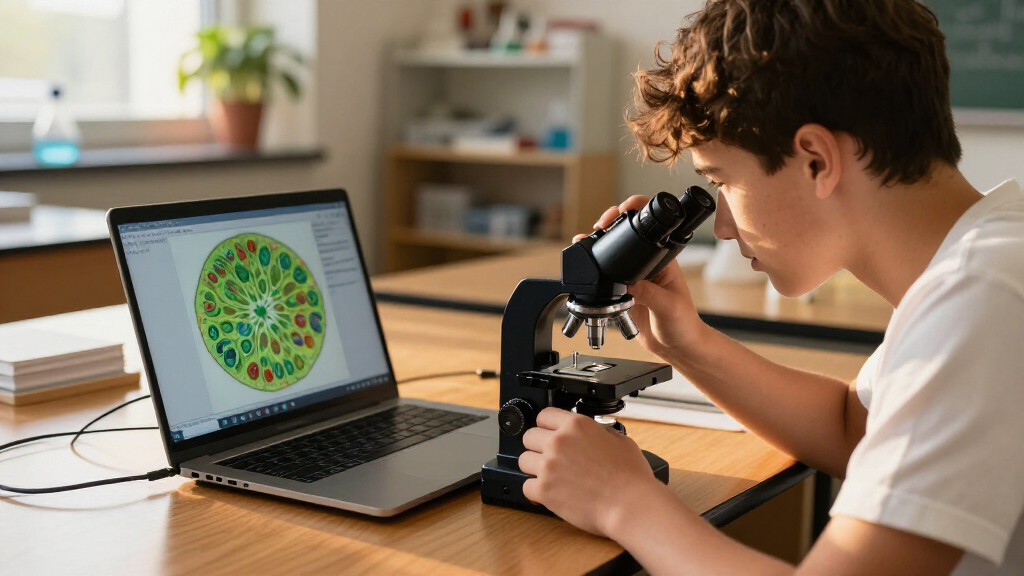
I judged each microscope through one lens: how well it serves a student doing actual schoolwork. That meant prioritizing ease of use first — screen size and readability, stand stability, focus controls a teenager can manage without frustration — then image quality at magnifications students actually use (roughly 50X to 500X for most biology and earth science work). I also weighed build quality against expected handling, because student gear gets dropped, shared, and shoved into backpacks.
Second, I scored versatility and completeness. Models that include slides, sample tools, or measurement features ranked higher for classroom readiness than bare scopes, and I penalized units whose app or software dependencies create friction on school networks. Finally, I considered value across the price spectrum — a cheap handheld earns its place if it honestly delivers for elementary learners, while a premium HDMI rig must justify itself with optics and features a cheaper model genuinely cannot match. The ranking reflects a balance of these factors, weighted toward everyday usability over headline specs.
| digital microscopes for student | Connectivity |
|---|---|
| BMDSAE 1000X Handheld Digital | USB-C (Windows XP-11, Mac 11.0+) |
| Celestron LCD Digital Microsco | — |
| Andonstar AD266S 20X-5000X HDM | HDMI, USB |
| TOMLOV DM301 Pro Microscope fo | WiFi app, USB, HD output to TV/PC/projector |
| Skybasic Wireless Digital Micr | WiFi (iOS/Android), USB (Windows/Mac) |
| Thames & Kosmos Digital Micros | — |
| TOMLOV DM4W Digital Microscope | USB (Windows/Mac compatible) |
| Andonstar AD249S-M Plus 3 Lens | HDMI, USB |
Factors to Consider When Choosing Digital Microscopes For Students
Before settling on a model, it helps to understand what actually separates a useful student microscope from an expensive paperweight. These are the factors that shaped my ranking — and the traps that catch buyers in this category most often.Screen Type and Size
The display decision shapes every other choice. A built-in screen (like the 7-inch TOMLOV or 10.1-inch Andonstar) means the microscope works anywhere, supports group viewing, and never depends on a phone, tablet, or software update — the most reliable option for classroom and homework use. Phone-connected models like the Skybasic save money and leverage a screen the student already owns, but they introduce pairing issues, battery drain, and the temptation to multitask. Tiny integrated screens like the BMDSAE’s 2-inch panel are fine for solo elementary exploration but frustrating for detailed work. A common mistake is buying a big-screen premium model for a young child who will use it twice; another is buying a phone-dependent scope for a school that bans devices during class. Match the screen strategy to where and how the microscope will actually be used.
Realistic Magnification Needs
Most school science — cell structure, leaf cross-sections, insect parts, crystals, textiles — lives between 50X and 500X. Claims of 1000X or 5000X on budget handhelds are achieved through digital zoom, which enlarges pixels rather than detail and produces mushy images past a certain point. The Andonstar models earn their higher ratings through better sensors and interchangeable glass lenses, which is a different situation entirely than a $40 unit claiming the same number. Students preparing for biology exams or science fairs benefit from true optical reach; younger students exploring backyard bugs will never notice the difference. My advice: ignore the magnification number on the listing and judge sample images, lens quality, and sensor resolution instead. Overbuying magnification is the single most common wasted dollar in this category.
Stand Stability and Focus Control
This is the spec nobody advertises and everybody regrets ignoring. A sturdy adjustable stand with fine focus is what separates a crisp image from a blurry one at anything above 100X, because hand shake makes precise focusing nearly impossible at higher powers. The Andonstar and Celestron models use proper pillar stands with geared adjustment, while basic handhelds like the Skybasic include minimal stands that flex under weight. For students documenting lab work or capturing photos for reports, stand rigidity directly determines output quality. A wobbly stand also teaches bad technique — kids learn to accept blur instead of refining focus. If the microscope will live on a desk rather than travel, prioritize stand quality over portability every time.
Durability and Age Appropriateness
A microscope that fits a 9-year-old will bore a 15-year-old, and vice versa. Younger students need simple controls, few breakable parts, and guided content — the BMDSAE’s self-contained design and the TOMLOV’s included experiment kit are built for this. Middle and high schoolers can handle interchangeable lenses, HDMI output to a monitor, and measurement software, which is where the Andonstar AD266S shines. Physical durability also differs by design philosophy: sealed handheld units survive drops better than compound-style scopes with exposed stages and glass slides. A realistic pattern I saw across this lineup is that accessory-rich kits wear out faster than the scope itself — slides get lost and plastic tools break — so check whether replacements are cheap and available before committing to a kit-heavy model.
Output and Sharing Options
Think about what happens after the image is captured. Students who need to submit lab reports or present findings benefit from microSD storage, USB transfer, and HDMI output to a projector — features the Andonstar models handle well. WiFi streaming to a phone suits sharing with a study group but complicates file management for graded work. Built-in screens that also record video, like the Celestron and TOMLOV units, offer the easiest path from observation to submission with no computer involved. The mistake to avoid here is assuming ‘digital’ automatically means ‘easy to export’: some cheap models only display live views and make saving images awkward. If documentation matters for the student’s coursework, verify the capture and transfer path before buying, not after.
Specialized Features You May Not Need
Several models in this roundup carry features that serve narrow purposes: the TOMLOV DM4W’s built-in precision measuring scale is genuinely useful for numismatics and QC inspection but irrelevant to most biology homework, and the Andonstar AD249S-M Plus’s integrated soldering station targets electronics students specifically. Paying for these when they won’t be used is wasted budget that could go toward better optics or a bigger screen. The flip side is true for students with focused interests — an aspiring engineer or coin collector gets real daily value from these tools, and a general-purpose scope would underserve them. The right question isn’t ‘which microscope has the most features’ but ‘which features match this student’s actual coursework and curiosity.’ In this category, specialization is common, and mismatched purchases are expensive.
Frequently Asked Questions
Is a handheld digital microscope good enough for school science work?
It depends on the grade level and subject. Handheld models like the BMDSAE and Skybasic excel at low-magnification exploration — leaves, fabric, sand, insects — which covers most elementary and middle school curiosity-driven learning. Where they fall short is sustained observation at higher powers, because hand shake and shallow depth of field make steady focusing difficult even with a stand. High school biology, where students examine cells or prepare their own slides, calls for a compound-style or well-mounted scope like the Celestron LCD II or TOMLOV DM301 Pro. My rule of thumb: if the student will spend more than fifteen minutes on a single specimen, buy a model with a solid stand and fine focus.
Do I need an HDMI digital microscope, or is a built-in screen enough?
HDMI output matters mainly for two situations: displaying to a large monitor or projector for group viewing, and recording high-resolution video for projects or lab documentation. If the microscope will live on one desk and serve one student, a good built-in screen like the TOMLOV DM301 Pro’s 7-inch panel is simpler, with no cables or external display to manage. The Andonstar AD266S and AD249S-M Plus make sense when a classroom, science club, or homeschool co-op shares the device, or when 4K video capture is part of the coursework. One caveat: HDMI models still need a display to reach full value, so factor that into the total cost if there’s no suitable monitor already available.
How much should I spend on a student digital microscope?
For elementary students, an inexpensive self-contained unit in the budget range is usually enough — the risk of it being abandoned or broken is real, and a basic model like the BMDSAE covers the learning outcomes without much loss. Middle schoolers benefit most from the mid-range tier, where the TOMLOV DM301 Pro and Celestron LCD II live; this is where stand quality, screen size, and image clarity improve noticeably for a modest step up in cost. Premium Andonstar territory is justified only for serious high school coursework, electronics hobby work, or a student who has already outgrown a simpler scope. The mistake I see most often is starting at the top — buying a feature-rich scope before knowing whether the interest sticks. Buy one tier up from the student’s current engagement level, not three.
Are WiFi microscope apps reliable on school devices?
Reliability varies, and it’s a genuine weak point of phone-dependent models like the Skybasic. The apps generally work on personal phones and tablets, but school-issued devices often restrict app installation or block ad-hoc WiFi connections, which can render the microscope unusable in class. Home use is far more dependable than classroom use for this reason. USB connectivity is a useful fallback since it works through a browser or basic camera software on most laptops without special apps. If the microscope is primarily for schoolwork on restricted devices, a built-in screen model avoids the problem entirely — that’s a major reason the TOMLOV ranked above the cheaper Skybasic in my lineup.
Can these microscopes see cells and bacteria?
Honestly, most digital microscopes in this price range are not the right tool for single-cell work. Viewing plant cells and larger microorganisms requires the upper magnification ranges with strong lighting and good optics — the Andonstar AD266S with its lens set comes closest among these picks, and the Celestron LCD II’s traditional design handles prepared cell slides respectably. Bacteria, however, generally need magnification and resolution beyond what any of these consumer digital units deliver well; that’s stereoscope-plus-compound-microscope territory. For cell-level study, the smarter path is a digital unit for everyday exploration paired with prepared slides, and acceptance that fine microbiology requires different equipment. Setting accurate expectations here prevents disappointment after purchase.
Conclusion
After comparing all eight models, the right choice comes down to the student behind the eyepiece. For best overall, the TOMLOV DM301 Pro delivers the most complete student package — large screen, stable stand, solid imaging, and included accessories — at a price that makes sense for most families. The Skybasic wireless model takes best value for budget-conscious buyers who already own a phone and mainly need low-cost exploration. On the premium end, the Andonstar AD266S is the standout for advanced students, with the AD249S-M Plus as the specific pick for electronics students who’ll use its soldering station.
For beginners and younger kids, the BMDSAE 1000X is the friendliest entry point — simple, durable, and hard to misuse — while the Celestron LCD II suits students following a traditional curriculum with prepared slides, and the Thames & Kosmos rounds things out as a dependable kit-style option for guided learning. The TOMLOV DM4W earns its spot only for measuring-focused work like coins or specimens that need a scale. Whichever direction fits, buy for the student’s current level and actual coursework, and upgrade only when they’ve outgrown the hardware — not the marketing.
Fall Picks
fall essentials
As an affiliate, we earn on qualifying purchases.